Why Repurposing Winning Ad Concepts Beats Constant Ideation

Repurposing winning ad concepts changes how performance teams scale creative. Instead of chasing new ideas every day, top teams identify one strong idea and systematically turn it into multiple executions that ship faster and teach more.
This approach shifts effort from constant ideation to structured variation, helping teams increase output without burning out or muddying performance signals.
In this guide, you’ll learn how to break a single winning concept into a full week of test-ready assets, and how Billo makes the process simple.
TL;DR
- Repurposing winning ad concepts lets one strong idea power multiple tests.
- Variations come from changing hooks, formats, cuts, and angles, not the core insight.
- This approach improves speed, consistency, and learning quality.
- Billo tools support structured variation without added operational overhead.
Why Repurposing Winning Ad Concepts Beats Constant Ideation
Constant ideation sounds productive, but it usually creates creative fatigue and inconsistent learning. When teams chase new ideas nonstop, they spread budget and attention across too many variables, making it harder to understand what actually drives performance.
Repurposing winning ad concepts focuses effort on what is already proven, an approach aligned with how leading teams optimize creative based on. By refreshing executions instead of replacing the core idea, teams maintain message consistency while increasing output and speed.
This approach also improves learning quality. Systematic variation isolates specific creative levers, like hooks or visuals, so performance changes are easier to attribute and act on.
In practice, this means fewer brainstorms, faster production cycles, and clearer insights into why a winning ad concept works.
What Actually Makes an Ad Concept Winning
A winning ad concept is not defined by a single high-performing video. It is defined by message – market fit that holds up across multiple executions and audiences, even as individual edits fluctuate.
Early performance signals matter. Strong concepts show consistent engagement and conversion lift in early tests, which is why platforms like Google emphasize evaluating creative at the concept level rather than judging one-off executions based on.
Stability is the real indicator of a winning ad concept. When the same underlying insight continues to perform as hooks, formats, or visuals change, the concept has earned the right to be scaled, as outlined in Meta’s guidance on creative testing.
This consistency is what makes a concept reusable. According to CXL, durable concepts enable cleaner testing because performance changes reflect execution choices, not shifting ideas.

The Repurposing Framework: One Concept → Many Assets
Repurposing works when variation is intentional, not random. A single winning concept becomes a flexible foundation that can be adapted across scripts, hooks, formats, and visuals without losing the core insight.
This framework keeps the message stable while systematically testing how different executions influence performance. According to Google, isolating these levers helps teams understand what actually drives lift, instead of introducing noise with entirely new ideas.
The goal is not more ideas, but more structured output from one proven ad concept. Each variation answers a specific performance question, making the results easier to interpret and act on.
1. Scripts
Scripts are the fastest way to multiply output from a single winning idea. Once a concept proves it resonates, that core message becomes the seed for multiple script variations rather than a one-off execution.
With repurposing winning ad concepts, teams adjust perspective, pacing, or emphasis while preserving the central insight. A script can spotlight different pain points, benefits, or moments in the same customer story without changing the underlying message.
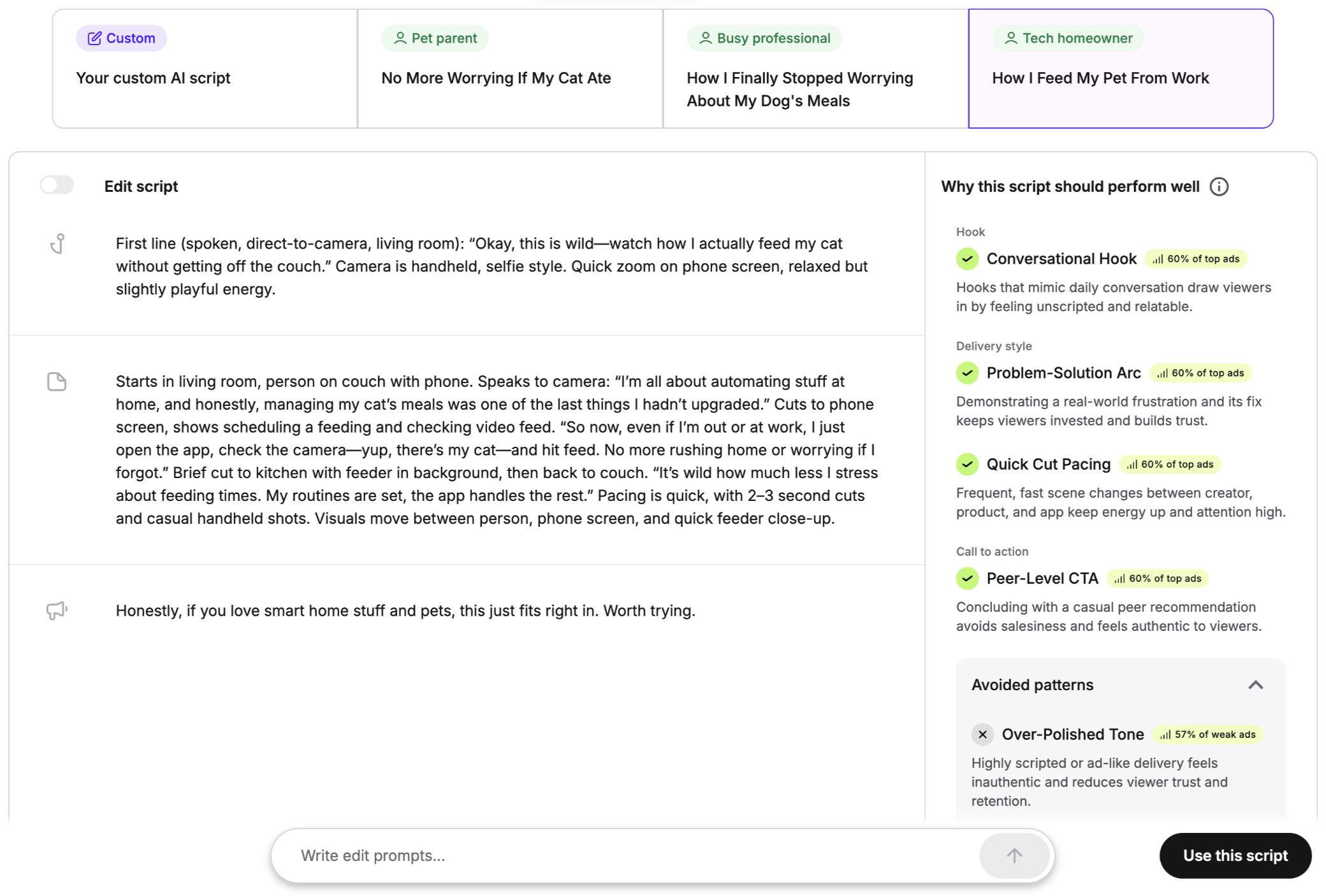
Billo’s Script Generator is designed for this exact workflow. It turns one proven idea into 4 test-ready scripts for 4 distinct buyer personas, reducing manual rewriting while keeping variations aligned to performance data.
With the new Winning Patterns feature, the Script Generator now also surfaces a breakdown of what actually works (and what to avoid) based on analyzed ads matching your specific product and persona. It’s a window into the strategic logic behind each script, so you’re not just getting output, you’re seeing the reasoning.
The result is faster iteration with purpose. Each script variation tests a specific angle, and Winning Patterns helps teams understand why certain framings strengthen a winning ad concept – turning raw AI output into actionable creative strategy instead of guesswork.
2. Hooks & Angles
Hooks determine whether a winning idea ever gets a chance to perform. Even the strongest concept fails if the opening does not stop the scroll or signal relevance fast.
When repurposing winning ad concepts, teams generate multiple hooks from the same insight by leading with different emotional or logical triggers. One version might open with a problem, another with a surprising outcome, and another with a direct benefit, all tied to the same core message.
This type of variation reveals which sub-message resonates most with different audience segments. Meta’s creative guidance shows that testing multiple angles within one concept improves signal clarity without resetting learning.
Isolating hooks as a variable allows teams to learn how to strengthen a winning ad concept rather than replacing it prematurely.
3. Formats & Aspect Ratios
Formats determine where and how a concept shows up in-feed. Repurposing a single idea into multiple placements increases inventory without changing the message.
When repurposing winning ad concepts, teams adapt the same story into 9:16, 1:1, and 16:9 versions to match platform placements. According to TikTok, format-aligned creatives improve delivery and watch behavior across surfaces.
This approach protects learning. Performance changes reflect format fit, not a new idea, strengthening confidence in a winning ad concept.
4. Cuts & Visual Variations
Cuts and visual changes extend the life of a concept without changing its meaning. By editing the same footage in different ways, teams unlock new performance insights from one idea.
When repurposing winning ad concepts, editors test pacing, B‑roll order, text overlays, and visual emphasis while keeping the message intact. These variations clarify what viewers respond to. According to Meta, isolating visual cues helps identify which elements drive engagement for the same underlying ad concept.
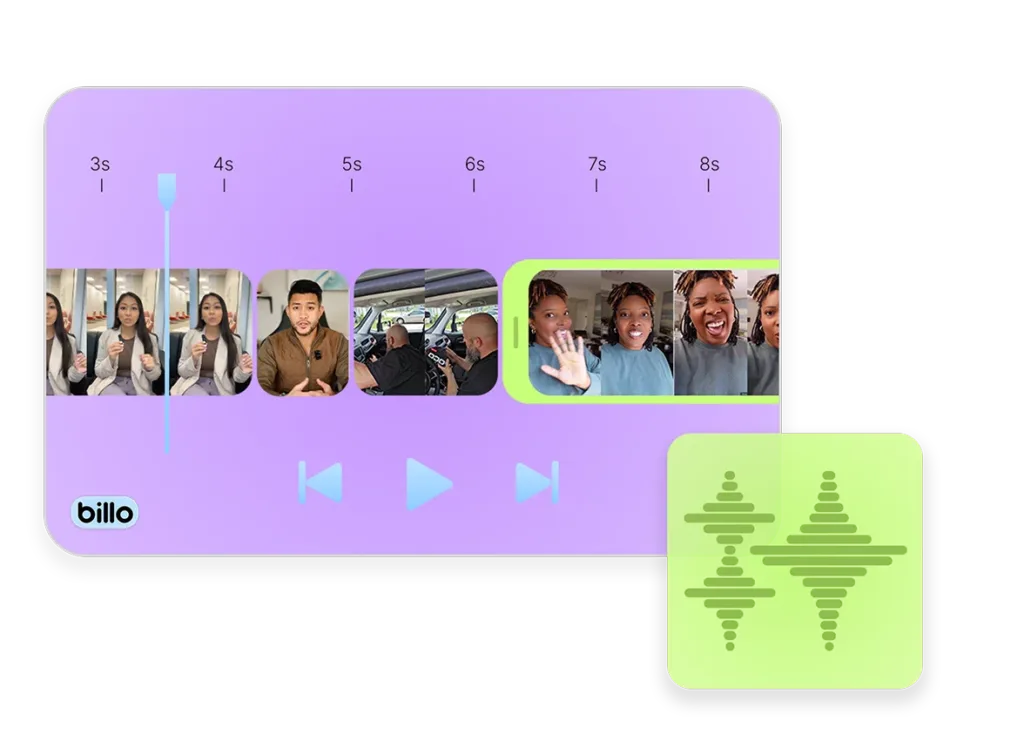
Billo allows you to create instant Ad variations in chosen narrative from your existing creatives. Thus giving you even more variations for the same concepts.
Instead of restarting ideation, visual testing deepens learning and extends the value of a winning ad concept.
Turning One Concept Into a Full Week of Test-Ready Ads
Scaling output does not require seven new ideas for seven days. A single winning concept can support an entire week of testing when it is broken into clear, structured variations.
The key is to divide the concept into mini-themes that highlight different parts of the same story. HubSpot benchmarks show that varying emphasis, not ideas, helps teams sustain testing volume while preserving learning quality.
Common mini-themes include:
- Problem-focused openings that surface the pain
- Solution-led versions that explain how it works
- Demo-driven cuts that show the product in action
- Social proof or outcome-focused variations
Throughout the week, teams rotate hooks, CTAs, and formats to capture shifts in user attention. This structure keeps spend concentrated on one winning ad concept while producing enough variation to support daily testing without creative chaos.
How Billo Makes Repurposing Winning Ad Concepts Easy
Repurposing only works when execution stays organized and fast. Billo removes the operational friction that usually slows variation by centralizing concept tracking, asset creation, and performance feedback in one workflow.

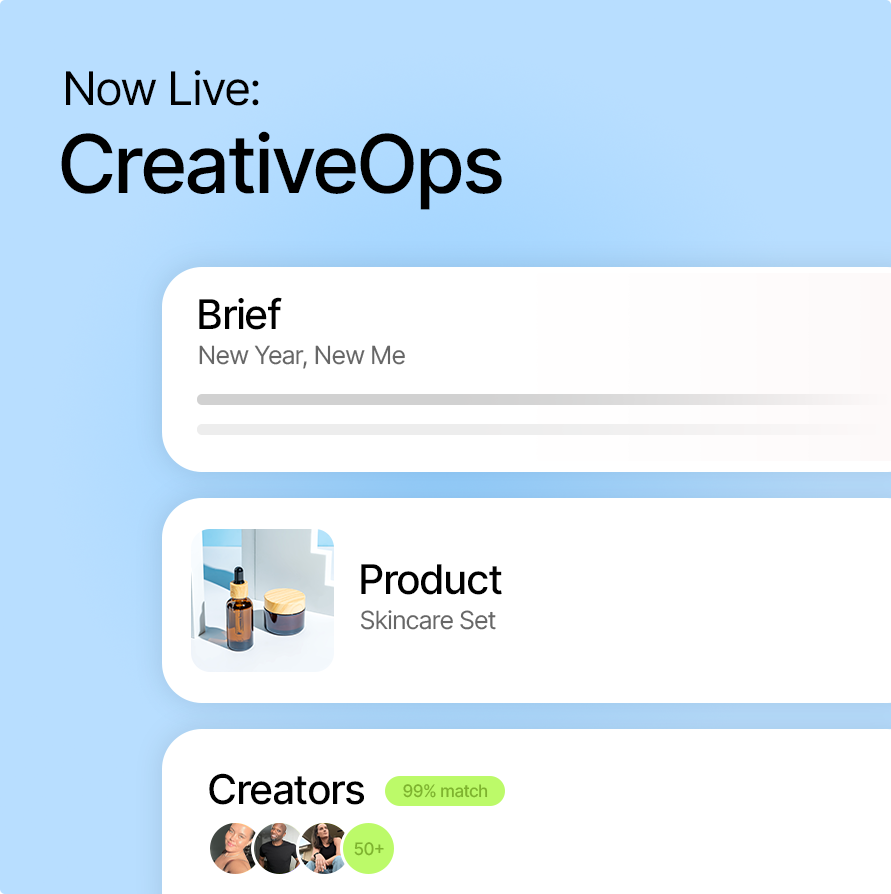
Instead of managing scripts, edits, and results across disconnected tools, Billo CreativeOps centralizes everything into one place. Here are some of the tolling you will find inside.
1. Script Generator
The Script Generator helps you turn your product link into 4 distinct scripts in minutes. This way teams can test new angles without rewriting from scratch, keeping every variation aligned to the core insight.
This makes repurposing winning ad concepts faster and more consistent.
2. Creative Analytics
Creative Analytics closes the feedback loop by showing which variations actually perform. It highlights which scripts, hooks, or formats strengthen a winning ad concept and which elements should be retired.
With clear performance signals, teams know when to scale a concept further or shift execution strategy.
3. Ad Variations
Ad variations extend the life of top performers by recombining existing footage into new variations. Teams can test fresh hooks, narratives or visual structures without reshooting content.
Summary & Next Steps
Scaling creative does not require endless new ideas. The teams that move fastest focus on execution, not reinvention, using variation to extract more value from what already works.
By repurposing winning ad concepts, you concentrate spend on proven insights while learning which hooks, formats, and visuals actually drive results. This leads to cleaner performance signals, faster optimization, and a more predictable testing cadence.
The next step is operationalizing this process. With tools like CreativeOps, Billo helps teams turn one winning ad concept into a repeatable growth engine instead of a one-off success.
If your creative pipeline feels fragile or chaotic, start by identifying your strongest concept and building structured variation around it. That is how repurposing becomes a sustainable advantage, not just a tactic.
FAQs
What is a winning ad concept?
How many variations should you test per concept?
Does repurposing hurt creative performance?
When should you retire an ad concept?

SEO Lead
Passionate content and search marketer aiming to bring great products front and center. When not hunched over my keyboard, you will find me in a city running a race, cycling or simply enjoying my life with a book in hand.
Make creator marketing a data-backed growth channel

Related from Creative Insider

AI Generated Ads vs. Human UGC: What the Performance Data Actually Shows

2026 Black Friday Benchmarks: What Your Hook Rate, CTR & ROAS Should Look Like

The Creative Operations Setup Paid Social Actually Needs