Snapchat ads for ecommerce: what works, what doesn’t, and how to start

Snapchat sits in an unusual position for ecommerce brands: big enough to matter, underused enough that CPMs are still competitive, and misunderstood enough that most brands who try it do it wrong. Let’s see what actually works in Snapchat ads for ecommerce – the right formats, the right creative approach, the technical setup that most brands skip, and how to read your results once campaigns are live.
TL;DR
- Snapchat works well for ecommerce brands in beauty, apparel, wellness, and food and beverage, particularly those targeting an 18-34 audience that’s already spending on Meta.
- The biggest reason Snapchat campaigns underperform is creative, not targeting. Polished brand video rarely works on this platform. Creator-shot, UGC-style content does.
- Start with single video ads for awareness and collection or dynamic ads for retargeting. Connect your product catalog and Snap Pixel before you launch.
- Budget at least $50/day for a meaningful test and plan for five to ten creative variations, not one or two.
- Snapchat is not a replacement for Meta. It’s a complementary channel for brands that have Meta working and want to reach the same audience at lower CPMs with less creative competition.
Is Snapchat advertising worth it for ecommerce brands?
The short answer is yes, for the right category and audience.
Snapchat reaches over 750 million monthly active users globally, with a core audience between 18 and 34. According to Snapchat’s social commerce research, Snapchatters are 60% more likely to make impulse purchases than users on other platforms. For ecommerce brands in beauty, skincare, apparel, wellness, and food and beverage, that demographic overlap is significant. These are buyers with established online shopping habits and high engagement with short-form video content.
The platform’s performance case has strengthened recently. A 2025 Triple Whale study analyzing roughly $3 billion in ad spend across platforms found that Snapchat achieved a 7.5% ROAS improvement for ecommerce advertisers while most other platforms declined. For DTC brands actively managing their paid social mix, that data point warrants attention.

Imagine you’re running a DTC skincare brand and your Meta CPMs have been climbing for six months. Your UGC ads are starting to fatigue, your audiences are overlapping, and you’re looking for somewhere to extend reach without starting from scratch on a completely unfamiliar platform. Snapchat’s audience skews slightly younger than Meta’s but overlaps substantially in the 25-34 bracket, and CPMs are often lower for brands new to the platform.
Where it works: Beauty, apparel, wellness, food and beverage, consumer goods. Brands with a visually interesting product, a story that can be told in under 15 seconds, and an audience under 35.
Where it doesn’t: High-consideration B2B purchases, very niche products with small addressable markets, or brands whose customer base skews heavily over 40.
One more thing worth saying upfront: if you’re running a dropshipping operation with no owned brand, Snapchat is unlikely to be a strong fit. The platform rewards authenticity and brand trust, and its audience is increasingly skeptical of generic product ads with no real story behind them.
Snapchat ads for ecommerce best formats
Snapchat offers more ad formats than most ecommerce brands need, so it’s worth being selective about where to focus.
| Format | What it does | Best for | Notes |
|---|---|---|---|
| Single image or video ads | Full-screen placement between Stories and in Discover. Video in the 5-15 second range performs best. | Top-of-funnel awareness and new audience acquisition | Start here. No catalog required to launch. |
| Collection ads | Hero video or image paired with four product tiles, each linking to a product page. | Consideration stage and retargeting site visitors who haven’t purchased | Requires a product catalog. Works well for apparel, skincare, and food and beverage brands. |
| Dynamic ads | Auto-pulls from your catalog and personalizes based on what each user has browsed. Review what’s required before building your catalog setup. | Bottom-of-funnel retargeting | Pixel and product feed must be correctly configured before campaigns go live. Runs largely on autopilot once live. |
| Story ads and filter ads | Branded tiles in Discover or interactive camera filters. | Brand awareness | Skip for performance-focused ecommerce campaigns. |
For a first campaign, start with single video ads for acquisition and dynamic or collection ads for retargeting. Get that combination right before adding complexity.
What creative actually drives ecommerce sales on Snapchat
This is where most ecommerce brands go wrong, and it’s also where the biggest performance gap exists between brands that see results and brands that don’t.
Snapchat is a personal platform. Its users share moments with people they know, in a format that feels immediate and unfiltered. When a brand ad appears in that feed and looks like it was produced by a marketing department, it registers as an intrusion rather than a discovery.
What works is content that feels native to the platform. User-generated content (UGC), shot vertically on a phone by a real creator with authentic delivery and a genuine point of view, consistently outperforms polished brand production on Snapchat.
Research from inBeat Agency’s UGC benchmarks shows that ads featuring UGC deliver four times higher click-through rates and reduce cost-per-click by up to 50% compared to traditional brand creative. The creative does not need to be perfect. It needs to feel real.
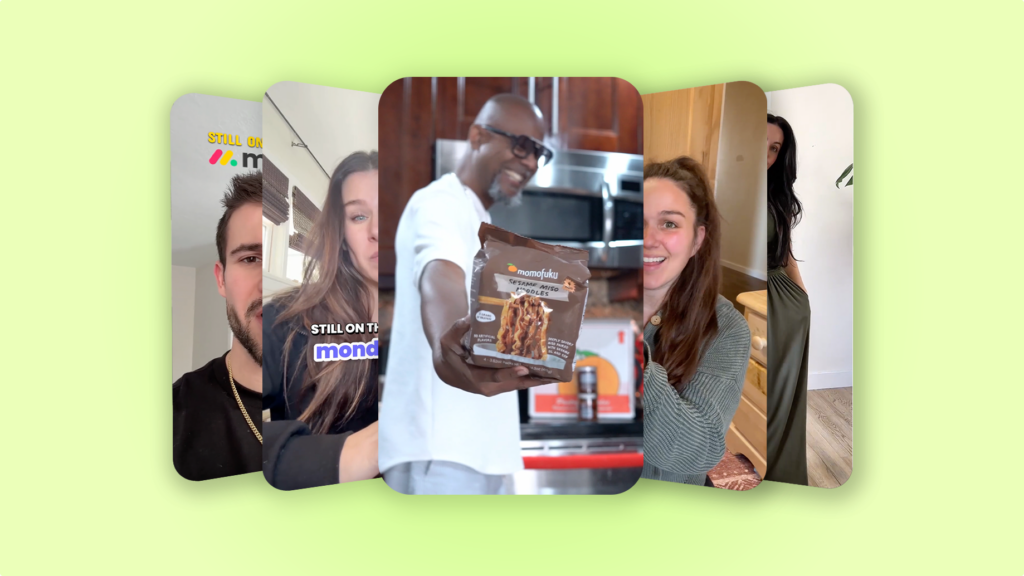
Imagine briefing a creator to film a short, honest first impression of your product: no script, natural lighting, the kind of thing they might actually send to a friend. Now compare that to a studio-produced brand video with professional editing and a voiceover. On Snapchat, the creator video will almost always generate stronger purchase intent. UGC video ads consistently outperform scripted brand content on platforms like Snapchat precisely because audiences have developed a sharp instinct for content that was made for them versus content that was made for a media plan.
The first two seconds determine everything
Snapchat users can exit an ad almost instantly, so the hook has to work before they’ve consciously decided whether to engage. The strongest hooks for ecommerce are visual: showing the product doing something surprising, a creator’s immediate reaction, or an opening line that directly addresses a problem your customer recognizes.
Sound-on is the default
Unlike Meta, where most users scroll with audio off, Snapchat users are predominantly watching and listening. Tone of voice, ambient sound, and the energy of the creator all contribute to whether an ad converts. Brief your creators accordingly.
Volume is not optional.
Most ecommerce brands testing Snapchat for the first time underestimate how many creative variations they need to run a real test. 5-10 videos, with different hooks, formats, and creators, gives the platform’s algorithm enough to work with. Launching with one creative and calling it a test is one of the most reliable ways to conclude, incorrectly, that Snapchat doesn’t work for your brand.
The technical foundation: pixel, catalog, and Shopify
Before you spend a dollar on Snapchat ads, get these four things right.
| Component | Why it matters | How to set it up |
|---|---|---|
| Snap Pixel | Tracks page views, add-to-carts, and purchases; feeds data back into Ads Manager for conversion optimization and audience building. | Follow Snapchat’s official pixel installation guide (covers direct implementation and GTM). Verify it’s firing on key conversion events before launch. |
| Conversions API (CAPI) | Post-iOS 14, browser-based tracking misses a portion of conversions due to cookie restrictions and ad blockers. CAPI sends events server-side, filling those gaps. Without it, the algorithm trains on incomplete signal and CPAs look worse than they are. | Use Snapchat’s getting started guide for Conversions API (covers direct integration and GTM). Implement before your first campaign goes live. |
| Product catalog | Required for collection and dynamic ads. Stale catalog data is one of the most common reasons dynamic ads underperform. | Shopify brands: the official Snapchat Ads app handles pixel setup and catalog sync in a single integration. Keep it updated. |
| Purchase conversion objective | Optimizes toward actual buyers rather than clicks that don’t convert. Takes longer to exit the learning phase, but produces better signal quality over time. | Set at campaign creation. Skip traffic or swipe-up objectives for ecommerce campaigns. |
Targeting strategy for ecommerce brands
Snapchat’s targeting options will feel familiar if you’ve spent time in Meta Ads Manager. The same broad principles apply, with one important difference: start broader than you think you need to.
A common mistake ecommerce brands make on Snapchat is importing the narrow, highly refined audiences they’ve built on Meta, stacking age ranges, interest categories, and behavioral signals until the audience is tiny. On Snapchat, this limits the algorithm’s ability to find buyers. Let the creative do the audience filtering. A well-made product video aimed at the right person will naturally attract that person, even within a broad audience.
The platform supports custom audiences built from pixel data, lookalike expansion from purchaser lists, and interest-based prospecting that performs well for DTC verticals. Analysis from Gupta Media’s Snapchat benchmarks shows that brands running with broad audiences and strong creative consistently outperform those with narrow targeting and weaker creative.
Lookalike audiences based on your purchaser list are worth building once your pixel has accumulated enough conversion data, typically a few hundred purchase events at minimum. Until then, focus on interest-based prospecting and pixel-based retargeting.
How much do Snapchat ads cost for ecommerce?
Snapchat Ads Manager has a minimum spend of $5/day, but that figure is not a useful benchmark for ecommerce brands. At $5/day you won’t generate enough impressions to learn anything meaningful.
A realistic starting budget for a first ecommerce test is $50 to $100 per day, run for at least two to three weeks. This gives the algorithm enough data to exit the learning phase on your conversion objective and gives you enough creative impressions to identify which videos are resonating. According to 2026 CPM benchmarks from AdLiftr, Snapchat CPMs currently run between $6 and $10 for most DTC categories, which compares favorably to Meta for brands entering the platform fresh.
Snapchat’s cost structure rewards brands that complete conversion tracking setup and sync audiences correctly back to Ads Manager before launching. Factor in that you’ll want multiple creatives running simultaneously and budget for the campaign as a whole, not just a single ad set.
For a more concrete benchmark: Gupta Media’s analysis of Snapchat ecommerce performance puts the median CPA for DTC first-time purchasers at around $23, with the top quartile of advertisers below $14. These figures vary by vertical and creative quality, but they give you a useful reference point for evaluating whether your early results are within a normal range or indicate something structural needs to change.
Measuring your Snapchat results
The hardest part of running Snapchat campaigns is not the setup. It’s interpreting what you see once campaigns are live, and knowing whether numbers are telling you to change something or simply wait.
Attribution window – the most important thing to understand before you read a single result
Snapchat’s default attribution is 28-day click, 1-day view. That click window is four times longer than Meta’s standard 7-day window, which means Snapchat’s in-platform ROAS and CPA figures will look meaningfully different from what your third-party measurement tool reports. This is not a sign the platform is inflating results. It’s attribution methodology. A customer who saw your Snapchat ad on day one and converted on day 25 is credited to Snapchat inside Ads Manager, but may not appear in your MTA data at all.
For a cleaner comparison with Meta, switch your Snapchat campaigns to a 7-day click / 0-day view attribution window. Your in-platform numbers will look worse, but they’ll be comparable. Understanding how Snapchat’s attribution methodology interacts with your broader measurement stack is worth doing before you make any scaling or kill decisions.
The learning phase and when to make decisions
Snapchat’s algorithm needs roughly 50 conversion events per week per ad set to exit the learning phase and optimize reliably. At $75/day and a median CPA of around $23 for DTC ecommerce, you’re looking at approximately 3-4 conversions per day, which means two to three weeks before the algorithm has enough signal to work with. Brands that cut campaigns after one week at this budget level are almost always cutting too early.
Two conditions tell you you’re ready to evaluate: the learning phase badge has cleared in Ads Manager, and you have at least two weeks of post-learning data.
Kill vs. keep: a simple diagnostic
When a campaign underperforms, the question is whether the problem is the audience, the creative, or the funnel. These signals are usually distinguishable:
- High CPM, low swipe-up rate: The ad is reaching people but they’re not engaging. The hook is the issue. Test different opening visuals or opening lines before changing anything else.
- Low CPM, low swipe-up rate: The audience is too broad or mismatched. The ad is being served cheaply to people who have no reason to care about your product.
- Strong swipe-up rate, high CPA: People are clicking but not converting. The problem is downstream: the landing page, the offer, or the product-market fit with Snapchat’s audience. The creative is working.
- High CPA in the learning phase: Normal. Wait until the algorithm has enough signal before drawing conclusions.
The practical rule: give any new campaign at least three weeks and 50 conversion events per ad set before making structural changes. Optimizing below that threshold is more likely to reset the learning phase than to improve results.
Running Snapchat ads is the easy part
The campaign setup takes an afternoon. The bottleneck for most ecommerce brands on Snapchat is not the platform knowledge. It’s having enough of the right creative. Billo connects DTC brands with vetted creators who produce vertical, authentic video built for paid social, at the volume you actually need to test properly. If you’re ready to build out your Snapchat creative library, take a look at how it works.
FAQs
Is Snapchat good for ecommerce?
How much should I budget to test Snapchat ecommerce ads?
What’s the difference between collection ads and dynamic ads on Snapchat?
What creative format performs best for ecommerce on Snapchat?

SEO Lead
Passionate content and search marketer aiming to bring great products front and center. When not hunched over my keyboard, you will find me in a city running a race, cycling or simply enjoying my life with a book in hand.
Make creator marketing a data-backed growth channel

Related from Creative Insider

Social Commerce: Turn A 15-Second Scroll Into A Sale Without The Traditional Funnel

Ad Hooks That Scale: Turning 1 Winning Angle Into 20 Performing Variations