The Ultimate Content Pipeline for Ads: Never Run Out of Winning Creative

Passionate content and search marketer aiming to bring great products front and center. When not hunched over my keyboard, you will find me in a city running a race, cycling or simply enjoying my life with a book in hand.

Automated ad platforms have made targeting, bidding, and optimization almost hands-off. But that convenience comes with a tradeoff: creative is now the primary lever that determines performance.
If you’ve ever watched a profitable campaign stall overnight – not because the algorithm broke, but because your ads went stale – you’ve felt this shift firsthand. When creative fatigues, performance drops fast. And by the time you react, you’re already behind.
The fix isn’t a last-minute scramble or a “creative sprint” every time results dip. It’s a structured, repeatable content pipeline – a system for planning, producing, reviewing, launching, and refreshing ad creative every single week.
In this guide, you’ll learn how to build a content pipeline for ads that never runs dry. We’ll break down the stages, roles, cadence, and tools required to keep creative flowing in always-on, automated campaign environments.
TL;DR
- A content pipeline for ads replaces scramble-mode launches with predictable creative output.
- Automated ad platforms require frequent refreshes, not perfect one-off ads.
- Winning teams optimize for throughput and iteration, not polish.
- Clear stages, owners, cadence, and tooling keep creative moving every week.
Define the Content Pipeline (Inputs, Stages, Owners, Cadence)
A strong content pipeline for ads is more than a content calendar. It’s an operational system that ensures creative moves from idea to launch and back again without stalling.
Strong pipelines work because the four fundamentals are locked in early:
- Defined inputs that fuel ideation
- Standardized stages that work flows through
- Clear owners responsible at each step
- A fixed cadence that prioritizes throughput over perfection
When any of those pieces are missing, creative becomes reactive. Reviews stall, deadlines slip, and refreshes happen only after performance drops.
Pipeline Structure
The most effective teams don’t reinvent the process for every launch. They use a repeatable structure everyone understands. Each stage has a clear outcome, not just activity. Creative moves forward only when that outcome is met.
A simple, effective pipeline looks like this:
Inputs → Brief → Produce → Review → Approve → Launch → Measure → Learn → Back to Inputs
Inputs and Ownership
Most pipelines fail at the top. When inputs are vague, quality and velocity suffer downstream. Start with defining persona marketing and then move into specific ideas you want to test. High-performing teams ground ideation in two sources: real-time trend and format signals from the platforms. And performance data from their own campaigns. Used together, these keep ideas both relevant and rooted in what actually works.
Ownership matters just as much. Every stage needs a clear owner and clear handoffs. When responsibility is fuzzy, work stalls — especially at review and approval. Tools can help with tracking, but they only accelerate what’s already defined. Without clear stages, owners, and cadence, a “pipeline” is just a plan. With them, creative becomes a predictable, repeatable system.
Build a Content Pipeline Planning System that Prevents Ad Fatigue
Planning your content pipeline isn’t about filling a calendar. It’s about designing a repeatable refresh system that replaces reactive swaps with proactive cycles.
Ad fatigue rarely shows up all at once. It builds quietly through overexposure, and by the time performance drops, your creative has already gone stale. The real job of planning is making sure fresh assets are ready before that happens – not scrambling after the fact.
1. Commit to Refreshes Before Ads “Die”
One of the most common mistakes in paid media is waiting for ads to fail before replacing them. In reality, performance decay is far more often tied to creative fatigue than to bidding or targeting issues.
High-performing teams avoid this by committing to pre-set refresh cycles. For fast-moving, high-spend campaigns, that often means weekly refreshes. For more stable evergreen programs, bi-weekly updates are usually enough. The exact timing matters less than the commitment itself. A fixed cadence ensures creative keeps shipping even when results look “fine.”
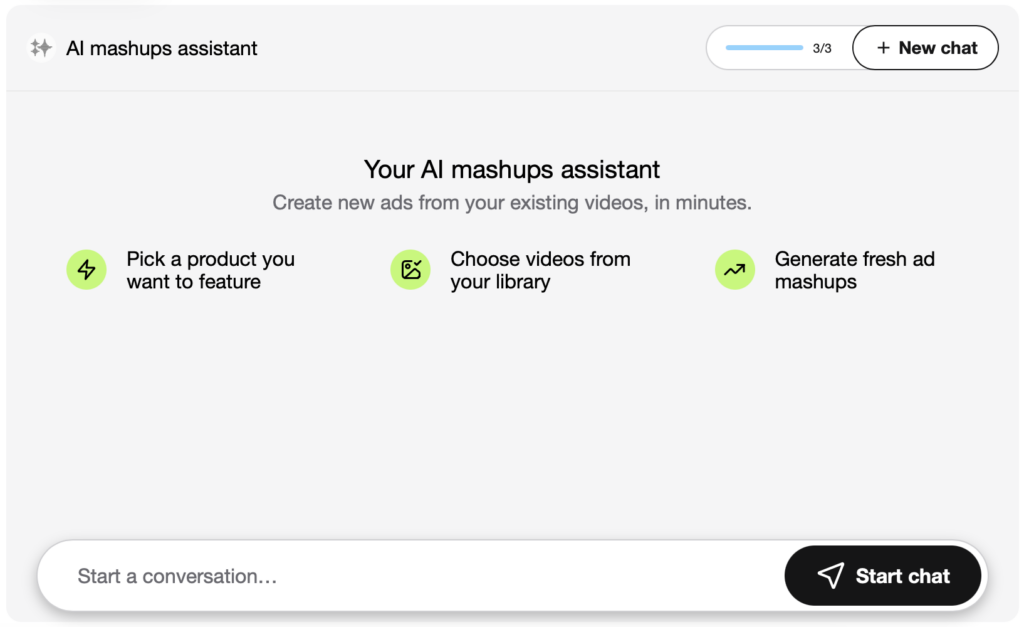
Tools like Billo can help source and iterate creatives with AI mashups that generate new ads in your chosen narrative from your existing content.
2. Use Cadence to Increase Learning Speed
A fixed cadence forces better trade-offs. When the goal is to ship every week, teams stop over-polishing and start learning faster.
Creative improves through iteration, not approval rounds. Early launches surface insights that shape the next batch. In automated environments, “good enough and live” consistently outperforms “perfect but late.”
3. Make Planning Visible to Everyone
Planning only works when it’s shared. Fragmented docs, private trackers, and scattered Slack threads slow everything down and introduce unnecessary friction.
A centralized planning view should make it easy to see what’s live, what’s coming next, and who owns each asset. When creative and media teams are working from the same source of truth, gaps get flagged early, dependencies are clear, and launches stop slipping.
Example: a simple weekly planning cadence
To make this concrete, here’s a lightweight weekly cadence many teams use:
- Monday: review last week’s performance, flag fatigue, and define iteration goals
- Tuesday: ideation and brief approval
- Wednesday–Thursday: production, edits, and internal review
- Friday: final approvals, uploads, and scheduling
This doesn’t require more resources just clearer expectations and consistency.
Use Batching to Multiply Creative Output
A single content shoot should fuel dozens of ad variations, not one polished deliverable. Batching is what turns limited production time into sustained creative velocity.
Without batching, teams end up reshooting constantly just to keep campaigns alive. With it, every asset becomes a testing surface and every shoot compounds its value over time.
Design for Efficiency, not just Aesthetics
The highest-performing ads on platforms like TikTok and Meta don’t win because they’re novel. They win because they follow repeatable creative structures that are easy to iterate on. A strong opening hook, some form of visual proof or demonstration, and a clear call to action are often all that’s needed.
These formats are intentionally simple because simplicity makes versioning possible.
Instead of chasing “the one perfect video,” high-performing teams build variations on top of the same base footage. They test different hooks, rotate CTAs based on offers or objections, and swap value propositions while keeping the visuals consistent. The result is faster learning without higher production costs.

Make Versioning Deliberate
Batching only works when variation is intentional. Random tweaks create noise. Structured testing creates insight.
Strong pipelines are clear about what’s being tested in each batch (whether that’s the hook, the angle, or the call to action) and how many versions will ship. They also know in advance how results will be evaluated, so learnings don’t get lost once campaigns go live.
Centralized asset libraries make this process far easier. When teams can reuse footage, templates, and formats, they stop starting from scratch and start building on what already works.
Batching isn’t about cutting corners. It’s about scaling insight.
One shoot can answer multiple performance questions. One creative concept can produce multiple winners. The more structured your batching, the faster you uncover what actually drives results and the more value every piece of creative delivers.
Build a Reliable Creator System
If creators are a core input to your content pipeline, relying on one-off collaborations is risky. One missed deadline or off-brand delivery can throw off your entire cadence.
A reliable pipeline doesn’t just need access to creators – it needs a repeatable creator system.
1. Build a Creator Bench You Can Trust
High-performing teams don’t source creators reactively. They maintain a small bench of reliable partners they can brief, iterate with, and re-engage quickly.
Instead of cycling through new creators every campaign, they work with a consistent group of proven partners. Formats that already perform get reused and refined, and output improves over time as shared learnings compound. UGC platforms make sourcing easier, and collaborating with a proven batch of creators much easier.

2. Treat Creators Like Partners
Treating creators like one-off contractors slows everything down. Treating them like creative partners speeds everything up.
Creators who understand your brand and audience need less onboarding, deliver stronger hooks, and make better decisions independently. Over time, repeat relationships reduce misfires, shorten production cycles, and raise the quality bar across campaigns.
3. Optimize for iteration, not “final” drafts
The best-performing ads are rarely perfect on the first pass. They get better through feedback and performance data.
Strong creator systems review early cuts, give clear feedback tied to performance goals, and optimize for what converts – not what looks finished. Fast feedback loops matter more than polished first submissions.
Your creator system should feel plug-and-play. Briefs get followed, rounds move quickly, and assets improve with every cycle.
Set Up a Tooling System That Keeps Creative Moving
Even the strongest pipeline breaks if work gets stuck. Most slowdowns don’t come from a lack of ideas – they come from unclear handoffs, scattered assets, and slow approvals.
Your tooling system exists for one reason: to keep creative moving forward without friction.
When workflows aren’t clearly defined, creative stalls at review and approval. Tasks sit idle, ownership gets fuzzy, and deadlines slip. A solid tooling setup removes that friction by standardizing workflows, assigning clear approvers, and moving work forward automatically once decisions are made. Automation doesn’t replace judgment – it replaces waiting.
Momentum also breaks when assets and feedback are scattered. Centralizing creative in one place keeps versions clean, feedback tied to specific moments, and reviews focused. Fewer revisions, less rework, and faster approvals follow naturally.
When creative, media, and marketing teams share the same system, coordination becomes invisible. Everyone knows what’s live, what’s next, and what’s blocked. Feedback stays attached to assets, and launches don’t depend on status check-ins.
Tooling isn’t optional infrastructure – it’s what your content pipeline runs on. The goal isn’t more tools. It’s less friction.
Build a Feedback Loop That Sharpens Every Batch
A content pipeline only improves if it learns. Without a structured feedback loop, every new creative batch is a guess and guessing gets expensive fast.
Performance data isn’t just for reporting. It’s the raw material that makes the next batch better than the last. Automated platforms reward advertisers who supply diverse creative that improves over time, which means regularly reviewing asset-level performance. The goal isn’t vanity metrics. It’s understanding what the algorithm is responding to and feeding it more of that.
Strong teams look for patterns across formats, hooks, angles, and fatigue timelines. Over time, certain approaches consistently outperform while others burn out quickly. Those patterns only compound when they’re documented and reused. If a result doesn’t change what gets briefed, batched, or produced next, it isn’t an insight yet.
Every review should lead to clear decisions about what to test, prioritize, or retire in the next cycle. That’s how a pipeline stops repeating itself and starts improving. Learnings should impact one or more of:
- Hooks you test next
- Formats you prioritize
- Creators you re-engage
Your best ads shouldn’t just perform – they should teach. When feedback loops are tight, every batch increases the odds that the next one wins. That’s how creative shifts from a cost center to a system that compounds.
Summary & Next Steps
Creative success in modern advertising isn’t about single wins. It’s about building a system that keeps producing – week after week.
A strong content pipeline for ads transforms creative from a bottleneck into a growth engine by making output predictable, iteration continuous, and learning cumulative.
The principles are simple:
- Treat creative like a production line, not a one-off launch
- Lock cadence first – quality improves through repetition
- Measure what works, then feed those insights directly into the next batch
You don’t need a massive team or new tools to start. Begin by mapping your current process, defining clear stages, and assigning ownership. Set a realistic weekly output goal then protect that cadence.
Once the pipeline is moving, velocity follows. And with velocity comes performance.
FAQs
What’s the difference between a content calendar and a content pipeline for ads?
A content calendar shows what’s being published and when. A content pipeline is the operational system behind it – defining inputs, roles, cadence, and workflows to ensure creative is produced and refreshed continuously.
How often should ad creative be refreshed?
As soon as performance dips. But ideally, you refresh on a fixed cadence to avoid reactive swaps. Most performance teams aim for weekly or bi-weekly updates.
How many creators do you need to keep a pipeline full?
Enough to avoid over-reliance on one source. Most brands build a creator bench of 3–5 reliable partners, then rotate based on campaign needs and performance.
Which tools are essential vs. optional?
Essential tools include a project manager (like Teamhood), asset library (like Billo), and review platform. Optional tools include trend dashboards or AI mashup generators – useful, but not required to get started.


Authentic creator videos, powered by real performance data
22,000+ brands use Billo to turn UGC into high-ROAS video ads.



Meta Ads Safe Zones: A Guide to the 2026 Unified...
Meta just made the biggest change to ad creative specs [...]...
Read full article
Persona Marketing in The Andromeda Era
Meta’s Andromeda doesn’t just “improve automation.” It upgrades the retrieval layer – [...]...
Read full article
Meta Andromeda Update Explained: Creative Volume...
Meta Andromeda update marks a major shift in how ads [...]...
Read full article