When to Trust Data-Driven Suggestions (and When to Trust Your Gut)

Passionate content and search marketer aiming to bring great products front and center. When not hunched over my keyboard, you will find me in a city running a race, cycling or simply enjoying my life with a book in hand.

Platforms, dashboards, and AI tools now shape nearly every marketing decision, offering a constant stream of data-driven suggestions. At the same time, bold creative thinking remains the engine behind breakthrough campaigns. Each has its place. Data helps you cut through noise, spot patterns, and make confident, repeatable decisions. Creativity brings context, originality, and the emotional punch that numbers alone can’t deliver.
The real skill isn’t choosing one or the other – it’s knowing when to lean on the data and when to trust creative judgment. Mastering that balance is what separates efficient marketers from exceptional ones.
TL;DR
- Data-driven suggestions work best for repeatable, low-risk decisions with clean signals.
- Intuition matters most when stakes are high, the problem is ambiguous, or data is weak.
- Breakthrough creative often outperforms what dashboards would recommend.
- Testing is essential because most ideas don’t win without validation.
- AI accelerates output but needs human guardrails to avoid generic, off-brand results.
- The smartest teams blend intuition and data instead of choosing one side.
What Data-Driven Suggestions Really Are (and Aren’t)
Platforms surface recommendations to help marketers optimize faster. They’re powered by massive datasets, machine-learning models, and aggregate behavioral patterns which makes them incredibly useful for speeding up routine decisions.
But they’re not built to understand your brand, your positioning, or the nuances behind why something matters. Data-driven suggestions are powerful tools, not strategic substitutes. They excel at showing you what’s likely to work based on the past. They struggle with what’s possible next.
Here’s how the most common types of platform-generated suggestions actually work and where their limits start to show:
Aggregated best-practice prompts: Broad benchmarks offer quick directional guidance, yet often miss the specific creative, audience, and brand factors that determine what actually works for you.
Platform-generated predictions: Machine learning highlights likely performance boosts based on past patterns, but becomes far less reliable when you introduce new products, unconventional creative, or anything the system hasn’t seen before.
Automated optimization nudges: Prompts like “expand audience” or “raise budget” improve delivery efficiency but ignore brand nuance, making them useful accelerators only when they align with your strategic intent.
When Data-Backed Decisions Clearly Win
The trick isn’t choosing data or intuition – it’s knowing where each excels. Below is a snapshot of the moments where data-driven decision-making consistently delivers better outcomes.
| ✨ What Happens | 💡 Why It Matters | 📌 How to Use It |
|---|---|---|
| Data outperforms intuition in high-volume, stable environments | Data spots patterns and micro-improvements humans would never notice. | Lean on data when decisions are repeatable, low-risk, and sample sizes are large. |
| Small tests uncover surprisingly powerful wins | Even tiny UX or creative tweaks can drive meaningful lift at scale. | Test minor variations regularly – small changes often reveal big opportunities. |
| Only a fraction of ideas actually work | Most “good ideas” don’t move the needle, but testing finds the few that do. | Keep a steady pipeline of ideas and let experiments determine what’s worth scaling. |
| Experimentation fuels company-level growth | Teams that test across product, pricing, UX, and creative innovate faster and make fewer costly mistakes. | Build experimentation into your workflow – not as a task, but as part of how the team operates. |
| Strong data foundations prevent wasted spend | Poor or siloed metrics push teams to optimize for the wrong outcomes. | Use holistic, business-aligned metrics to guide decisions – not isolated channel KPIs. |
| Where data-driven suggestions shine | Data excels when patterns are consistent and feedback loops are fast. | Apply it to high-volume optimizations, funnel refinements, and quick, reversible experiments. |
Where Data-Driven Suggestions May Mislead Marketers
Data-driven suggestions can start to mislead marketers the moment the signals get noisy or the incentives behind the numbers don’t quite match your goals.
It’s easy to gain false confidence when dashboards look definitive, even though the underlying data might be incomplete, misattributed, or simply wrong. In those moments, a poor-performing variant can appear to be a winner, and you won’t realize it until budget has already been spent.
Platform nudges make this even trickier. Recommendations to widen your audience or increase spend might improve delivery on paper, but they don’t always support your actual strategy. This is why it is important to take data-driven suggestions and weigh them against the business goals before moving forward.
And even well-run experiments can send you in the wrong direction if you’re not careful. Short-term tests often reward the cheapest clicks or fastest conversions, which can overshadow the deeper signals that matter more – like quality, intent, or downstream revenue. Without context, data pushes you toward easy wins instead of the right ones.
The Case for Creative Breakthroughs (When to Ignore the Numbers)
Not every decision should be left to the dashboards. Some of the biggest leaps in marketing happen when teams step outside what the data can predict. Here’s where creativity takes the lead.
| 🎨 What Happens | 💬 Why It Matters | 📌 How to Use It |
|---|---|---|
| Historical data pushes caution | Data only reflects what’s worked before, so it naturally favors safe, familiar ideas over bold, category-shifting ones. | Treat past performance as a reference point — not a ceiling. Use it to inform, not limit, your creative ambitions. |
| Breakthrough ideas create disproportionate impact | Emotional storytelling and cultural insight can deliver growth that optimization alone can’t match, as seen in iconic campaigns across major brands. | Make room for ideas that break patterns, challenge norms, or tap into deeper human truths. These often outperform incremental tweaks. |
| Going off-script becomes a strategic advantage | When categories feel saturated or perceptions need shifting, data loses clarity. Creativity becomes the sharper tool. | Prioritize bold creative when markets are crowded, when you’re repositioning, or when data is thin, noisy, or inconclusive. |
AI and Algorithmic Suggestions: A Useful Copilot?
AI has become an incredible creative copilot. It speeds up brainstorming, helps produce endless variations, and makes it easier to get from idea to execution. Most marketers say their AI-assisted content performs better in the short term, and it’s easy to see why. AI removes friction. It drafts, rewrites, and researches at a pace humans can’t match, while teams stay in control of strategy and voice.
But there’s a real downside if you’re not careful: AI can also flatten creativity. When everyone uses the same tools in the same way, outputs start looking eerily similar. That “AI sameness” effect shows up in everything from captions to visuals, and it’s especially obvious when the creative looks like AI. Interestingly, research shows that AI-generated images perform best when they don’t reveal any telltale AI traits – the more human they appear, the better they tend to do.
That’s why strong guardrails matter. Automated systems can drift off-brand, over-optimize for cheap signals, or nudge you toward tactics that conflict with your broader creative direction. The teams getting the most out of AI aren’t handing over the reins – they’re using AI to accelerate the work while leaning even harder into human judgment, taste, and strategy. In other words: AI can be a powerful copilot, but only if you stay the pilot.

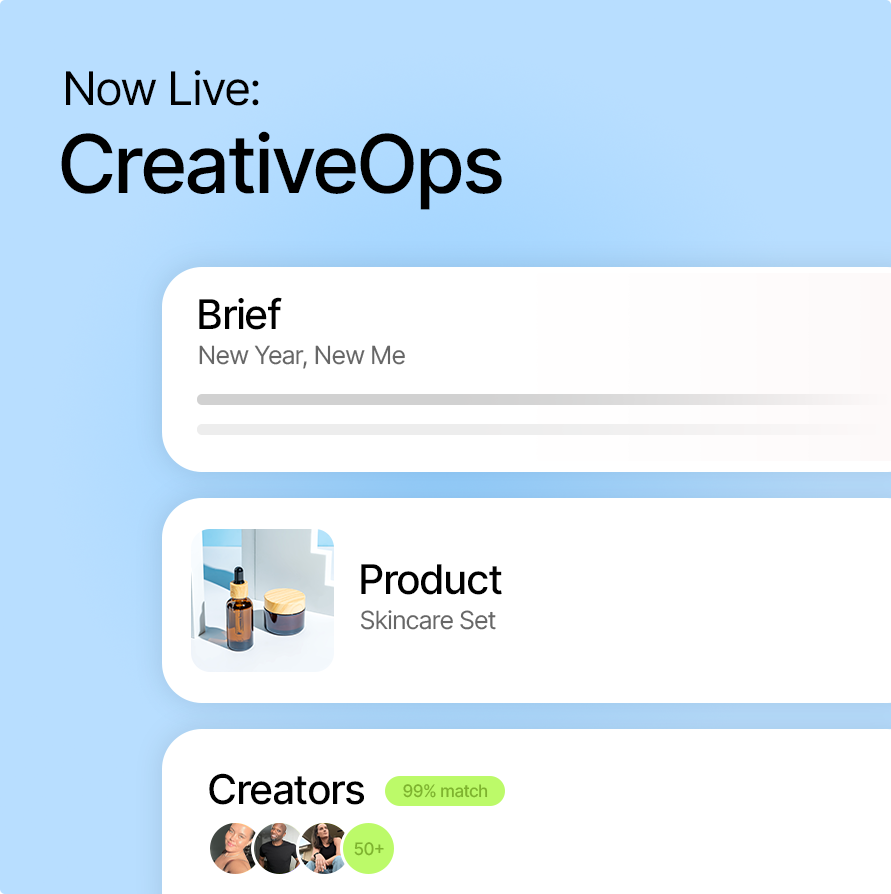
And that’s exactly how we see the Billo’s CreativeOps workflow. It keeps AI as a source for data and insights, but remains drive by the human-direction with authentic creators carrying out the vision.
Practical Decision Framework: When to Follow Data vs. Go Off-Script
Every marketer knows the moment when the data points in one direction, and your gut pulls you toward another. And the truth is, both can be right, but never at the same time. The real skill is knowing which tool belongs to which moment.
Intuition becomes essential when the stakes are high, the decision won’t repeat, or the data is thin, noisy, or incomplete. These are the situations where dashboards can’t tell you the full story, because they can only reflect what’s already happened. When you’re making a call about positioning, brand shifts, or big creative bets, your experience and judgment carry more weight than any metric ever could.
But flip the scenario, and data becomes the smarter choice. In fast-moving, high-volume environments – ad testing, UX iterations, creative variants – intuition alone is unreliable. Most “good ideas” simply don’t perform once they hit real traffic. That’s why experimentation matters: only a fraction of ideas actually improve outcomes, and you need the numbers to sort the winners from the near-misses.
The sweet spot is learning how to blend both. Let intuition generate the hypotheses – the creative angles, the risky ideas, the new directions. Then let the data validate, refine, or challenge them. This back-and-forth is what keeps teams from becoming either overly cautious or blindly metrics-driven.
If you want a simple cheat code for decision-making, here it is:
- Low risk + strong data? Follow the numbers.
- High risk + weak data? Trust creative judgment.
- Everything in the messy middle? Test it — and test it with variety.
That’s how modern teams move fast without losing strategy, and stay creative without losing control.
Billo CreativeOps
If you’re serious about blending intuition with data, Billo makes the process feel effortless. You can turn creative hypotheses into real ads fast, test them across audiences, and double down on the winners without burning your team out.
What makes this even more powerful is the Billo Script Generator. Instead of guessing what your ad should say, it builds scripts based on patterns found in top-performing content across the platform – hooks that consistently stop the scroll, angles that convert, and story structures proven to drive results. You still make the creative calls, but you’re starting from a foundation shaped by real performance data, not hunches.
It’s the perfect blend of creative instinct backed by what actually works in the wild.

Where Billo-style workflows fit
- Build briefs from top-performing angles
- Mix proven concepts with bold creative ideas
- Use iterative feedback loops to refine strategy
Summary & Next Steps
Use data-driven suggestions when the decision is repeatable, the signals are clean, and the risk is low – that’s where data does its best work. But when the insights are thin or the stakes are high, slow down and let human judgment take the lead.
Remember that creative quality is still the biggest growth lever you have. Bold, insight-led ideas open doors that dashboards can’t. Treat them as essential inputs, then use testing to validate and refine them.
And finally, build a workflow where analysts and creatives share ownership of performance. AI can multiply your options, surface patterns, and accelerate production. But it’s still up to humans to decide when to follow the data, when to challenge it, and when to go completely off-script.
FAQs
How do I know when to trust the data and when to trust my gut?
Use data for repeatable, low-risk decisions with strong signals, and lean on intuition when the stakes are high or the problem is too new or ambiguous for historical patterns to guide you.
What if my best-performing creative contradicts platform recommendations or “best practices”?
Treat performance as the truth. If the data consistently proves an unconventional creative works, scale it while keeping an eye on brand fit and long-term positioning.
How can AI help without making our creative look generic?
Use AI for speed, ideation, and variation, but keep humans in charge of strategy, tone, creative, and final direction to avoid sameness and maintain brand originality.


Authentic creator videos, powered by real performance data
22,000+ brands use Billo to turn UGC into high-ROAS video ads.



The Power of Content Seeding: How to Plant Your ...
Content distribution has shifted — dramatically. Today, 70% of B2B [...]...
Read full article
10 Common Digital Marketing Mistakes to Avoid in...
Digital marketing is fast, and what worked years ago might [...]...
Read full article
Best Twirl Alternatives: Which to Choose for You...
Twirl is one of many platforms helping brands connect with [...]...
Read full article