Three Hook Types Account for Over Half of All Top Performers
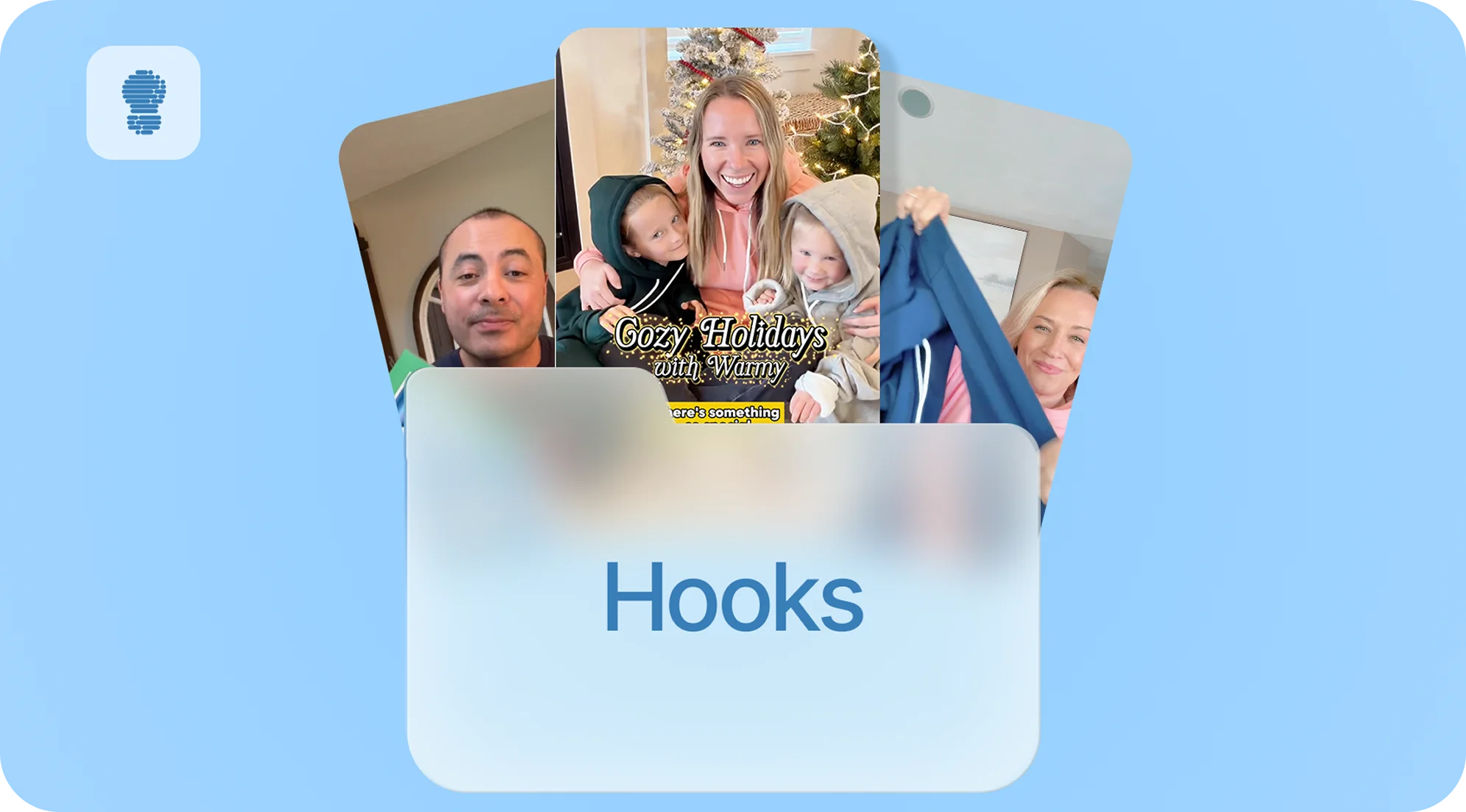
When we grouped every top-performing hook by type – three pulled away from the rest: Authentic Moment, Audience Call-out, and Humor. Together, they accounted for over half of all top performers in the dataset.
That tells you something about what’s actually working in the opening seconds of creator ads. The highest performers tend to open with one of three moves: show something real, name who you’re talking to, or make someone laugh. Everything else we tracked performed well in individual cases, but these three showed up consistently across products, verticals, and audience segments.

If you’re building a creator brief and need a starting point, this is your shortlist.
Authentic Moment Hooks Dominate the Data
Over a quarter of all top-performing hooks in our dataset used authentic moment framing, making it the single most common hook type among the highest performers we tracked.
These hooks feel caught, not scripted. The creator shares something personal, situational, or emotionally honest in the first few seconds, and the product enters the frame naturally after that moment lands. There’s no pitch in the opening line, just a person being real about something they’re experiencing.
One hook in this category had no clear spoken line at all. The creator simply reacted to receiving a product on camera (“Oohh, what is this?”), and the genuine curiosity did the work.
What we took away from this is that vulnerability and relatability outperformed polish in nearly every case. The more the opening felt like a real moment the viewer could place themselves in, the stronger it performed.

Audience Call-Out Hooks Lead with Identity
Audience call-out hooks were the second most common type among top performers. The very first words name who the viewer is, not what the product does.
By calling out a specific identity, role, or situation, the hook creates an immediate sense of “this is for me” in the right viewer while everyone else scrolls past. These hooks trade broad reach for deep relevance, and the hook rates reflect it.
The call-out doesn’t have to be a direct address, though. The top performers used four distinct approaches to identify their audience in the opening seconds:
- a direct address that names the viewer outright: “Husbands, this is your 1 chance not to mess up.”
- a role that identifies the viewer by what they do or who they are: “Are you still guessing how much you should charge for your handmade products?”
- a situation that describes something the viewer recognizes from their own life: “As a hockey mom, I wish I had found this years ago.”
- a relationship that speaks through a connection the viewer has with someone else: “If you love your wife, order this right now.”
If you’re briefing creators and want to test this hook type, the key detail we’d highlight is this: give the creator a specific audience to address in the first sentence, and let the product come second.

Humor Showed Up in Three Different Styles
Humor was the third most frequent hook type among top performers, and what surprised us is that it wasn’t one kind of funny. Three distinct comedic styles made the top tier, which suggests that humor is a reliable hook regardless of the specific approach.
Here are some of the top-performing humor hook examples we tracked:
- “Dude.” (Deadpan, one word. The absurdity of the understatement does the work.)
- “Seriously, no one wants to leave the bathroom smelling suspicious.” (Relatable embarrassment turned into a comedic setup.)
- “My husband wants to show you his product. You better be cool and be nice, okay?” (Playful misdirection that pulls the viewer in before revealing what the ad is actually about.)
Each of these uses a completely different comedic approach, but the result is the same. The viewer’s guard drops before the product ever enters the frame. Humor consistently lowered the “I’m being sold to” reflex faster than any other hook type in the dataset.
The practical takeaway for briefing is that you don’t need your creator to be a comedian. You need them to find one moment of levity, awkwardness, or absurdity that feels natural to them and connects to the product. Forced humor didn’t show up in the top tier. The hooks that performed felt like the creator genuinely found something funny, and the viewer wanted to stick around to see where it went.

Authority Hooks Only Worked When the Credential Was Visible
Authority and expertise hooks appeared in the top tier, but with a very specific pattern. The credential had to be immediate, visual, and directly tied to the product’s use case.
The clearest example was a creator in a firefighter uniform who opened with “I am a firefighter and my priority is your safety” before introducing the product. The viewer didn’t need to take the creator’s word for it because the uniform was visible in the first frame. The authority was established before a single claim was made.
The visual proof doesn’t have to be a uniform. A recognizable environment works just as well, a dentist in a dental office, a chef in a commercial kitchen, a nurse in a hospital hallway. As long as the viewer can see the credential rather than just hearing someone claim it, the authority lands.
Hooks like “as an expert in…” or “I’ve been in this industry for 10 years” were absent from the top tier entirely. Self-reported credentials are a hard ask when the viewer is deciding whether to keep scrolling.

Some of the Top Performers Used Zero Voiceover
Some of the strongest-performing hooks in our dataset had no spoken words at all. The creator simply demonstrated the product on camera, and the visual did all the work.
In a feed where nearly every ad opens with someone talking directly to the viewer, silence is a genuine pattern interrupt. The absence of a voiceover made these videos feel different from everything around them, and that difference earned attention.
There are moments where the product itself is visually compelling enough to hold the opening seconds without narration. If your product has a satisfying unboxing experience, a visible transformation, or a clear before-and-after that plays out on screen, a voiceover-free hook is worth testing. Our data suggests it can outperform most talking-head formats when the visual is strong enough to stand on its own.

The Hook Types That Were Almost Entirely Absent
What didn’t show up in the top tier told us as much as what did.
List hooks, comparison hooks, FOMO framing, secret/insider setups, and alternative positioning (“forget X, try Y instead”) were almost entirely absent from the top-performing dataset. These are the hook formats that show up constantly in creative strategy templates and best-practice guides, but our data suggests they rarely earn top-tier hook rates in practice.
The common thread is that they follow recognizable frameworks, use deliberate persuasion structures, and signal “ad” within the first few words. Viewers have developed a strong filter for these patterns, and the scroll reflex kicks in before the hook has a chance to land.
That doesn’t mean these formats can never work, but if your current creative rotation leans heavily on list hooks (“3 reasons why…”), FOMO (“only 24 hours left…”), or insider framing (“the secret nobody talks about…”), you’re competing in a space where viewer resistance is highest. The hooks that actually earned top-tier performance felt personal, unscripted, and human first.
How to Apply These Findings to Your Next Creator Brief
Start your creative rotation with Authentic Moment, Audience Call-out, and Humor. These three hook types accounted for the majority of top performers, so they give you the highest probability of a strong hook rate out of the gate.
When briefing creators, the key details matter. For Authentic Moment, give the creator a real situation rather than a script. For Audience Call-out, name the specific person or role to address in the first sentence. For Humor, brief the product and situation but let the creator find the comedic angle naturally. Forced humor was absent from the top tier.
Once that rotation is producing results, test one underused format per cycle. Confessional, Strong Reaction, and visual-only demos all posted strong individual results and can expand your mix without falling back on the template-driven formats that underperformed.