Youtube video ads: formats, creative, and performance

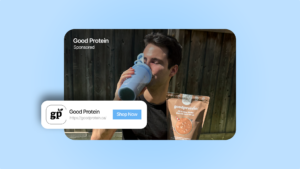
YouTube has over 2 billion monthly users and generated $40.4 billion in ad revenue in 2025 – more than the combined advertising total of Disney, NBC, Paramount, and Warner Bros. Discovery. For brands running paid video, it’s no longer a secondary channel.
TL;DR
- YouTube runs five main ad formats – skippable in-stream, non-skippable in-stream, bumper, Shorts, and display. Each with different pricing models, creative requirements, and performance signals.
- Set your campaign objective before producing creative: it determines which formats are available and how Google optimizes delivery.
- UGC-style creator content can achieve up to 4x higher CTR than studio video on skippable formats; polished creative still wins on non-skippable and Masthead placements.
- Track view rate, CTR, and CPV for in-stream; completion rate for Shorts; and ad recall lift for bumpers. Set a 30-day view-through attribution window or you’ll undervalue the channel.
YouTube advertising has a learning curve that most guides underestimate. The platform runs multiple ad formats with different pricing models, creative requirements, and performance dynamics. What works on Facebook or TikTok often underperforms here, especially once you account for YouTube’s most defining feature: the skip button.
This guide covers the practical essentials: how to set up a campaign, which formats to use, how to approach creative, and what to track once your ads are live.
1. Set your campaign objective first
Before choosing a format or producing creative, define what you want the campaign to do.
Google Ads organizes YouTube campaigns around four main objectives: brand awareness and reach, product and brand consideration, website traffic, and conversions. The objective you select determines which ad formats are available and how Google’s algorithm optimizes delivery.
If your goal is driving purchases or signups, choose conversions and connect your campaign to a Google Ads conversion action via Google Tag Manager or the site tag.
If your goal is reach and awareness (launching a new product, entering a new market), brand awareness and reach unlocks the formats optimized for impressions and views rather than clicks.
Getting the objective right before production matters because it affects creative length, call-to-action placement, and how you’ll evaluate success later. Running a conversion-focused campaign with awareness-length creative, or vice versa, is one of the most consistent mistakes advertisers make when starting on YouTube.
2. Know the YouTube ad formats
YouTube runs several distinct ad formats, and matching your creative to the right one is one of the highest-leverage decisions you’ll make.
Skippable in-stream ads
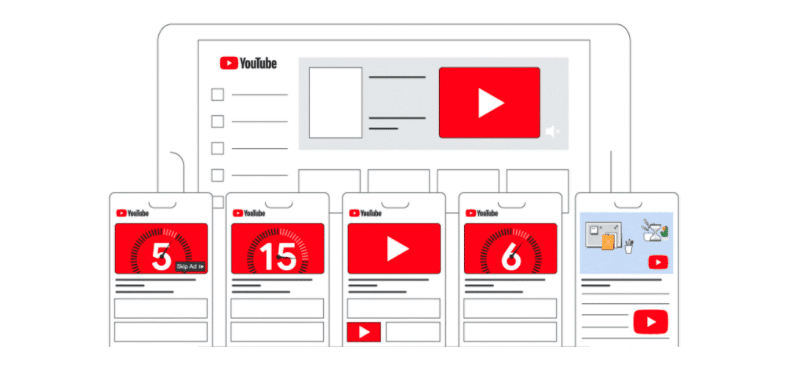
Skippable in-stream ads appear before, during, or after videos. Viewers can skip after five seconds, and you only pay when someone watches 30 seconds or more, or clicks your CTA. This is the most common YouTube ad format and the one with the widest creative range: ads can run from 12 seconds to several minutes. Because viewers can skip, the first five seconds determine whether you earn a view or lose one before you’re charged anything.
Non-skippable in-stream ads
Non-skippable in-stream ads are up to 15 seconds and must be watched in full before the video continues. You pay per thousand impressions (CPM) rather than per view. These work best for short, polished brand messages where forced exposure supports the creative goal: product launches, brand awareness pushes, and retargeting sequences.
Bumper ads
Bumper ads are six-second, non-skippable ads with the lowest CPM on the platform, roughly $3-$4. They are not a click-driving format; they are built for frequency and recall. In a Google study of 122 bumper campaigns, 70% drove significant brand awareness lift with an average increase of 9%, and 9 out of 10 drove ad recall with an average lift of 30%.
The best application is retargeting: take the sharpest six seconds from a longer in-stream ad and use it as a follow-up sequence for audiences who have already seen your main creative.

YouTube Shorts ads
YouTube Shorts ads appear between organic Shorts content in the vertical feed. They’re up to 60 seconds, carry the lowest CPM of any YouTube format (around $4), and behave nearly identically to TikTok in-feed ads from a viewer perspective. Shorts accounted for 22% of YouTube’s total ad revenue in 2025, up from 15% the year prior, and now generate more revenue per watch hour than long-form content in the US. That growth is exactly why YouTube is overhauling how much of that revenue creators actually see, with new Partner Program rules taking effect in 2027.
If you’re already producing vertical short-form content for TikTok or Reels, most of it can run on Shorts with minimal adaptation.
Display and overlay ads
Display and overlay ads appear alongside or on top of videos rather than as pre-roll. They drive lower engagement than in-stream formats but work as a low-cost complement to video campaigns, particularly for retargeting audiences who have already interacted with your video ads.
3. Creative approach: what actually earns attention
YouTube’s creative dynamic is different from every other paid social platform, and it comes down to viewer choice. On skippable in-stream ads, a viewer actively decides in the first five seconds whether your content is worth their time. That decision isn’t made on brand recognition: it’s made on whether the opening looks like something worth watching.
Logo animations, brand intros, and slow product reveals signal “advertisement” in the first two seconds, and viewers skip. An opening that starts with a recognized problem, a credible on-camera claim, or a compelling visual earns attention past that threshold.
What works in the first five seconds
A direct statement of a problem the viewer recognizes, an unexpected visual, or someone on camera saying something specific and credible. The hook doesn’t need to be flashy; it needs to be immediately relevant to the viewer.
UGC-style content (creator-led, conversational, filmed without heavy production)
Youtube UGC consistently outperforms polished studio video on skippable placements. UGC-based ads can achieve up to four times higher CTR than studio-produced brand creative on skippable formats, and the hook rate and CTR advantage for UGC runs 31% and 33% respectively on skippable formats. That said, UGC is one creative approach among several: polished, produced creative retains an edge in non-skippable in-stream and Masthead placements where forced exposure changes the viewing dynamic.
Sound framing matters more on YouTube than on Meta or TikTok.
YouTube audiences are more likely to watch with audio on than viewers on other social platforms, which means your creative should be written for sound-on delivery: clear spoken narration, natural pacing, and no captions-only strategy. This is a meaningful difference from Meta and TikTok, where designing for sound-off viewing is the baseline requirement.
YouTube Shorts
For YouTube Shorts, apply short-form social rules: first-second visual hook, vertical 9:16 format, punchy structure. Shorts viewers scroll the feed like TikTok users; the creative principles are nearly identical, but including SEO-relevant product naming (saying the product and category clearly on camera) matters more on YouTube because the platform indexes audio for search.
For a full breakdown of creator sourcing, briefing, and Open Call, the YouTube UGC ads guide covers the workflow in detail.
4. Brief and produce for the platform
Producing YouTube video ads efficiently means building creative for the format from the start, not adapting existing assets after the fact.
For skippable in-stream, you only pay when a viewer watches 30 seconds of your video (or the full duration if shorter), which means your brief and runtime decisions directly affect your cost structure. Brief around a 30-60 second runtime with a clear structure: hook in the first five seconds, context or problem in the next 15-20 seconds, demonstration or proof in the middle, and a direct CTA at the end.
For consideration campaigns, 60 seconds to 3 minutes allows for fuller narrative delivery; for awareness and action campaigns, 15-20 seconds is typically the most efficient length.
A few production decisions that matter more on YouTube than elsewhere:
- Say the product name clearly on camera. YouTube indexes video audio for search, which means creators who name the product and category help your ads surface in related content searches.
- Keep pacing conversational. Fast-cut editing that feels native on TikTok can feel jarring on YouTube in-stream, where viewers have made a deliberate decision to watch something. Slightly longer takes and natural delivery tend to hold attention better.
- Plan multiple hooks from one shoot. The biggest creative variable on skippable formats is the opening. Producing two or three hook variations from the same shoot gives you testable assets without reshooting the whole ad.
For production principles that apply across platforms and formats, see the guide to creating high-converting product videos.
5. Track your results
Tracking YouTube ad performance means looking at different signals by format, not applying the same metrics across every placement.
| Format | Track these | Benchmarks | What to skip |
|---|---|---|---|
| Skippable in-stream | View rate, CTR, CPV | View rate avg 31.9%; CPV $0.05-$0.10; CTR 0.5%-2.0%. If view rate is below 28%, the issue is almost always the hook, not targeting. | All standard metrics apply |
| YouTube Shorts | Completion rate, CPM | CPM ~$4 | View rate (Shorts threshold differs from in-stream and the numbers are not comparable) |
| Bumper ads | View-through conversions, brand lift | Ad recall lift avg +30% | CTR (recall format, not click-driven) |
One attribution adjustment that most brands miss: YouTube’s view-through conversion window. If you’re evaluating YouTube performance on last-click only, you’ll systematically undervalue the channel. Many YouTube viewers convert later through a direct search or a retargeting touchpoint rather than clicking the ad in the moment, making view-through attribution essential for an accurate read on the channel’s contribution. Set a 30-day view-through attribution window in Google Ads and review the assist data before making budget decisions.
YouTube video ads summary
YouTube video ads work best when format, objective, and creative are aligned before production begins. On skippable in-stream, creative approach matters more than targeting: UGC-style content that opens with a genuine problem statement consistently outperforms polished brand spots on this format, while bumpers and non-skippable placements still favor produced creative.
Set up view-through attribution before drawing any conclusions from the data, or YouTube will consistently look worse than it actually is.
FAQs
What types of YouTube video ads can I run?
How much do YouTube video ads cost?
YouTube Shorts and bumper ads both average around $4 CPM, making them among the most cost-efficient placements on the platform.
Non-skippable in-stream CPMs are higher given forced-view inventory. In all cases, creative performance has a larger impact on effective cost than targeting or bidding strategy.
What makes a good YouTube ad hook?
How is tracking YouTube ads different from Meta or TikTok?

SEO Lead
Passionate content and search marketer aiming to bring great products front and center. When not hunched over my keyboard, you will find me in a city running a race, cycling or simply enjoying my life with a book in hand.
Make creator marketing a data-backed growth channel

Related from Creative Insider
Snapchat ads for ecommerce: what works, what doesn’t, and how to start
Social Commerce: Turn A 15-Second Scroll Into A Sale Without The Traditional Funnel