How to repurpose UGC: turn creator videos into a full-funnel content engine

Have you ever noticed your CPA creeping up even though you haven’t changed your targeting? In most cases, the culprit isn’t the audience – it’s creative fatigue. The same three videos have been running for six weeks, the algorithm has exhausted them, and performance is quietly declining while you’re focused on everything else.
The instinct is to brief new creators and start over. But the more overlooked fix is getting more from the content you already have. User-generated content (UGC) is one of the highest-performing creative formats available to performance marketers today, and most brands are deploying it on one channel when it could be running across five.
TL;DR
- One well-briefed UGC video can fuel paid social, organic social, email flows, product pages, and retargeting without new shoots.
- You’re already running UGC on paid social – your paid performance data tells you which videos are strong enough to expand to product pages, email, and retargeting.
- Rights clearance must happen before repurposing: paid use, editing rights, and platform scope all need explicit agreement.
- Measure by channel using UTM parameters and unique promo codes; hook rate is the fastest early signal for paid.
Why repurposing UGC is worth the effort
Most brands treat UGC like a one-time ad asset: brief the creator, receive the video, run the campaign, move on. But the production cost and the usage rights you paid for don’t vanish when the campaign ends. The asset can keep working if you put a system behind it.
The economics are straightforward. UGC drives 53% higher click-through rates and lowers cost-per-click by 50% compared to brand-produced ads, and those gains compound when the same asset runs across multiple placements rather than just one. Brands that build structured UGC strategies report $4 in value for every $1 invested, with content creation costs dropping by up to 70% compared to relying on studio production alone.
The problem most performance teams run into isn’t a lack of good UGC – it’s a lack of a system for deploying it. Only 16% of brands have a dedicated UGC strategy, even though 93% of marketers who have used it say it outperforms branded content. That gap is an advantage for brands willing to build the repurposing pipeline now.
The 5 channels where repurposed UGC drives the most impact
Most brands start here: they brief creators, receive the videos, and run them as paid social ads. That’s the right instinct. Paid social is where UGC performs most visibly and where the ROI is easiest to measure.
The opportunity is what happens after. Once you have a paid social winner, that same asset can keep working on four more channels without a single additional brief. Each placement adds return on production you’ve already paid for.

1. Paid social (TikTok Spark Ads, Meta Partnership Ads)
Paid social is where most brands first deploy UGC, and for good reason: the performance lift from creator-authentic content is measurable and significant. The key differentiator is running UGC through the right ad format, not just using it as generic ad creative.
TikTok Spark Ads, which run UGC directly from a creator’s handle rather than a brand account, deliver 142% higher engagement, 43% higher conversion rates, and 30% higher completion rates compared to non-Spark formats. Brands that put 40-60% of their TikTok budget through Spark consistently see the largest gap in cost per acquisition. On Meta, Partnership Ads give the creative higher placement priority and audience trust because the brand and creator accounts are linked at the signal level, an advantage standalone brand ads simply cannot replicate.
Imagine you’re a DTC skincare brand that just received five creator videos from a campaign. Running them as standard in-feed ads from your brand account will get results, but running them as Spark Ads from each creator’s own handle will get materially better ones. The content looks organic because it originated from an organic account, and the platforms reward that authenticity with better placement and lower CPMs.
2. Organic social (Reels, Shorts, cross-posting)
Organic deployment often gets skipped because brands assume UGC is primarily a paid asset. That assumption leaves free impressions on the table and, more importantly, bypasses a testing step that tells you which content is actually worth amplifying.
The most effective organic strategy follows a clear sequence: launch the UGC on the creator’s own channel first, then after 24-48 hours of native engagement, whitelist the post for paid. This organic-to-paid pipeline retains the content’s authentic feel while extending its reach far beyond the creator’s existing followers. At the same time, a single 60-90 second vertical video can be adapted for TikTok, Instagram Reels, and YouTube Shorts, compressing production cost while multiplying the impressions you get per dollar spent on creator fees.
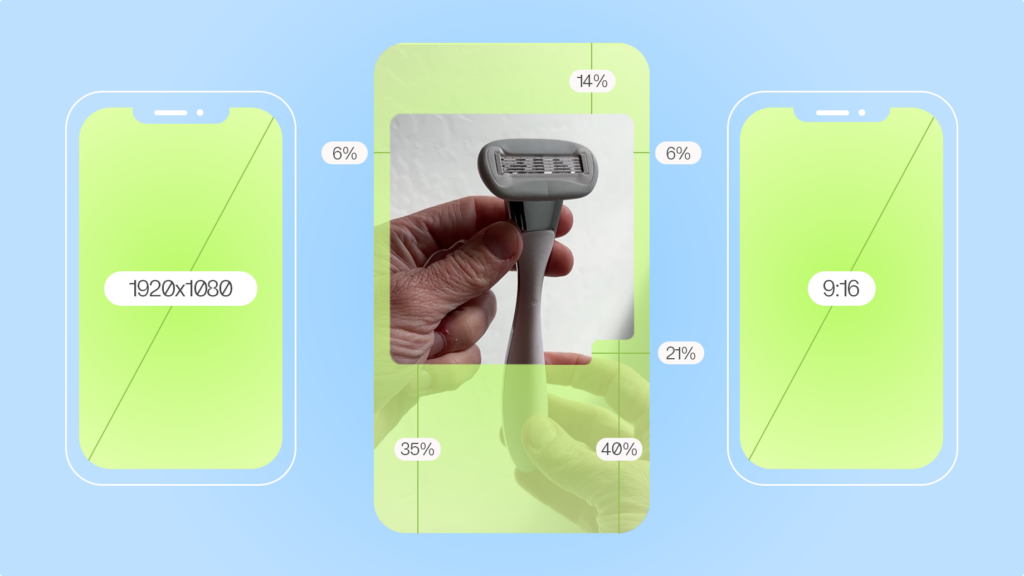
The practical rule here is the same core content with platform-aware adaptation: adjust aspect ratios, safe zones for overlays, and CTAs per platform rather than reshooting.
3. Website & product pages
Product pages are where purchase decisions happen, and UGC is uniquely effective there because it answers the question buyers are actually asking: does this work for someone like me?
Product pages with verified UGC galleries deliver 10-25% conversion lift and 15-40% longer dwell time compared to pages with studio-only images. Shoppers who interact with UGC galleries convert at 140% higher rates and generate 15% higher average order value. Video reviews specifically add 5-9% to add-to-cart rate, which compounds quickly across high-traffic pages.
Imagine you’re running a supplement brand with solid Meta traffic hitting a product page, but your Shopify conversion rate is stuck at 1.8% despite multiple copy tests. Before changing targeting or rebuilding the page, add 3-5 authentic customer videos above the fold and measure the difference over two weeks. In many cases, the traffic quality is fine. The missing element is social proof at the moment of decision, and a real customer talking about real results does that better than any headline.
4. Email marketing
Email is often the last place marketers think to use UGC, but it’s one of the most cost-effective placements available. The same creator videos you brief for paid social can easily migrate to your email flows. But do not try to embed raw MP4 files, which will instantly tank your deliverability and break across major email clients. Instead, convert the highest-impact 3-second hook of your UGC into an optimized, looping GIF with a faux ‘Play’ button overlay that links directly to your landing page.
You already have an engaged list; adding this quick visual social proof takes minimal effort and consistently moves the click metric. Embedding UGC in email flows increases click-through rates by 73-78%, and 50% of marketers now include UGC in their email campaigns. The highest-impact placements are:
- Post-purchase sequences, where a customer review or unboxing video reinforces the buyer’s decision and nudges toward repeat purchase;
- Win-back flows, where social proof rekindles intent for lapsed customers;
- Product announcement emails, where real customer context outperforms brand copy for establishing credibility with a warmed audience.
Post-purchase and win-back placements are exactly where a retention-focused brief outperforms a reused acquisition clip, and our guide to UGC for retention marketing breaks down how to brief creators for that specifically.
Imagine you’ve just wrapped a Black Friday campaign with six creator videos. The paid campaign is over, but those videos are still sitting in your asset library. Adding the 2 or 3 best-performing ones as thumbnails in your post-purchase flow takes an hour and will outperform the stock imagery currently in those emails.
The practical move: pull your 3 best-performing creator videos, add them as thumbnails in your next post-purchase flow, and track CTR against your current baseline.
5. Retargeting
Retargeting audiences are already familiar with your brand, which changes what the content needs to do. You’re not introducing a product; you’re removing the final objections standing between a warm prospect and a purchase. The creator videos you already have from your paid social campaigns are the right raw material here – you just need to select for the right angle.
A shopper who visited your product page twice in the last two weeks but didn’t convert. They know what you sell. What they haven’t decided is whether it will work for them. A creator testimonial focused on outcome (“I was skeptical but here’s what actually happened after two weeks”) hits differently at this stage than an unboxing video or a product feature walkthrough.
UGC is particularly well-suited to this because customer testimonials with direct CTAs and urgency signals outperform awareness-style content at the bottom of the funnel, where the audience already has your product in mind. The numbers support it: UGC ads drove 6.73x higher conversion rates compared to non-UGC creative in Q1 2026, a 57% jump from the prior quarter, with authentic customer video outperforming studio creative by 29% specifically at the lower funnel.
The briefing implication: if you know you’ll run retargeting, brief one or two creator videos specifically for outcome-focused storytelling from the start, not just for awareness hooks.
The UGC repurposing pipeline
Three steps take a single asset from delivery to deployment across every channel. The table below shows what each step involves, what to watch for, and where Billo removes the friction.
| Step | What to do | Key watch-outs |
|---|---|---|
| 1. Rights clearance | Confirm your license covers every intended channel: platforms, duration, paid ad use, editing rights (resizing, subtitling), and geo scope. If you source through Billo, usage rights are structured into creator agreements from the start – no negotiation needed. | Music is the most common trap. Platform blanket deals cover organic use, not brand commercial reuse – putting paid spend behind a clip with copyrighted audio creates a new unlicensed use. Brief for original or cleared audio. |
| 2. Format adaptation | Prepare channel-specific variants from the same source file. Core checklist: 9:16 for TikTok/Reels/Shorts, 1:1 for feed, 16:9 for YouTube; captions burned in; safe-zone compliance; platform-specific CTAs. | Brief for modularity upfront: clean product shot held 2+ seconds, verbal product name mention, verbal CTA. Assets briefed this way adapt without reshoots. |
| 3. Select winners to expand | Use your paid social data to decide what gets deployed further. Strong hook rate and a CPA you’re happy with means the video has already proven itself – that’s the one worth adding to your product page, email flow, and retargeting. | Underperformers on paid won’t be rescued by a product page placement. Let paid social do the initial sorting, then expand only the winners. |
What to look for when selecting UGC to repurpose
Not every piece of UGC you receive belongs in a full-channel repurposing workflow. Some assets work well for one placement and poorly for others. Run a quick audit before you invest time in adaptation.
Modular composition brief tips
The best way to ensure your UGC is repurposable is to brief for it before the creator shoots. When you specify modular composition in the creative brief, you receive assets that adapt cleanly without requiring reshoots or heavy editing.
The brief should require:
- A clean product shot held for at least two seconds (gives you a stillable frame for thumbnails and static ads),
- A verbal mention of the product name for audio indexing,
- Safe-zone compliance for platform overlays like TikTok captions and Instagram UI,
- A clear verbal CTA that works without visual context.
Performance signals that tell you an asset is worth scaling
For paid social, the earliest reliable signal is hook rate: three-second video views divided by impressions. Hook rate is readable at 500-1,000 impressions, well before CTR and CPA stabilize, making it your fastest indicator of whether an asset deserves wider deployment or should be set aside.
Before scaling any asset, three filters quickly down-select your library:
- Which videos drove the highest engagement,
- Which creators drove actual conversions via promo codes or click-throughs,
- Which assets already have cleared rights for paid use.
If a video passes all three, it goes into the channel pipeline. If it doesn’t, it may still have a role in organic or email, but it shouldn’t anchor your paid amplification.
When a strong asset starts to tire, the data will show it before it becomes a budget problem.
Key fatigue signals:
- CTR dropping more than 30% from peak,
- CPA rising more than 40%,
- Frequency reaching 4-5 per user.
At this point, remix rather than retire: swap the hook, re-sequence scenes, test a new CTA, and keep the core value proposition that made the original perform.
How to measure repurposed UGC across channels
Set up tracking before deployment and every future campaign generates clean, comparable data.
UTM parameters are the foundation – apply them to every placement. For teams on the quest to repurpose UGC across all five channels, use multi-touch attribution rather than last-click. UGC frequently touches mid-funnel before a paid ad closes the sale, so last-click consistently undercounts its contribution.
| Channel | Key metrics | How to track |
|---|---|---|
| Paid social | Hook rate, CTR, conversion rate, CPA | Platform native analytics + UTMs; hook rate is readable at 500-1,000 impressions before CTR/CPA stabilize |
| Product pages | Dwell time, add-to-cart rate, conversion rate | UTM source tags; A/B test pages with UGC vs. studio-only images |
| CTR, click-to-open rate | UTMs on video thumbnail links; unique promo code per flow | |
| Retargeting | CPA, ROAS, conversion rate vs. non-UGC | Run UGC and non-UGC creative as separate ad sets against the same audience segment |
| Organic social | Engagement rate, saves, shares | Native platform analytics; note which organic posts earn the strongest engagement before whitelisting |
Summary & Next Steps
A single creator video can work across 5 different . The brands that get full value from their UGC get three things right: rights clearance that covers every intended channel, a brief that specs for modular composition, and using paid social performance data to decide what gets expanded further.
If you’re building the sourcing side of this from scratch, Billo structures it so you receive rights-cleared video files with briefs already set up for multi-channel deployment, which is what makes the pipeline above actually runnable.
FAQs
Do I need different usage rights for each channel?
Which channel should I repurpose UGC to first?
What formats work best for repurposed UGC?
How many times can I repurpose the same piece of UGC?

SEO Lead
Passionate content and search marketer aiming to bring great products front and center. When not hunched over my keyboard, you will find me in a city running a race, cycling or simply enjoying my life with a book in hand.
Make creator marketing a data-backed growth channel

Related from Creative Insider
Inside Canvas UGC: the new model for brand-owned social accounts
UGC for Retention Marketing: Same Creators, Different Brief
How to pitch UGC to clients: performance agency’s playbook