A food delivery app told me a human saw my order. Ads are next.

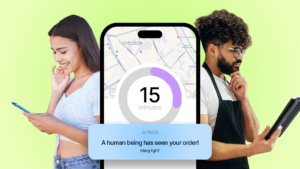
A food delivery app told me a human being has seen my order.
“Human made.” “A human will respond.” These are becoming the new “organic,” the new “non-GMO” – premium signals that won’t work forever but buy trust right now, which is exactly what users are shopping for.
Buyers pay for proof of the exception
Food and supplements went through this cycle already. Once a category gets industrialized enough, buyers stop trusting the default and start paying for proof of the exception. “Organic” wasn’t a taste claim. It was a trust claim wrapped in two syllables.
AI-generated content has industrialized the default. Most of what shows up in a feed now could have been produced by a model, and increasingly was. So the exception – a human actually touched this – becomes the thing worth advertising.
This copy predates AI by years. Wolt’s been running some version of “a human has seen your order” for a long time. What changed isn’t the label – it’s what it’s competing against.

Cost and trust used to be the same curve. They’re not anymore.
In the age of AI everything, human-first labels have become one of the main conversion reasons. Not a nice-to-have. A lever.
That’s backwards from how most teams are still building. The instinct in a downturn is to strip out anything expensive and human, replace it with a model, ship faster. That instinct is correct for cost. It’s wrong for trust.
This is already the whole game in ads
Replace “order” with “ad” and the same sentence gets more expensive, not less. Meta and TikTok will hand any advertiser an AI-generated face and a script in seconds. So will every competitor. That’s not a differentiator – it’s a race to the bottom, and every brand has access to the same bottom.
What’s scarce isn’t creative output anymore. It’s proof that a real person made the thing, used the product, said the words. That proof is what stops the scroll and what regulators, platforms, and buyers are all converging on at the same time.
Billo was built on that bet before it was fashionable to state it out loud: real creators, not AI faces. AI does the scaling – variations, matching, distribution. It doesn’t do the performing. The performing is the part users are now explicitly paying a premium to trust.
Where this nets out
The reassurance people needed for any online purchase has taken on a different meaning now that “made by a person” can no longer be assumed by default. The brands that can prove it, not just claim it, are the ones that will keep converting once the label stops being novel and starts being expected.
Billo’s been building the infrastructure for that proof. It’s compounding.

CEO & Co-founder @ Billo
Billo is a data-driven creator marketing platform that turns creator videos into trackable, scalable ads across Meta, TikTok, and YouTube Shorts. Built Billo from zero to 37k+ brands and hundreds of thousands of ads, driving $2.5B in tracked purchase value. I focus on systems, clarity, and execution.
Make creator marketing a data-backed growth channel

Related from Creative Insider
YouTube Shorts monetization just changed: 2027 payout overhaul for creators & brands
What happens to real UGC & AI UGC when AI labels are mandatory?
Platform AI labeling in 2026: how TikTok, Meta, YouTube and C2PA label your ads