UGC Brief Template: How to Write a Video Brief That Gets Usable Content Back

Key takeaway: Most UGC comes back unusable because the brief was unclear, not because the creator was bad.
You’ve found the right creators. You’ve got the budget. You hit send on the brief and wait. Then the videos come back and… they’re not what you needed. Sound familiar?
It happens all the time, and the brief is almost always the reason. When briefs are vague or disorganized, 55% of first submissions need revisions. That’s more than half your content coming back unusable on the first try. Give creators a clear, structured brief and that number drops to 15–20%.
Here’s why that matters so much: UGC ads outperform traditional branded creative by 93%. But you only get that lift when the content actually lands. A great brief makes that happen. A bad one wastes everyone’s time.
Below, you’ll find everything that belongs in a solid UGC brief template, what makes video briefs different from traditional creative briefs, the mistakes that keep leading to unusable content, and a ready-to-use template you can grab and fill in right now.
TL;DR:
- Think of your UGC brief as a production spec, not a wish list. The clearer it is, the fewer revisions you’ll need.
- Always include placement context, one core message, storyboard beats, tech specs, and usage rights.
- Over-scripting kills authenticity. Vagueness kills usability. You want the sweet spot in between.
- If the brief takes a creator more than 15 minutes to read, trim it down.
- Billo’s Script Generator can build data-backed briefs for you automatically from a product URL, complete with matched creators.
- Scroll to the bottom for a copy-and-use UGC brief template you can start with today.
What Is a UGC Brief (And Why Most of Them Fail)
A UGC brief is the document you send creators before they start filming. It tells them what you need, why you need it, who the content is for, and how to deliver it. When it’s done well, creator acceptance rates go up by as much as 40%. That means fewer revision cycles and a much faster path to a live ad.
But most briefs don’t work that well. The content comes back off-target, and usually the creator isn’t the problem. The brief is. It left too many open questions, and the creator filled in the blanks themselves.
You’ve probably seen the usual culprits: briefs that say “make it authentic” without explaining what authentic looks like for your brand, briefs that script every word until the video sounds robotic, briefs that never mention where the video will actually run, briefs loaded with marketing jargon the creator doesn’t speak, or briefs with zero clarity on the revision process.
For a deeper breakdown of the five most common brief failures and how to fix each one, the UGC brief mistakes guide covers them in detail.
The numbers tell the story. Agencies report about 60% first-submission acceptance rates, which means four out of every ten videos need at least one round of rework. Each revision costs time, delays your launch, and usually waters down the original idea. Fixing the brief is the fastest, cheapest way to fix all of that.
What to Include in Your UGC Brief Template
A solid UGC brief template covers six areas. Leave any of them out and you’re asking the creator to guess, and they’ll usually guess wrong.
1. Campaign Goal and Placement Context
This is the single most important part of your brief, so put it first. Tell the creator exactly where this video will live: TikTok in-feed ad, Meta retargeting, Instagram Reels, a product page, an email. A video designed for a fast-scroll feed needs a completely different hook and pacing than one sitting next to a pricing table.
Be just as specific about what you’re trying to achieve. Goals like “to educate” or “to inform” are too fuzzy to be useful. Compare that with “drive app installs from paid TikTok among fitness-interested women aged 25–34.” Now the creator knows exactly what they’re building toward.
2. Target Audience
Skip the generic demographic brackets and describe your buyer in terms a creator can actually use. Go beyond age and location: what frustrates them, what they’ve already tried, and what words they use when they talk about the problem your product solves. This matters more than it sounds. The top-converting openers in Billo’s health hook types that sell describe a problem the viewer already lives with, in the words they’d use with a friend.
“Health-conscious millennials” tells a creator almost nothing. “Busy parents who meal-prep on Sundays and are tired of spending $200/week on groceries that go bad” gives them a hook, a tone, and a story to build around.
3. Video Format and Technical Specs
This is the section that prevents videos from coming back in the wrong format. Spell out resolution (1080×1920 for vertical), aspect ratio, orientation, and length. Platform sweet spots vary a lot: TikTok ads work best at 21–34 seconds, Meta recommends 15 seconds or less, and Instagram Reels’ viral range is 7–15 seconds.
Don’t forget device (phone camera vs screen recording), whether you need captions baked in, and audio requirements (voiceover, trending sound, or music-free for paid use).
4. Storyboard Beats or Script Framework
This is where a lot of brands go wrong. They either hand over a word-for-word script (which sounds robotic) or say “just be yourself” (which produces something unusable). The sweet spot is storyboard beats: Hook (0-2s) to stop the scroll, Problem (2-5s) to name the pain, Demo or Result (5-12s) to show the product working, Proof (8-12s) for a personal outcome or social proof, and CTA (12-15s) to tell the viewer what to do.
One important thing: keep each video focused on a single takeaway. If you want to hit three different value propositions, brief three different videos. Trying to stuff multiple messages into one UGC hook almost never works. For category-specific brief guidance, like including which hooks, formats, and tone directions convert in beauty and skincare, see the beauty UGC guide.
For real opening lines from top performers, see the beauty ad hooks that convert.
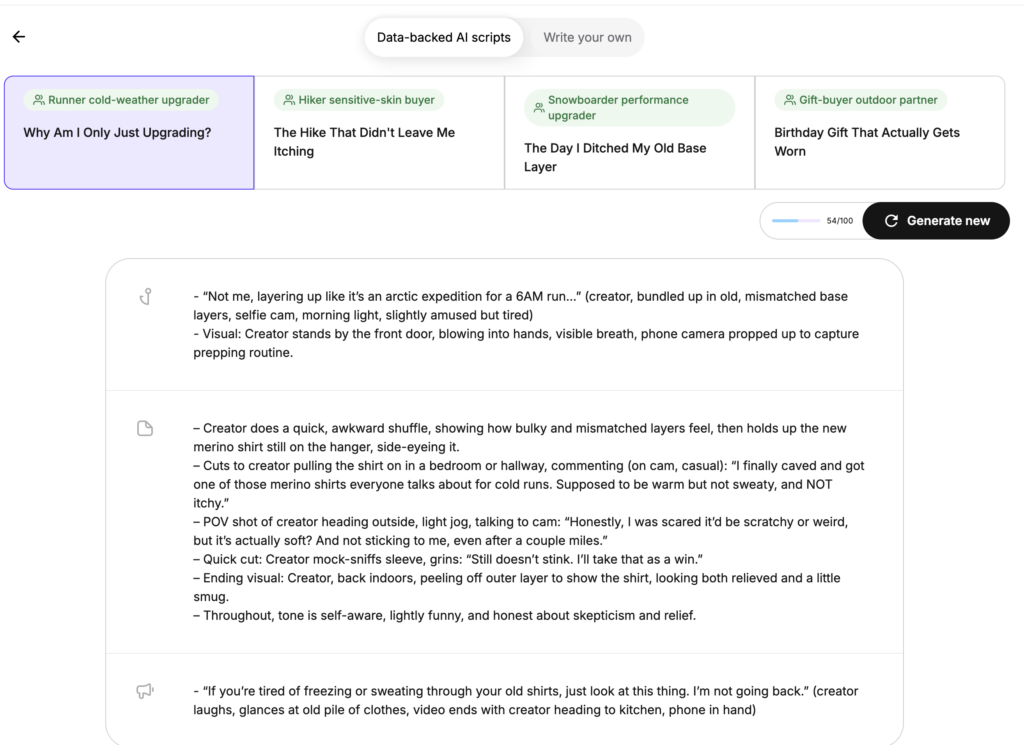
Automated tools like Billo script generator can help you map out the optimal script in seconds. Allowing for easy scaling of creative.
5. Brand Guidelines and Do-Not List
Cover the basics: tone of voice, logo placement rules, color palette notes, and product pronunciation if it’s tricky. Then add a “do not” list: no competitor mentions, no unsubstantiated claims, no filters that change how the product looks, and any other hard lines for your brand.
But keep it tight. Too many rules strip out the authenticity that makes UGC work in the first place. If you catch yourself dictating every word, pause. You’re writing an ad script, not a UGC brief, and the final video will sound like it. For more on walking that line across multiple creators, the guide on maintaining brand consistency at scale goes deeper.
For health and wellness brands with FTC and FDA compliance requirements on top of standard brand rules, this guide to wellness UGC briefs shows how to set the guardrails without scripting the video.
6. Usage Rights, Deliverables, and Timeline
Be clear about what you’re getting and what you can do with it. How many finished videos? Do you need raw footage? How many revision rounds are included? Where can you run the content: paid ads, organic, landing pages, email, all of the above? Get this in writing before anyone starts filming.
On timing, professional UGC typically takes 7–14 business days from kickoff to final delivery, covering creator matching, product shipping, filming, editing, and review. Build that into your campaign timeline so you’re not scrambling for creative at the last minute.
One more thing worth checking before you hit send: if your brief calls for something demanding, a specific location, a tricky effect, multiple takes, Billo’s Brief Complexity Bonus will flag it automatically and suggest a bonus, so the payout keeps pace with the ask.
UGC Brief vs General Creative Brief: What’s Different
If you’ve written creative briefs for agencies before, UGC briefs are going to feel a lot shorter and more hands-off. That’s by design.
With a traditional creative brief, you’re writing for a production team that handles everything: casting, lighting, locations, editing, format adaptation. You can go deep on brand messaging and leave the execution details to the pros.
UGC flips all of that. Your creator is the entire production team. Director, camera operator, talent, editor. So the brief needs to be more specific about technical stuff (resolution, platform, length) but way less prescriptive about how the creative comes together. If you dictate every camera angle and line reading, you lose the thing that makes UGC valuable in the first place: a real person showing your product in their own way.
UGC also demands brevity. These videos are 15 to 60 seconds, shot on phones, and need to feel native to the platform.
Here’s a quick side-by-side:
| Traditional Creative Brief | UGC Brief | |
|---|---|---|
| Who reads it | Agency / production team | Individual creator |
| Length | 5–10 pages | 1–2 pages |
| Who controls production | The brand | The creator |
| Format specificity | Format-agnostic | Platform-specific |
| Tone direction | Prescriptive | Directional with creative freedom |
| What it looks like | Polished, studio-quality | Raw, phone-native feel |
Skip the Manual Work: Build Your Brief With Billo’s Script Generator
Don’t want to start from a blank page? Billo’s Script Generator turns any product URL into four ready-to-use scripts in seconds, each optimized for a different ICP and reverse-engineered from the top 15% of UGC ads. Each script comes matched with creators who have a track record on performance metrics, so you go from product link to brief-plus-creator in one step.
UGC Brief Template (Copy-and-Use)
Copy it, fill in what applies, delete what doesn’t, and try to keep the final version to 1–2 pages.
Want to see what well-briefed content actually looks like? Browse the UGC video examples library for reference when you’re building out your storyboard beats.
FAQs
How long should a UGC brief be?
Should I write a full script or just give storyboard direction?
What’s the biggest mistake brands make with UGC briefs?
Can I automate the brief-writing process?

SEO Lead
Passionate content and search marketer aiming to bring great products front and center. When not hunched over my keyboard, you will find me in a city running a race, cycling or simply enjoying my life with a book in hand.
Make creator marketing a data-backed growth channel

Related from Creative Insider
Inside Canvas UGC: the new model for brand-owned social accounts
UGC for Retention Marketing: Same Creators, Different Brief
How to repurpose UGC: turn creator videos into a full-funnel content engine