UGC Creators vs Influencers: What’s the Difference?

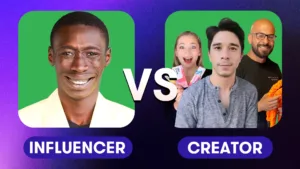
The influencer marketing industry is on track to hit $40.5 billion in 2026, and the UGC platform market is growing right alongside it at $8.5 billion. Both are booming, but the roles they play in a brand’s marketing stack are fundamentally different.
If you’re trying to figure out UGC creators vs influencers and where to put your budget, the real question has nothing to do with which approach is “better.” What matters is what you’re actually paying for with each option: content assets you own, or access to someone else’s audience. This guide breaks down exactly how user-generated content (UGC) creators and influencers differ, what each costs in 2026, and when to use one, the other, or both.
TL;DR:
| Dimension | UGC Creator | Influencer |
|---|---|---|
| What you’re buying | Content assets (video/photo) | Distribution + trust transfer to their audience |
| Content ownership | Brand owns rights outright (typical) | Creator retains rights; brand licenses for 30-90 days unless negotiated |
| Distribution | Brand deploys on its own channels and ad accounts | Creator publishes to their own followers |
| Cost range | $100-$500 per video (avg ~$198) | $50-$25,000+ per post depending on tier |
| Best funnel stage | Mid/bottom: conversion and retargeting | Top: awareness and reach |
| Brand control | High: brand provides brief, creative direction | Lower: creator’s authentic voice is the value |
| Audience relevance | Creator’s own following is irrelevant | Creator’s follower size, niche, and engagement are everything |
What is a UGC Creator vs an Influencer?
A UGC creator produces content that a brand uses on its own channels. They film, edit, and deliver video or photo assets that the brand then runs as paid ads, posts on social feeds, drops into emails, or places on landing pages. The creator’s own follower count doesn’t matter, because the brand is the one distributing the content. What matters is the creator’s ability to look natural on camera and produce content that feels authentic to everyday users.
An influencer, on the other hand, creates and publishes content to their own audience. When a brand partners with an influencer, they’re paying for access to that creator’s followers, their trust, and their niche credibility. The influencer handles both the production and the distribution.
Here’s the nuance that trips up a lot of marketers: a growing number of creators now do both UGC and influencer work. The same person might film a product video for your ad account on Monday and post a sponsored reel to their 50K followers on Wednesday. The difference between UGC and influencer marketing is contractual and operational. It depends on how the content gets used, not who made it.
Understanding the difference between organic UGC vs paid UGC adds another useful layer here, since not all user-generated content is created equal.
Key Differences Between UGC Creators and Influencers
1. Content distribution and audience engagement
- UGC Creators specialize in creating content that appears natural and relatable, as everyday users might post. They typically do not share their branded posts with their audience. Instead, brands use their content on their marketing channels as UGC ads. UGC creators are like the social media equivalent of commercial actors, producing appealing content that looks authentic.
- Influencers, on the other hand, are deeply connected to their audience. They share their content, organic posting, partnership ads directly on social media feeds and engage actively with their followers. Their role includes building relationships beyond mere marketing, making their content more personalized and influential.
2. The nature of their influence
- UGC Creators are hired for their ability to create visually appealing and compelling content that blends seamlessly with organic user-generated content. Their influence is subtle, as they are not typically tagged in promotional posts.
- Influencers sway their followers’ purchasing decisions due to their expertise, knowledge, or relationship with their audience. They are trendsetters and opinion leaders in their niches. In the case of KOLs, the expertise is based on actual professions they have.
3. Engagement with brands
- UGC Creators often work freelance and may also function as influencers. They are paid to produce specific content for brands, which is used across various marketing channels. UGC creators may not necessarily have rights to the content once it is handed over to the brand.
- Influencers engage in more comprehensive partnerships with brands. Their agreements often include creating and distributing content across their channels, like Instagram posts, TikToks, etc. The brand may be granted rights to reuse the content, but that isn’t always the case.
4. Role in marketing strategy
- UGC Creators are crucial for getting authentic and high-converting testimonials. Such content is key to strategies that make the brand seem relatable and genuine.
- Influencers are central to marketing strategies aiming to tap into new audiences, increase reach, and drive sales through trusted recommendations. Their influence is based on solid and trust-based relationships with their followers.
Summing up, UGC creators focus on creating content that brands use to appeal to customers in a more subtle, relatable manner. Influencers, with their connection and influence on their audience, are potent catalysts for brand promotion and audience engagement.
Which Should You Focus On?
In modern marketing, the decision between UGC creators and influencers can be huge. Сontent authenticity is becoming increasingly valuable, and the influence of social media personalities is evolving, so you must weigh the pros and cons of each approach. This decision will significantly impact your brand’s resonance with its target audience.
Pros and cons of UGC creators
| Pros: | Cons: |
|---|---|
| Cost-Effectiveness: UGC is generally less expensive and more manageable, especially for smaller or emerging brands. | No built-in distribution: You’ll need ad spend or owned channels to get the content in front of people |
| Full content ownership: The brand can run the asset anywhere, for as long as needed | Quality variance across creators: This makes vetting and briefing essential |
| Strong conversion performance: With UGC driving up to 10x higher conversion rates versus polished brand content | Usage rights complexity: Whitelisting, exclusivity, and perpetual licensing add layers of cost and contract negotiation |
| Volume and iteration: Because it’s easy to produce multiple creative variations for testing hooks, formats, and angles | |
| Platform flexibility: Since the same asset can run across Meta, TikTok, YouTube Shorts, email, and landing pages |
Use a UGC brief template for an easier briefing process.
Pros and cons of influencers
| Pros: | Cons: |
|---|---|
| Instant reach to an engaged, niche audience: No need to build one from scratch | Higher costs: Especially at macro tiers and above, where ROI can be harder to measure |
| Trust transfer that delivers real results: The 2026 Influencer Marketing Benchmark Report finding that 89% of marketers say influencer ROI equals or beats other channels | Limited content rights: Typical licensing windows of 30 to 90 days before additional fees apply |
| Content and distribution bundled together: The creator handles both production and publishing | Brand risk: If the influencer’s values or behavior don’t align with your brand |
| Higher engagement rates on certain platforms: TikTok influencer content averaging 5.3% engagement compared to 1.9% on Instagram | Less creative control: The authenticity that makes influencer content work depends on giving creators freedom |
One more thing to consider on both sides: creative fatigue hits every ad eventually, and having a system for repurposing winning ad concepts helps you get more mileage out of your best-performing assets regardless of whether they came from a UGC creator or an influencer.
What about AI-generated UGC?
AI-generated UGC is the newest variable in the equation, and it’s moving fast. AI UGC tools now let brands produce dozens of video variations in hours using digital avatars and voice synthesis. Over 80% of marketers are already using AI for some form of content creation, and the ad creative space is one of the most active use cases.
Early performance data shows that AI-generated UGC performs comparably to human-created UGC on direct-response metrics like click-through rate and cost per acquisition. But there’s a trust gap: when audiences sense that content is AI-generated, credibility drops, particularly for products that rely on strong social proof or personal testimonials. That trust gap is now structural. TikTok, Meta, and YouTube automatically label suspected AI content, and labeled creative measurably underperforms in the auction.
The approach that’s working best for high-performing teams is to treat AI as a testing layer and real creators as the scaling layer. Use AI to rapidly test hooks, scripts, and angles at low cost. Once you identify the concepts that perform, produce the winners with real creators. For a deeper dive into this tradeoff, the full breakdown of AI-generated UGC is worth reading.
One regulatory detail to keep in mind: the FTC now expects “double disclosure” on AI influencer content, requiring that it be marked as both sponsored and AI-generated. The EU AI Act has similar requirements. With 207 million active content creators worldwide and growing, the line between human and synthetic content is only going to get more scrutinized.
UGC Creator Examples vs Influencer Examples
Seeing real campaigns side by side makes the difference between UGC creators and influencers much easier to grasp.
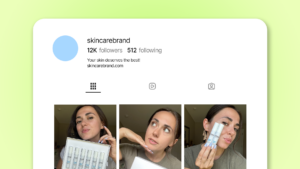
UGC creator example: A skincare brand running conversion ads.
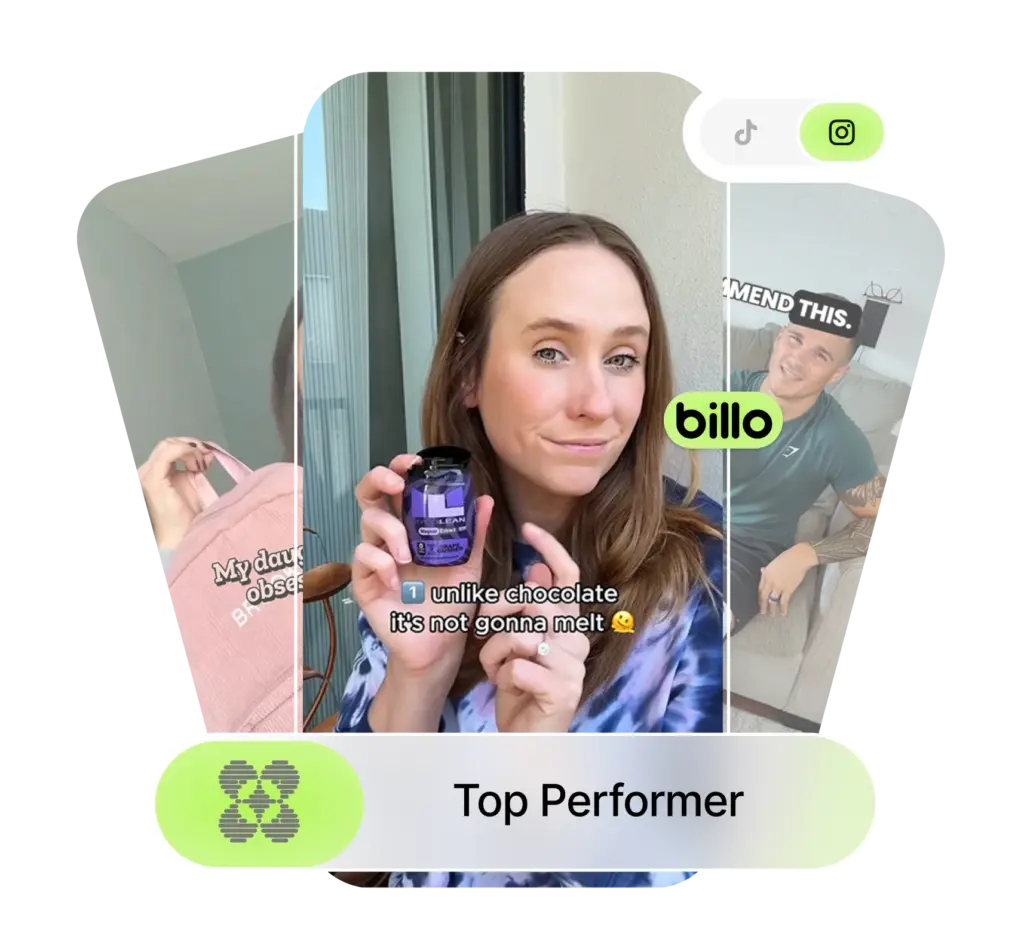
A DTC skincare brand hires a UGC creator through a platform like Billo to film a 30-second “get ready with me” video featuring their new serum. The creator ships back the finished video, the brand’s media buyer loads it into their Meta ad account, and it runs as a paid ad targeting cold and retargeting audiences.
The creator never posts it to their own feed, and their follower count played zero role in the hiring decision. What mattered was their on-camera presence and ability to make the product look natural in a morning routine. For more examples of how brands structure these campaigns, the full breakdown of UGC campaign examples covers everything from hashtag-driven campaigns to direct-response video ads.
Influencer example: Dunkin’ and Charli D’Amelio.
Dunkin’ partnered with TikTok star Charli D’Amelio (151 million followers at the time) to promote a signature drink called “The Charli.” D’Amelio posted the content to her own audience, and the campaign generated over 1.4 million likes and 6,400 shares.
The value came entirely from her reach and the trust her followers had in her recommendations. Dunkin’ was renting access to Charli’s audience, not just buying a video. For 27 more campaigns like this across fashion, tech, wellness, and food, the full collection of influencer marketing examples breaks down what worked and why.
The contrast is clear: the UGC creator produced an asset the brand controls and distributes. The influencer was the distribution channel. Both delivered value, but in completely different ways. To browse thousands of vetted UGC creatorsready to produce content for your brand, Billo’s creator directory is a good starting point.
How To Decide: UGC vs Influencers, or Both?
The right choice depends on what you’re optimizing for right now.
If your primary goal is conversion and ROAS, lean heavily into UGC. It costs less, you own the assets outright, and it consistently drives stronger bottom-funnel performance. Pair it with solid UGC best practices and you have a reliable creative engine.
If your primary goal is awareness and reaching new audiences, invest in influencer partnerships. Nano and micro-influencers offer the best balance of engagement and cost, and their recommendations carry genuine weight within their communities.
If you have the budget for both, run the hybrid playbook. Use influencers at the top of the funnel to generate awareness, then retarget those audiences with UGC creative that drives conversions. Tools like Billo CreativeOps can help you manage this kind of multi-channel creator strategy without losing track of what’s working.
The market is clearly moving toward “both.” The UGC platform market is growing at over 28% annually. The brands that treat these as complementary tools rather than competing options are the ones seeing the best results.
There’s also a newer variant of this decision worth knowing about: some brands are skipping the creator’s personal account altogether and building their own. Canvas UGC describes that brand-owned approach, and it’s worth understanding even if you stick with the traditional model for now.
Summary
UGC creators and influencers serve different functions in a brand’s marketing stack. UGC creators produce content assets that brands own and deploy on their own channels, primarily for conversion. Influencers distribute content to their own audiences, primarily for awareness and trust-building.
The strongest strategies in 2026 use both, matched to the right stage of the funnel. Pair that with AI-generated UGC for rapid creative testing, and you have a complete system for keeping your ad pipeline full and your performance metrics heading in the right direction.
FAQs
Can an influencer also be a UGC creator?
Is UGC cheaper than influencer marketing?
Who owns the content, the creator or the brand?
Should I use AI UGC instead of hiring real creators?

SEO Lead
Passionate content and search marketer aiming to bring great products front and center. When not hunched over my keyboard, you will find me in a city running a race, cycling or simply enjoying my life with a book in hand.
Make creator marketing a data-backed growth channel

Related from Creative Insider
Inside Canvas UGC: the new model for brand-owned social accounts
UGC for Retention Marketing: Same Creators, Different Brief
How to repurpose UGC: turn creator videos into a full-funnel content engine