UGC for beauty & skincare brands: ads that actually convert

Health & Beauty has the highest hook rate of any category in Billo’s dataset: 28.34% vs a 24.42% cross-industry average. Your audience is already primed to engage. The question is – how to make them convert.
TL;DR
- Beauty category ROAS averaged 1.82 in H1 2026, below the 2.17 cross-industry figure and 11th of 14 categories. Strong hooks and clicks aren’t the gap: the gap is post-click, which means creative volume and variant testing matter as much as creative quality.
- The four formats that convert in beauty: before/after transformation, unboxing, routine integration, and ingredient callout.
- The four hooks that earn the first three seconds: skin concern call-out, confessional, visual tension, and bold claim. For real opening lines from H1 2026, see the beauty ad hooks that convert.
- Micro-creators (5K-30K followers, consistent skincare focus) outperform larger creators on ROAS in beauty because their audience self-selected for the category.
- Run three to five creators per product per cycle, across two to three brief variants. That’s the minimum to identify what’s working before scaling spend.
Have you ever looked at your Meta ad performance mid-month and realized your best-performing beauty creative from three weeks ago is quietly dying? The hook rate is sliding, the CTR is dropping, and you know you need something new, but the brief hasn’t gone out yet, the creators haven’t been sourced, and the campaign keeps running on borrowed time.
This is the core challenge in beauty advertising right now. Whether video UGC works is a settled question: it does, and the data is clear. The harder question is producing enough of it, fast enough, to keep pace with how quickly beauty audiences burn through creative.
If you’re managing a health or wellness line alongside your beauty portfolio, the creative approach shares the same foundation, with one key difference around compliance language for supplement or health claim content. The companion guide on UGC for health and wellness brands covers that specifically.
Why beauty creative fatigues faster than most categories
UGC for beauty audiences on Meta and TikTok are highly engaged and highly saturated. They see a large volume of skincare and cosmetics advertising every week, which means your creative window before an ad starts to fatigue is shorter than in most other categories.
The signal is specific: frequency climbs, ROAS starts sliding around week two or three, and CPM inches up as the algorithm finds fewer unconvinced buyers in the audience.
For beauty brands running paid social at scale, where running 10 or more active ads simultaneously is standard, this cycle repeats monthly. A new product launch, a seasonal campaign, a BFCM push: each one creates demand for multiple creative variants, not just one or two hero videos.
What Billo’s data shows about beauty UGC performance
Billo’s analysis of 88,329 Meta video ads from sales campaigns covers H1 2026 performance (January to June) across 14 industries. Health & Beauty sits near the top of the table on hook rate and leads on CTR, but tells a more complex story on ROAS.
| Metric | Health & Beauty | Cross-industry average | What it means for your campaigns |
|---|---|---|---|
| Hook rate | 28.11% | 25.44% | Third of 14 categories and well above average. Your audience is primed to stop on beauty content. So is your competitor’s audience. |
| CTR | 2.36% | 1.93% | Highest of any category. Once the hook lands, the click follows. The top of the funnel is working. |
| ROAS | 1.82 | 2.17 | Below average, 11th of 14, despite the best CTR in the dataset. The gap is post-click: landing pages, offer, how well the creative promise matches what the buyer finds when they arrive. |
The ROAS number is the one most beauty teams overlook. Health & Beauty had the best CTR of the 14 categories and finished 11th on ROAS. It’s the second half in a row where the category wins the click and loses the sale. That combination tells you the creative is doing its job, and the conversion ceiling is set by the full funnel, not just the video. For a media buyer, optimising UGC for hook and CTR is the right starting point. Getting ROAS above 2.17 requires the landing page and offer to match the creative promise.
You can track how Health & Beauty hook rates, CTR, and ROAS shift month by month in Billo’s Creative Insider benchmark data.
The UGC formats that work best for beauty brands
Not all UGC performs equally in beauty. These four formats have the strongest track record for hook rate and conversion because they deliver what beauty buyers are actually looking for: evidence that the product does something real on real skin.
Before/after and skin transformation
This is the highest-intent format in the category. A creator showing a visible change (reduced redness, cleared breakouts, improved texture over two to four weeks) provides proof that no product shot or studio video can match. The viewer’s first question in beauty is always “will this work for someone like me?”, and a genuine transformation from a creator with a relatable skin concern answers it more directly than any other format.
It’s still one of the five patterns in Billo’s top-performing beauty UGC ads from H1 2026.
Unboxing and first impressions
Unboxing content performs strongly for beauty launches and new product introductions because it mirrors the customer’s own first experience. Opening the packaging, reading the ingredients, applying the product for the first time: creators who walk through this naturally are doing conversion work that a landing page cannot replicate.
For skincare specifically, unboxing pairs well with ingredient callout content. A creator who opens a niacinamide serum and immediately explains why she specifically chose that active for her skin type is simultaneously entertaining, educational, and credible.
Routine integration
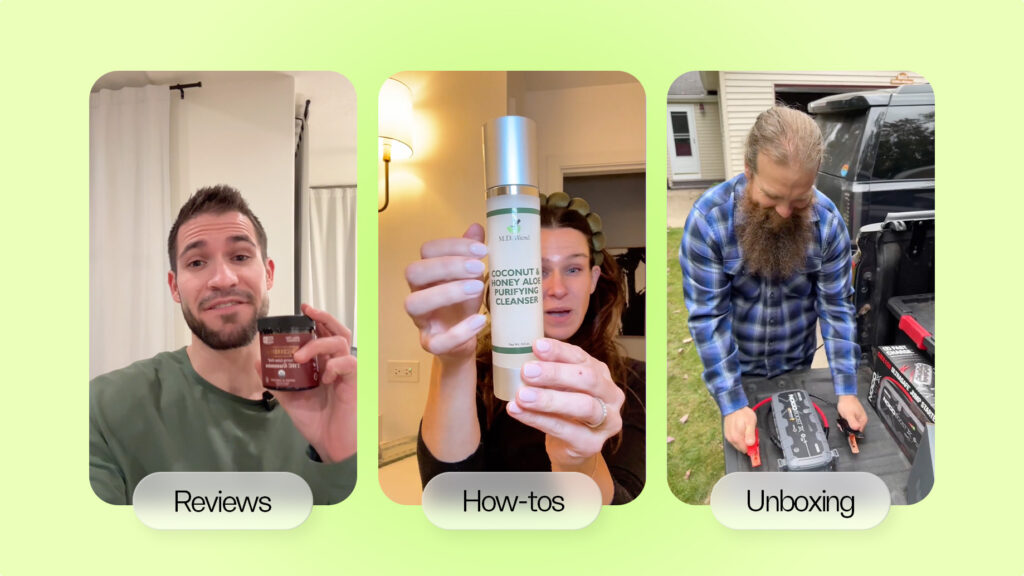
Routine videos place the product in a real context: someone’s actual morning or evening skincare routine, showing where your product fits alongside everything else they use. This format answers a common pre-purchase question (“how does this fit into what I already do?”) and builds familiarity before the click. A warm recommendation inside a routine video from a creator with consistent skincare content carries more weight than a cold review.
Ingredient callout
Ingredient-educated buyers are increasingly common in beauty, driven by years of skincare content on TikTok and YouTube. Creator videos that explain a formulation benefit in plain language, explained genuinely in the creator’s own words rather than read from a product label, signal credibility and speak to buyers who have done their research and want validation before purchasing.
The hooks that earn the first three seconds in beauty UGC
Health & Beauty ranks among the top three categories on hook rate because the products can be showcased visually in the first two seconds: a transformation in progress, a texture change on application, something the viewer has to stay to understand. The question is how to brief those mechanics consistently. Billo’s hook development workbook, built from patterns across 326,000+ video ads, maps 22 hook types to audience personas. Four perform consistently in beauty.
| Hook type | How it works | Example line |
|---|---|---|
| Skin concern call-out | Name the specific concern in the first line, not the category. Specificity signals the creator actually has the problem, not just the product. | “I’ve had hyperpigmentation on my cheeks since I was 16 and nothing has shifted it until this.” |
| Confessional | A before-this-product frame that pre-empts scepticism by acknowledging the viewer’s own experience first. Highest-converting structure for audiences who have already tried things that didn’t work. | “I used to have a 12-step routine because I kept adding things that weren’t working. I’ve replaced six of them with this.” |
| Visual tension | Open with a close-up of the concern before the product appears, or cut mid-application before the reveal. Brief it as: “Show the skin concern directly. Introduce the product after.” | “I’ve been using this every night for three weeks. Here’s what my skin looks like now.” |
| Bold claim | Highest variance, highest ceiling. Brief this only for creators with documented results and let them write the line. A coached bold claim reads as coached. | “I’ve had active acne since I was 13. At 29, this is the first cleanser that’s actually reduced it.” |
Want to see these mechanics in live ads? Billo’s breakdown of beauty ad hooks that convert pulls the top opening lines from H1 2026. It also flags a trap worth knowing: some of the highest hook rates in the set barely broke even, because the hook reached too broadly.
How to brief beauty creators so assets come back right
Briefs are where most beauty UGC campaigns lose time. A brief that is either too rigid or too vague creates the same outcome: assets that come back off-angle, require rework rounds, and delay campaigns. For a creative manager or brand lead responsible for keeping the pipeline full, a failed brief round wastes budget and costs launch timing.
A brief that produces usable beauty UGC on the first pass covers:
- The one message you want the viewer to take away: a single skin concern addressed, a single product benefit demonstrated, not a list of features
- The specific use case or skin type the product targets, so creators can genuinely represent it rather than pretend
- What to show (application technique, texture on skin, packaging close-up) without scripting what to say
- Any hard restrictions: claims that cannot be made, ingredients to avoid mentioning for regulatory reasons, required brand language
- The exact offer line to say, such as the bundle value, the discount and the real deadline. In Billo’s H1 2026 beauty ad data, a dollar value plus a deadline was the most repeated close. ‘Shop the sale’ didn’t make the list.
- Tone direction: aspirational, raw and relatable, or educational? Each produces different content; the brief should be explicit
What to leave out: word counts, line-by-line scripts, requirements to mention the brand name in the first three seconds. Creators know how to make engaging content. The brief’s job is to give them the product context and direction they need to make content that converts, without scripting the authenticity out of it.
Choosing creators for beauty and skincare
Creator selection in beauty is more consequential than in most other categories because the product is applied to skin. Relevance (skin type, concern, and tone) directly affects whether the target audience trusts the review.
When building your creator pool for beauty campaigns, prioritise:
- Skin type match: a creator with oily skin reviewing a mattifying serum will always outperform a creator without that concern, because viewers with the same issue will trust their experience
- Diversity in skin tones, ages, and concerns: beauty audiences are acutely aware of whose skin is being shown, and campaigns representing only one profile will read as narrow regardless of how good the creative is
- Category experience: a creator who regularly posts skincare content has an audience with active purchase intent in the category, which makes their recommendation carry more weight than a lifestyle creator branching into beauty for one post
Getting the volume your beauty campaigns need
The brief, the format, and the creator pool are the three inputs. But the question that ultimately drives performance for scaling beauty brands (and the agencies managing their ad accounts) is whether you can generate enough creative variants to keep testing.
Beauty brands that use Billo effectively typically run three to five creators per product per campaign cycle, across two or three brief variants. That gives you enough creative diversity to identify which angle, format, and creator type performs best before you scale spend, rather than doubling down on a single asset and hoping it holds.
For multi-brand operators or agencies managing several beauty client accounts simultaneously, the same structure applies across brands. The briefing workflow, creator roster, and review process can be standardised, so each new campaign doesn’t start from scratch.
If your current beauty creative is three or more weeks old and you’re watching performance slide, that’s the signal. The pipeline needs refreshing before the campaign does. Browse Billo’s beauty creator pool to see who’s available in your category.
FAQs
How many UGC creators do I need for a beauty campaign?
What’s the difference between beauty UGC and influencer marketing?
How do I make sure UGC creators stay on-brand?
Do beauty UGC ads work for premium or high-price-point products?
When should I refresh my beauty UGC creative?

SEO Lead
Passionate content and search marketer aiming to bring great products front and center. When not hunched over my keyboard, you will find me in a city running a race, cycling or simply enjoying my life with a book in hand.
Make creator marketing a data-backed growth channel

Related from Creative Insider
Billo vs SideShift: a side-by-side comparison
Billo vs Influee: a side-by-side comparison
Best Cohley alternatives: 6 platforms compared for 2026