AI UGC generators: top tools compared, opportunities & limitations


If you’re evaluating AI UGC generators right now, you’ve probably already seen the pitch: videos in minutes, synthetic avatars instead of actors, dozens of creative variations at a fraction of a real shoot’s cost. The economics make sense, especially when ad creative lifespan on TikTok has shrunk to 7 to 14 days and creative fatigue can cut conversion rates by 30 to 40%.
But in 2026, the question is no longer whether these tools work. It’s when they stop working, and what the trust and compliance costs look like when you rely on them exclusively.
TL;DR
- AI UGC generators (both avatar-based and text-to-video) are cost-effective for creative volume testing, localization, and top-of-funnel awareness.
- They fall short on trust, brand voice consistency, and high-consideration categories (health and wellness, skincare, apparel) where real social proof is a conversion requirement.
- Tools covered: Arcads (best for Meta/TikTok paid social), Creatify (best for ecommerce volume), HeyGen (best for multilingual campaigns), and Higgsfield (text-to-video specialist).
- Starting June 2026, AI-generated performers in ads require legal disclosure under the US and EU law, adding a compliance cost to any pure-AI creative strategy.
- The best-performing playbook: use AI to test hooks and angles at volume, then invest in human creators to scale the winners.
- Billo’s model: human-first, AI-assisted. Real creators by default; AI where the use case genuinely fits.
How AI UGC generators work
AI UGC generators produce user-generated content (UGC)-style video, covering product reviews, testimonials, unboxings, and talking-head ads, all without a real creator in front of a camera. The output is designed to look native inside social feeds on Meta, TikTok, and YouTube. Two distinct formats have emerged, and they serve different creative purposes.
Avatar-based generation uses a synthetic presenter to deliver a script on camera, mimicking the classic talking-head UGC format. You feed the platform a script (or let it generate one), select an avatar, and receive a lip-synced video in minutes.
Text-to-video generation works differently: full scenes are built from a prompt, combining motion-heavy product visuals, lifestyle shots, and dynamic hooks, with no human face required.
Popular AI UGC generators compared:
| Tool | Best For | Starting Price | Standout Feature |
|---|---|---|---|
| Arcads | Meta/TikTok paid social | $100/mo | Most realistic avatar expressions and gestures |
| Creatify | Avatar demographic testing | $33/mo | Batch same script across 500+ avatar identities |
| HeyGen | Multilingual campaigns | $24/mo (annual) | 175+ languages with voice cloning |
| Higgsfield | Text-to-video specialist | See site | Seedance 2.0 physics-aware motion, no avatar required |
Here is each tool in more detail:
Arcads
Priced from $100/month. Is purpose-built for Meta and TikTok ad formats, with scripts structured around hook, value proposition, and CTA. Its avatar delivery is among the more natural-looking in the category for short-form ad formats, which makes it useful for validating which angles resonate with an audience before committing real creator budget.
Creatify
Priced from $33/month is built for high-volume creative hypothesis testing. Its batch mode lets you run the same script across dozens of different avatar identities simultaneously, so you can test which presenter demographic (age, ethnicity, energy level) resonates with a specific audience before investing in real creator production.
HeyGen
Priced from $24/month, billed annually. Leads on realism and multilingual output: 175-plus languages, voice cloning, and the highest lip-sync accuracy in the category. It’s the right tool for brands that need a consistent spokesperson across markets without reshooting.
Higgsfield
Priced on request. Is the specialist pick if your primary need is text-to-video or cinematic product formats rather than avatar-based talking-head ads. Its Marketing Studio uses Seedance 2.0, ByteDance’s multimodal video generation model, to generate motion, audio, and speech in a single pass with native lip-sync and physics-aware movement. The UGC Factory feature handles consistent character identity across shots, which makes it a different category of tool from Arcads or Creatify rather than a direct alternative to them.
Imagine you’re a media buyer at a DTC wellness brand about to launch a new product. With any of these tools, you can go from a product brief to 20 testable video variations in an afternoon, with no casting, no shoot, and no editing queue. That speed is the core value proposition. The question is what you give up for it.
What UGC AI generators are genuinely good at
The strongest case for AI UGC generators is volume testing. Performance teams running paid social at scale need a minimum of 8 to 12 new creative variants per month per platform just to stay ahead of fatigue. Meta’s Advantage+ Shopping Campaigns recommend up to 150 assets per ad set for maximum testing coverage. At $2 to $10 per AI-generated asset versus $150 to $212 for a human creator video, the economics of creative iteration change completely.
The smartest workflow uses AI to validate which hooks, angles, and script structures actually convert, then invests real creator budget only in the proven winners. Brands running this approach have documented CAC reductions of 29 to 30% by out-testing the competition rather than outspending them.
Imagine you’re running Meta ads for a skincare brand. You have five hypotheses about what’s driving purchase intent: ingredient education, before-and-after framing, routine fit, price anchoring, and dermatologist credibility. Testing all five with human creators costs $750 to $1,000 and takes two weeks. Testing all five with AI costs under $50 and takes an afternoon. You find the winner, then brief a real creator on exactly that angle.
AI UGC also performs well in two other specific scenarios:
- Localization at scale. HeyGen’s voice cloning and 40-plus language support lets brands adapt a single creative for multiple markets in minutes, with no new shoot, no new casting, and consistent messaging across all of them.
- Top-of-funnel cold-audience awareness. For initial hypothesis testing against audiences who haven’t seen your brand before, AI UGC achieves 85 to 110% of the click-through rate of well-performing traditional UGC at 70 to 90% lower production cost. Strong enough to find signal, but not yet strong enough to close the sale.
The pattern emerging across high-performing DTC accounts is consistent: AI for top-of-funnel testing, human creators for conversion-stage content where trust actually closes the deal.
Where AI generators fall short
Brand voice consistency
The most common tell in AI UGC has nothing to do with the avatar’s face. It’s the script. AI-written copy defaults to perfect grammar, no contractions, and zero filler words, a pattern audiences increasingly recognize as synthetic even when they can’t articulate why. Maintaining a distinctive brand voice across campaigns requires human editorial input on every script. The tool itself can’t hold a brand’s personality.
Avatar reuse creates a second consistency problem. The same synthetic faces are shared across platforms and tools, which means your audience may have already seen your “exclusive” spokesperson in a competitor’s ad. At scale, this erodes the authenticity signal you were trying to create in the first place.

Trust and consumer perception
46% of consumers are uncomfortable with brands using AI creators, and 48% say AI content feels less trustworthy than human-created content. What makes this harder to manage is the disclosure paradox: research shows that disclosing AI use actually worsens the trust penalty rather than neutralising it. You carry the risk whether or not you tell people.
Regulated and high-trust categories
This is where the risk sharpens considerably. Health, wellness, and supplement brands face a compounded problem. Beyond the general AI disclosure rules, the FTC requires that testimonials reflect the honest opinion of a real person who has actually used the product. 2026 is shaping up to be the FTC’s most active year for health claims enforcement, and an AI avatar making product health claims satisfies neither the testimonial standard nor the disclosure requirement simultaneously.
Skincare and apparel carry similar limitations, though for different reasons. Buyers in these categories want to see real skin texture, real fit, and real lifestyle context. An avatar cannot provide embodied proof, and no matter how realistic the generation quality becomes, the content is missing the one thing that drives conversion in these verticals: a real person’s real experience.
The compliance cost of pure AI UGC
Three regulatory deadlines are converging in 2026, and all three target AI-generated people in advertising. If your creative strategy relies heavily on synthetic avatars, compliance is no longer a legal team problem; it’s a media buying problem.
New York’s Synthetic Performer Disclosure Law (effective June 9, 2026)
Any ad shown to New York audiences featuring an AI-generated human performer requires conspicuous disclosure. The law applies regardless of where your brand or agency is based. Penalties are $1,000 for a first violation and $5,000 for each subsequent one. In practice, most brands are implementing a visible “AI-generated” label in a corner overlay, sized to remain readable across every aspect ratio: 1:1, 4:5, and 9:16.
FTC enforcement (2026)
The FTC launched a dedicated AI enforcement unit in January 2026. The maximum penalty is $53,088 per violation, and each post counts as a separate violation. A 100-post campaign theoretically carries more than $5 million in exposure. The FTC’s trigger is not how much human editing followed the AI generation; it’s whether a reasonable consumer would interpret the content as a genuine human review or testimonial.

EU AI Act Article 50 (effective August 2, 2026)
AI-generated video testimonials must carry visible disclosure and machine-readable metadata. Critically, the brand is legally responsible for compliance, not the tool vendor. If you’re running ads to European audiences and your AI UGC isn’t properly labelled, the liability sits with you.
What this means practically
Agencies need to confirm that any third-party creative partners are disclosing AI use and including the required labels before ads go live. This adds a QA step to every campaign that uses AI-generated performers, and it’s a step that applies retroactively to ads already in rotation.
For a full decision table comparing human UGC, AI UGC, and hybrid approaches by compliance risk and cost, this UGC AI compliance guide includes a Q3/Q4 audit checklist built around these three regulatory frameworks.
Human vs. synthetic – what the performance data actually shows
The performance comparison between AI and human UGC is more nuanced than most tool vendors present it. The headline numbers for AI look strong, but they depend heavily on what you’re measuring and at which stage of the funnel you’re looking.
At the click level, AI UGC is genuinely competitive. Field data shows AI-generated content achieves 85 to 110% of the click-through rate of well-performing traditional UGC. For cold-audience top-of-funnel testing, that’s close enough to make AI a rational choice for initial creative validation.
At the conversion level, the gap widens in favour of human creators. Real user-generated content drove 6.73x higher conversions compared to non-UGC content in Q1 2026, with the gap growing quarter over quarter. Emplifi’s benchmark puts authentic UGC at 10x higher conversion rates than brand-created content. AI UGC wins on volume metrics: CTR, views, and immediate engagement. Human UGC wins on quality metrics: purchase influence, trust, and lifetime value.
A 2026 AI generated ads study that tested 20 real brand ads head-to-head found the same pattern at the creative-effectiveness level, not just conversion, with human-made ads outscoring AI-generated ones by 14 to 17 percentage points depending on the metric.
Imagine you’re a media buyer managing a DTC supplement account. AI-generated ads are generating strong click-through rates at the top of funnel, but when the same audience hits the product page, conversion is lagging. The content got the click; it didn’t close the sale. That’s the pattern that emerges consistently when AI UGC is used all the way down the funnel rather than as a testing layer.
When to use human creators instead
The categories where human creators consistently outperform AI aren’t arbitrary; they share a common characteristic. The purchase decision depends on social proof from a real person, not just product information delivered by a convincing avatar.
Health, wellness, and supplements
This is the highest-risk category for AI UGC and the clearest case for defaulting to human creators. The FTC requires that testimonials reflect the genuine opinion of a real person who has actually used the product. A standard an AI avatar cannot meet by definition.
For supplement and wellness brands, using AI-generated testimonials for any claim-based creative is both a trust risk and a compliance exposure that sits on top of the AI disclosure requirements already discussed. Human creators are the safe default for this category, and AI is only appropriate for brand awareness formats that make zero product claims.
Skincare and beauty
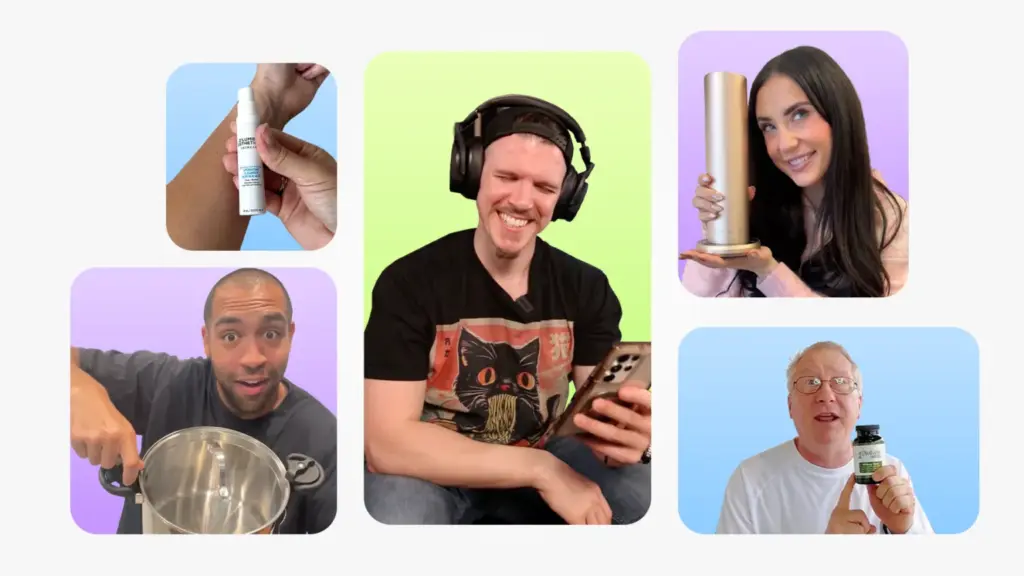
70% of beauty shoppers research reviews before purchasing. What they’re looking for is embodied proof: real skin texture, real absorption, real before-and-after results. An avatar cannot provide that.
Skincare UGC also commands 20 to 40% higher creator rates than general lifestyle content, precisely because the content has a longer shelf life. A well-produced human creator video for a skincare product can run profitably for months, making the higher upfront cost easy to justify.
Apparel and fashion
Fit, drape, and movement cannot be faked by a synthetic presenter. Apparel buyers need to see how a product sits on a real body in a real context, and the try-on and outfit-of-the-day formats that drive conversion in this vertical are fundamentally dependent on human presence.
Community building and long-term brand equity
92% of consumers trust peer recommendations over brand content, and 79% say authentic UGC influences their purchasing decisions. Beyond the conversion data, human creators bring niche audiences, genuine relationships, and organic reach that no AI tool replicates. If you’re building a brand that depends on community and not just customer acquisition, real creators are doing work that AI simply cannot.
The simplest rule: if the conversion depends on a consumer believing a real person had a real experience, use a real person.
Billo’s approach – human-first, AI-assisted
Billo’s default is real, vetted creators. That’s a deliberate choice.
The categories that matter most to performance marketers, including health and beauty, wellness, apparel, and skincare, are exactly the categories where authentic human social proof drives conversion and where AI-generated content carries the highest compliance and trust risk. Building the platform around human creators first means the content that comes out of Billo is compliant by default, not by exception.
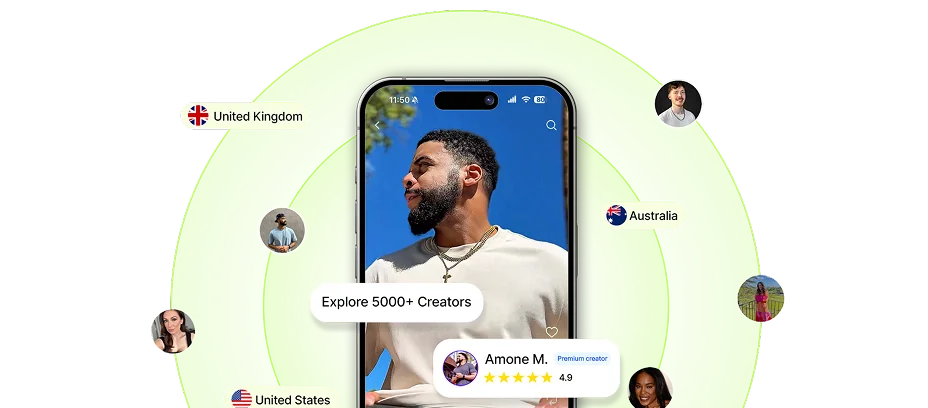
CreativeOps AI tooling sits alongside Billo’s creator network as a testing layer. The workflow that consistently performs is using AI-generated variations to validate hooks and angles at volume, identifying what resonates with a specific audience, then briefing real creators on the winning concept. You get the speed and cost efficiency of AI at the hypothesis stage, and the conversion quality of human creators at the scale stage.
Summary & next steps
AI UGC generators have earned a place in a performance marketer’s toolkit, though a specific one. They’re genuinely strong for creative volume testing, localization, and top-of-funnel awareness where speed and iteration matter more than emotional depth.
The limitations are just as real. Brand voice consistency requires human editorial input that most tools can’t provide. High-consideration categories (health and wellness, skincare, and apparel) depend on embodied social proof that AI avatars can’t replicate. And in 2026, a tightening regulatory environment has added disclosure obligations and legal penalties that make pure-AI creative strategies genuinely risky to run at scale without proper compliance processes in place.
Which tools will be the best choice for your campaigns will depend on the liabilities you decide to take on.
FAQs
Do I need to disclose AI-generated ads?
Will consumers know it’s AI?
Which is cheaper long-term – AI or human UGC?
Is AI UGC against platform rules?
Which AI UGC generator is best for ecommerce brands?

SEO Lead
Passionate content and search marketer aiming to bring great products front and center. When not hunched over my keyboard, you will find me in a city running a race, cycling or simply enjoying my life with a book in hand.
Make creator marketing a data-backed growth channel

Related from Creative Insider
Billo vs SideShift: a side-by-side comparison
Billo vs Influee: a side-by-side comparison
Best Cohley alternatives: 6 platforms compared for 2026