Billo vs Insense: a detailed guide for choosing the right UGC platform for your brand

Billo and Insense are two of the more widely used platforms in the creator marketing space, but they’re built around different approaches. Billo combines a creator marketplace with a performance data layer, offering video production alongside tools to guide briefs, creator selection, and scaling decisions. Insense is a creator marketplace that connects brands with influencers and UGC creators to produce content for organic and paid campaigns across TikTok, Instagram, and Facebook.
TL;DR
- Billo is built around paid video ads. Videos start from $99 each, bought as packs, with no subscription. CreativeOps benchmarks your ads on hook rate, CTR and ROAS.
- Insense is built around running a creator program. One subscription covers UGC, influencer posts, product seeding, affiliate and TikTok Shop, with creator payments billed on top.
- Both let you run ads from the creator’s handle. Billo supports Meta Partnership Ads and TikTok Spark Ads with creators who offer them. Insense offers Meta Partnership Ads with one-click requests for account-level access from eligible creators.
- Pricing works differently. Billo charges per video, and each creator sets their own price for organic posting and Partnership Ads. Insense charges $400-$650 a month depending on plan and billing, plus creator payments and a 7-20% fee on each creator payment.
- Choose Billo if most of your creator content ends up as paid ads and you want to pay per video. Choose Insense if you manage ongoing creator relationships across several channels, need creators in more countries, or run several brands as an agency.
Billo and Insense both connect brands with creators for UGC, but they’re built for different jobs. Insense focuses on flexible creator sourcing across a range of use cases, from product seeding to affiliate and TikTok Shop campaigns. Billo’s approach centers on a two-component system: Partnerships Hub for creator production and partnerships, and CreativeOps, a data engine trained on 1.41M active ads analysed and $2.5B purchase value, designed to take the guesswork out of creative decisions.
So which one fits your brand? That depends on what you’re optimizing for. This guide breaks down the differences in features, pricing, workflow, and analytics so you can make a clear, informed comparison.
Billo vs Insense: at a glance
| Billo | Insense | |
|---|---|---|
| Best for | Performance video you intend to run as a paid ad on Meta and TikTok | Running influencer relationships, affiliate and TikTok Shop alongside your UGC |
| Ads from the creator’s handle | Yes, with creators who offer it. Meta Partnership Ads at content level (ad code) or account level (no public post needed), plus TikTok Spark Ads | Yes. Meta Partnership Ads, with one-click requests for account-level access from eligible creators |
| Performance data | CreativeOps: hook rate, CTR and ROAS benchmarks for your ads | Performance tracking as part of campaign management |
| Pricing | From $99 per video, bought as packs. Organic posting and Partnership Ads priced separately by each creator, with no minimum | From $400/month billed annually, $500/month billed quarterly, or $650 for a one-month trial, plus creator payments and a fee on each creator payment: 20% (Trial), 10% (Brand) or 7% (Agency) |
| Commitment | None. No subscriptions or contracts, and your balance stays valid for 12 months. Full refund if you don’t find the right creator | Quarterly or annual billing on Brand and Agency; the monthly trial rolls into the quarterly Brand plan after one month. Extra seats $30/month, extra brands $100/month |
| Creator network | 5,000+ vetted creators in the US, Canada and the UK, matched to your brief | 100k+ creators across 35+ countries, with self-serve filtering |
| Content types | Short-form video ads, testimonials, unboxings, demos, plus organic posting | UGC, influencer posts, product seeding, affiliate campaigns, TikTok Shop |
| Setup | Self-serve. Videos delivered within 7 days of the creator receiving your product or brief | Self-serve campaigns, plus managed services with pricing on request |
Checked 9 October 2026.
Pricing breakdown: which platform fits your budget?
Billo and Insense take very different approaches to pricing. Billo is straightforward and pay-as-you-go, while Insense operates on a subscription model with creator costs and fees on top.
Billo pricing
Billo is pay-as-you-go, with no subscriptions or contracts. Videos start at $99. You buy a pack, which loads your Billo balance, and order videos from it as you need them.
Your balance is valid for 12 months from purchase. Packs don’t renew automatically, so you top up when you need more videos. Each creator prices organic posting and Partnership Ads separately, with no minimum, and CreativeOps is an optional add-on. If you don’t find the right creator, you get a full refund. Current packs are on the Billo pricing page.
Insense pricing
Insense runs on a subscription, and creator payments are billed separately. Each creator payment carries one marketplace fee, set by your plan: 20% on Trial, 10% on Brand and 7% on Agency. Insense says the fee covers payment facilitation and a service fee.
- Trial: $650 for one month, with 1 campaign and up to 10 creators. It upgrades to the Brand plan, billed quarterly, unless you cancel at least 48 hours before the trial ends.
- Brand: $500/month billed quarterly ($1,500 a quarter) or $400/month billed annually. Unlimited campaigns and creators for 1 brand, 2 user seats, with product seeding, affiliate and TikTok Shop included.
- Agency: $800/month billed quarterly ($2,400 a quarter) or $640/month billed annually. Up to 5 brands, 4 user seats and unlimited Meta Partnership Ads connections.
- Add-ons: $30/month per extra seat and $100/month per extra brand.
- Managed services: priced separately, after a demo call.
Plans billed quarterly renew automatically every three months. (Insense pricing page, checked 9 October 2026)
User experience and interface
Billo
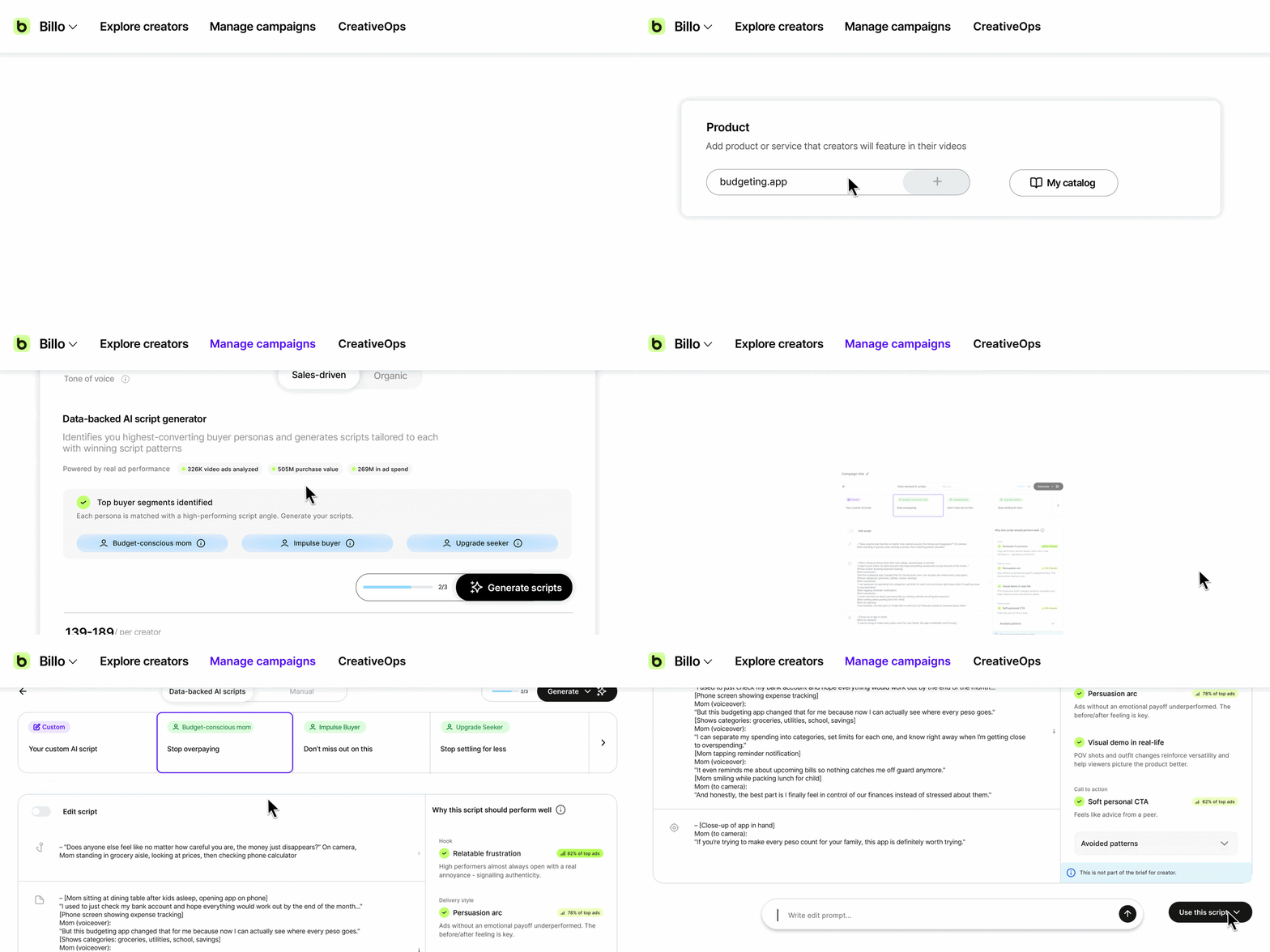
Billo is built for speed and simplicity. Onboarding is fast: brands generate a data-backed brief, get matched with vetted creators, manage revisions, and track performance all in one place. Campaigns can be launched in hours rather than weeks.
Brands can specify platform goals (TikTok, Meta, YouTube, Amazon), creative formats, and ad specs such as length and aspect ratio. From there, Billo surfaces creators matched not just on style but on historical performance in that niche. Communication between brands and creators happens inside the platform on a single timeline, covering briefing, feedback, revisions, and approvals.
CreativeOps adds a performance layer on top of the workflow. After campaigns run, brands see results benchmarked against category averages, with clear recommendations on what to scale or cut. The Ad Variations feature lets brands generate new cuts from existing footage using patterns from current top performers, extending the life of strong creative without ordering new production.
Insense
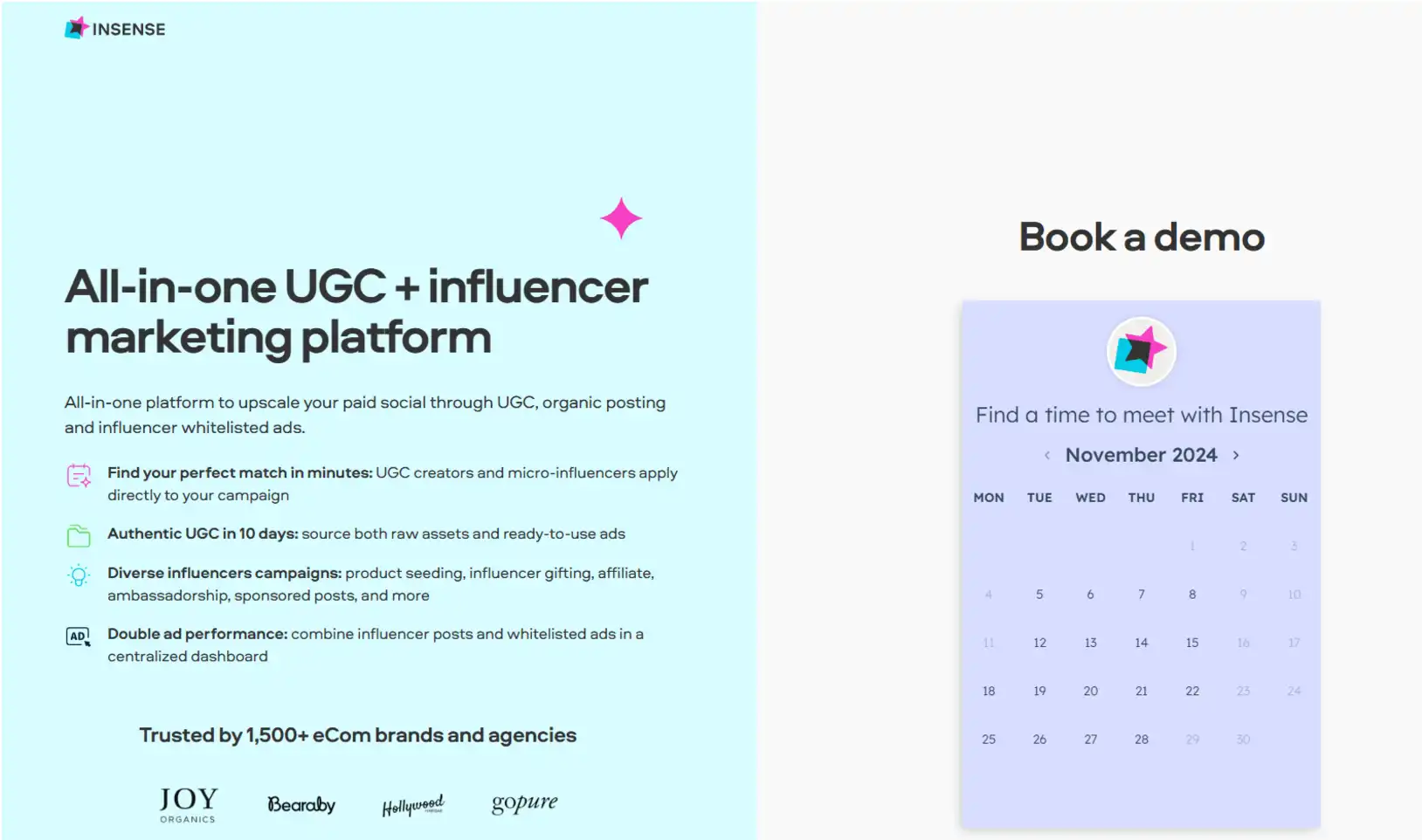
Insense is a more feature-rich platform, designed to support a wider range of campaign types and team structures. The interface includes detailed creator filters (gender, location, category, follower count, hashtags), multi-format content approvals, and an integrated content library for storing and repurposing assets.
Onboarding involves more steps, and the platform is better suited to teams with dedicated marketing operations capacity. Communication follows a structured submission-and-approval process, which works well for enterprise-scale programs but can feel heavy for smaller teams running one or two campaigns at a time.
On the analytics side, Insense provides audience and demographic insights tied to influencer campaigns. This is useful for brands evaluating reach and brand fit, though it offers less direct guidance on paid ad performance metrics like ROAS or Hook Rate compared to Billo’s CreativeOps dashboards.
Can you run ads from the creator’s handle with Billo?
Yes. Billo supports creator-handle ads, often called whitelisting, with any creator who offers the service:
- Meta Partnership Ads, account level: with your Meta Business account connected to Billo, the creator approves a connection request and you can run any approved video from their handle. No public post is needed. Setup is in account-level permissions.
- Meta Partnership Ads, content level: the creator posts the video and shares an ad code, which you run from Ads Manager. The steps are in promoting creator content on Instagram and Meta.
- TikTok Spark Ads: the creator posts and shares a Spark Ads code for TikTok Ads Manager, as described in what Spark Ads are and why to use them.
Select organic posting or Partnership Ads when you create the campaign. Ad permissions last 30 days and can be extended. Each creator prices the video, the organic post and Partnership Ads separately, with no minimum, so you only pay for creator-handle ads on the campaigns where you use them. Our guide to whitelisting on social media covers how it works across platforms.
Billo vs Insense: which is best for your business?
The right platform depends on your business type, team capacity, and what you need creator content to do. Here’s how each platform maps to common use cases.
| Use case | Billo | Insense |
|---|---|---|
| Ecommerce and DTC | Strong fit for brands scaling paid video ads on TikTok and Meta. CreativeOps analytics help identify and double down on winning creative. Adore Me: CTR +15%, CPA -8%. Pineapple Products: ROI +10.75%, conversions +5%. | Better fit for brands needing format variety alongside standard UGC: product seeding, influencer posts, affiliate, and TikTok Shop. Bones Coffee: $25K+ revenue and 2.16 ROAS from 16 video assets. Nurture Life: full campaign delivered in under 2 weeks. |
| Agencies | Suits performance agencies that need a scalable, data-backed creative pipeline across client accounts. Intelligence Media: 120% increase in sales and 200% increase in net profit in 2 months. | Agency plan covers up to 5 brands, unlimited campaigns, and a 7% marketplace fee. Well suited to agencies managing influencer campaigns across a broader client mix. Easy A Media: 100+ creators, hundreds of assets in 45 days. |
| Apps and digital products | Strong for cost-efficient install campaigns on Meta and TikTok with authentic creator-led video. Brickster/Chatster app: CPI fell 500%, CPA dropped 2.5x, Facebook ad spend scaled 600%. | Good for matching creators to specific user demographics and product profiles. Zing Coach: CPA reduced by over 25% after sourcing 20+ matched creators. |
| Amazon sellers | Supports Amazon sellers via paid social driving traffic to product listings. Less Amazon-native but effective as a top-of-funnel channel for brands using TikTok or Meta to drive discovery. | Proven track record using TikTok Spark Ads to boost Amazon product searches and brand visibility. Malouf: Amazon product and brand searches increased over 100%, achieving its lowest cost-per-impression ever. |
| Brick and mortar / local | Creator network spans the US, Canada and the UK. Workflow is optimised for digital-first paid media rather than hyperlocal influencer sourcing. | Specific experience sourcing local influencers by city for in-person brands. Postino Wine Cafe: creators sourced across Houston, Dallas, Atlanta, and beyond – content received in under 2.5 weeks. |
Is Insense worth it?
Insense is worth it if you’re running a creator program: ongoing partnerships, product seeding, affiliate and TikTok Shop, or creators across many countries, managed from one dashboard.
If you mainly need ad creative, the numbers look different. Insense starts at $400 a month billed annually or $500 a month billed quarterly, before creator payments, and adds a 7-20% fee to each creator payment depending on plan (Insense pricing page, checked 9 October 2026). Billo videos start at $99, with no monthly fee in months you don’t order.
At 40 or 50 videos a month the subscription matters less, and the choice comes down to workflow and data. CreativeOps benchmarks your ads on hook rate, CTR and ROAS, and Billo’s internal analysis of brand-connected Meta ad accounts (January 2025 to August 2026) shows Billo video ads had about 25% higher CTR than the other video ads in the same accounts.
For a wider field than this head-to-head, we’ve compared the main options in Top 5 Insense alternatives to try out this year.
The verdict: how to choose between Billo and Insense
Both platforms will get you creator video. The question is what happens to it next.
Choose Billo if
- Most of your creator content ends up as a paid ad on Meta or TikTok
- You want performance data on the creative (hook rate, CTR, ROAS) as well as the files
- You want to run ads from the creator’s handle without a platform subscription
- You’d rather pay per video than commit to a quarter, so your spend tracks your testing volume
- Your creators should be in the US, Canada or the UK
Choose Insense if
- Your creator program is a relationship program, with ongoing partnerships, product seeding, affiliate and TikTok Shop, and ad creative is one output among several
- You need creators across more countries than the US, Canada and the UK
- You’re an agency running several brands from one dashboard and want the seat and brand-slot structure that comes with it
If you’re not sure, start with what you’re buying. Buying creative? That’s Billo, and you can add creator-handle ads on the campaigns where they earn their place. Buying a creator program to run for the next year? Insense is built for that, and the subscription is the price of the infrastructure.
FAQs
Is Billo only for organic content?
Can you run Spark Ads or Partnership Ads with Billo content?
Which is cheaper, Billo or Insense?
Do I have to commit to a subscription with Billo?

SEO Lead
Passionate content and search marketer aiming to bring great products front and center. When not hunched over my keyboard, you will find me in a city running a race, cycling or simply enjoying my life with a book in hand.
Make creator marketing a data-backed growth channel

Related from Creative Insider
Billo vs SideShift: a side-by-side comparison
Billo vs Influee: a side-by-side comparison
Best Cohley alternatives: 6 platforms compared for 2026