How Many Ad Creatives Do You Need? 2026 Benchmarks for DTC Brands

Only about 6% of ads capture the majority of spend in any account. Volume is how you find winners. During seasonal peaks like BFCM, plan for 2 to 3 times your normal cadence.
Your best ad from last month now costs 30% more per conversion. The backup you launched two weeks ago already looks tired. Sound familiar? The question every media buyer lands on next is how many ad creatives do you need to stay ahead of fatigue and keep scaling.
This post answers that with real data from two benchmark reports covering a combined $3.7 billion in ad spend, broken down by budget tier and platform. It’s written for teams running paid social as part of their DTC marketing.
TL;DR:
| Budget Tier | Monthly Ad Spend | New Creatives/Week | New Creatives/Month | Refresh Cadence |
|---|---|---|---|---|
| Starter | $5K – $15K | 3 – 5 | 12 – 20 | Every 3 – 4 weeks |
| Growth | $15K – $50K | 8 – 15 | 32 – 60 | Every 2 – 3 weeks |
| Scale | $50K – $150K+ | 20 – 30+ | 80 – 120+ | Every 1 – 2 weeks |
Why You Need More Creatives Than You Think
Creative fatigue is likely why you are reading this.
The most reliable early signal is your conversion rate declining while impressions stay stable. That pattern usually appears before your click-through rate starts dropping, which means by the time CTR falls off, fatigue has already been costing you conversions for days or weeks. Beyond that, watch for a CTR decline of 20% to 30% from your campaign’s peak, frequency climbing past 3 to 4, and rising CPMs that signal your ad is losing auction competitiveness as engagement weakens.
Meta flags it directly in Ads Manager with “Creative limited” or “Creative fatigue” delivery labels.
One pattern worth noting: beauty and wellness brands tend to hit fatigue faster than apparel brands. That is because their audiences are more narrowly targeted, which means more overlap between ad sets. Billo’s internal analysis of 150,000+ video ads confirms this. The higher the audience overlap, the faster creative wears out.
The refresh benchmarks are straightforward: every 2 to 4 weeks on Meta, weekly on TikTok. Replace your creative when frequency exceeds 4.0 or CTR drops more than 20% over a two-week window, whichever hits first. And don’t rely on CTR alone. Tracking hook rate and hold rate alongside CTR gives you a much clearer picture of where exactly your creative starts losing people.
How Many Ad Creatives Do You Need by Budget Tier
Now that you know what fatigue looks like and when to act on it, the next question is how many creatives you need to sustain that refresh cadence without running dry.
These benchmarks draw from two major reports: the AppsFlyer 2025 State of Creative Optimization report (1.1 million video variations, $2.4 billion in spend) and the Motion Creative Benchmarks 2026 report (550,000+ ads, 6,000+ advertisers, $1.3 billion in spend). The pattern across both: only 6% of ads drive the majority of spend, roughly half receive zero or minimal spend, and for every 10 creatives tested, 1 to 3 become strong winners. The rest help the algorithm learn.
Volume matters beyond the ad account, too. When launch volume drops, fewer new winners surface and blended efficiency follows a few months later. It’s one of the first things to check when your marketing efficiency ratio starts to slip.
Knowing which ads qualify as winners is where creative analytics becomes essential.
Starter ($5K–$15K/month)
At this spend level, plan to test 3 to 5 new creatives per week. Focused on distinct angles rather than variations of the same idea. Strategic diversity matters more than raw volume.
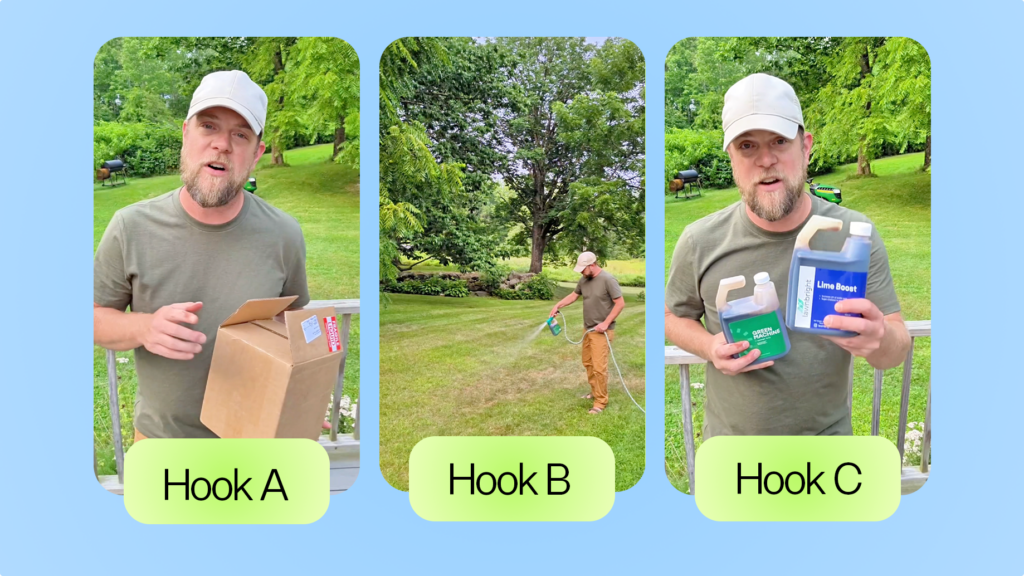
Prioritize testing different formats (testimonial vs. product demo vs. problem-solution) and different hooks, since AppsFlyer’s data shows the top 2% of creatives capture 43 to 53% of all ad spend. This means your first priority is finding what resonates before scaling production.
Growth ($15K–$50K/month)
This is where creative volume becomes a real growth lever for most DTC brands. A study of over 200 DTC accounts found that brands producing 30+ new creatives per month scale 3 times faster than those producing fewer than 10. At this tier, plan for 8 to 15 new creatives per week.
For health and beauty brands, an analysis across beauty accounts found a useful ratio: roughly 1 new ad for every $3,000 in monthly Meta spend. For beauty brands specifically, Billo’s data shows ROAS starting to slide at weeks two to three – here’s how to structure your refresh cadence and creative volume for beauty.But volume without diversity is a trap. Brands producing 100+ ads that all look the same still fail to scale. The goal is variety across hooks, formats, angles, and creator voices.
To put this in practice: a DTC wellness brand on Billo can easily go from producing 8 creatives per month to 45 by shifting to a brief-to-variation workflow. Ordering creator videos in bundles and splitting each winning video into multiple hook and CTA combinations with Ad variations. Their cost per creative dropped while their testing velocity tripled.
For the brief structure and creator selection criteria behind that workflow, the health and wellness UGC guide covers how to brief for trust without over-scripting compliance.

Scale ($50K–$150K+/month)
At higher spend levels, creative testing becomes its own operational function. Admetrics’ benchmarks suggest 20 to 30 new creatives per week per $100,000 in monthly spend, with winners graduating to scaling campaigns within 48 hours and underperformers cut within 72 to 96 hours.
Ad testing at this level is a disciplined, repeatable process. Motion’s data backs this up: top-spending accounts ship 12 to 19+ new creatives per week and hit a 9% winner rate, compared to 4% at mid-tier.
Budget Structure
A practical budget structure for accounts focused on creative testing allocates 60 to 70% of spend to scaling campaigns (like ASC), 20 to 30% to broad prospecting for creative tests, and 5 to 10% to retargeting. Earmark 10 to 20% of your total ad budget specifically for ongoing creative testing so you are always looking for the next winner.
Agencies and Multi-Brand Companies
If you’re an agency managing paid social across multiple client accounts, multiply the numbers above across your portfolio. An agency with 10 clients in the growth tier needs 80 to 150 new creatives per week, which is why centralized creative production becomes a survival requirement.
The operational challenge is maintaining creative diversity across accounts: standardized brief templates keep production efficient, while varying hooks, creators, and angles for each brand prevents the portfolio from looking homogeneous.
Multi-brand companies have an upside though: winning hooks and creator styles can be adapted across sibling brands in adjacent verticals, reducing the cost per winning concept at portfolio scale.
Platform-Specific Volume Needs
| Meta | TikTok | |
|---|---|---|
| Variations per ad set/campaign | 8 – 15+ (up to 150 in ASC) | 10 – 20 per campaign |
| Refresh cadence | Every 2 – 4 weeks | Weekly |
| Top-performer volume | 12 – 19+ new creatives/week | 200+ new creatives/month |
| Key algorithm shift | Andromeda matches ads to people; needs diverse options | Rewards freshness; weekly refresh = 37% lower CPMs |
| Diversity requirement | Meaningfully different hooks, formats, angles per ad set | Native-feeling, creator-led; format variety critical |
Meta’s Andromeda retrieval engine, rolled out in 2025, matches different ads to different people based on predicted response. It needs diverse options to work well, which is why Meta dropped its old “no more than 6 ads per ad set” guidance. Load 8 to 15+ genuinely different variations per ad set, or up to 150 assets in Advantage+ Shopping Campaigns. The key is meaningful diversification: different hooks, formats, and angles rather than minor tweaks.
TikTok demands even more volume. Test 10 to 20 variations per campaign and refresh every 2 to 3 weeks. The fastest-growing TikTok brands produce 200+ new creatives per month. Advertisers who refresh weekly see up to 37% lower CPMs over 30 days. On TikTok, creative volume is the bottleneck, not media budget.
How to Produce That Many Creatives?
Producing 30 to 120+ creatives per month sounds like it requires a full studio. In practice, DTC brands solve it with creator content and a structured workflow.
Why Human Creator Content Wins
User-generated content (UGC) ads outperform professional content by 3 to 5 times across conversion rates, CPM, and ROAS. That performance gap is the main reason UGC has become the default production model for DTC brands running paid social at scale, and it’s why US spending on UGC content exceeded $10 billion in 2025, up 11% from the year before.
The cost structure also works in your favor. The average UGC creator rate in 2026 is $198 per deliverable, with rates ranging from $75 for beginner creators to $3,000+ for premium talent. Ordering in bundles of 3 to 10 videos typically brings a 10% to 25% discount compared to one-off orders, which makes high-volume production considerably more affordable than it looks on paper.
AI video tools have a place in early concept testing, but for performance budgets, human creator content consistently converts better because it carries trust and authenticity that paid social audiences respond to. Upcoming regulation in the EU (August 2026) and New York (June 2026) is also raising the compliance cost of synthetic creative, making human-first production the more durable path.
If you choose to go the AI path, consider reviewing an UGC AI compliance guide for the newest requirements.
The CreativeOps Approach
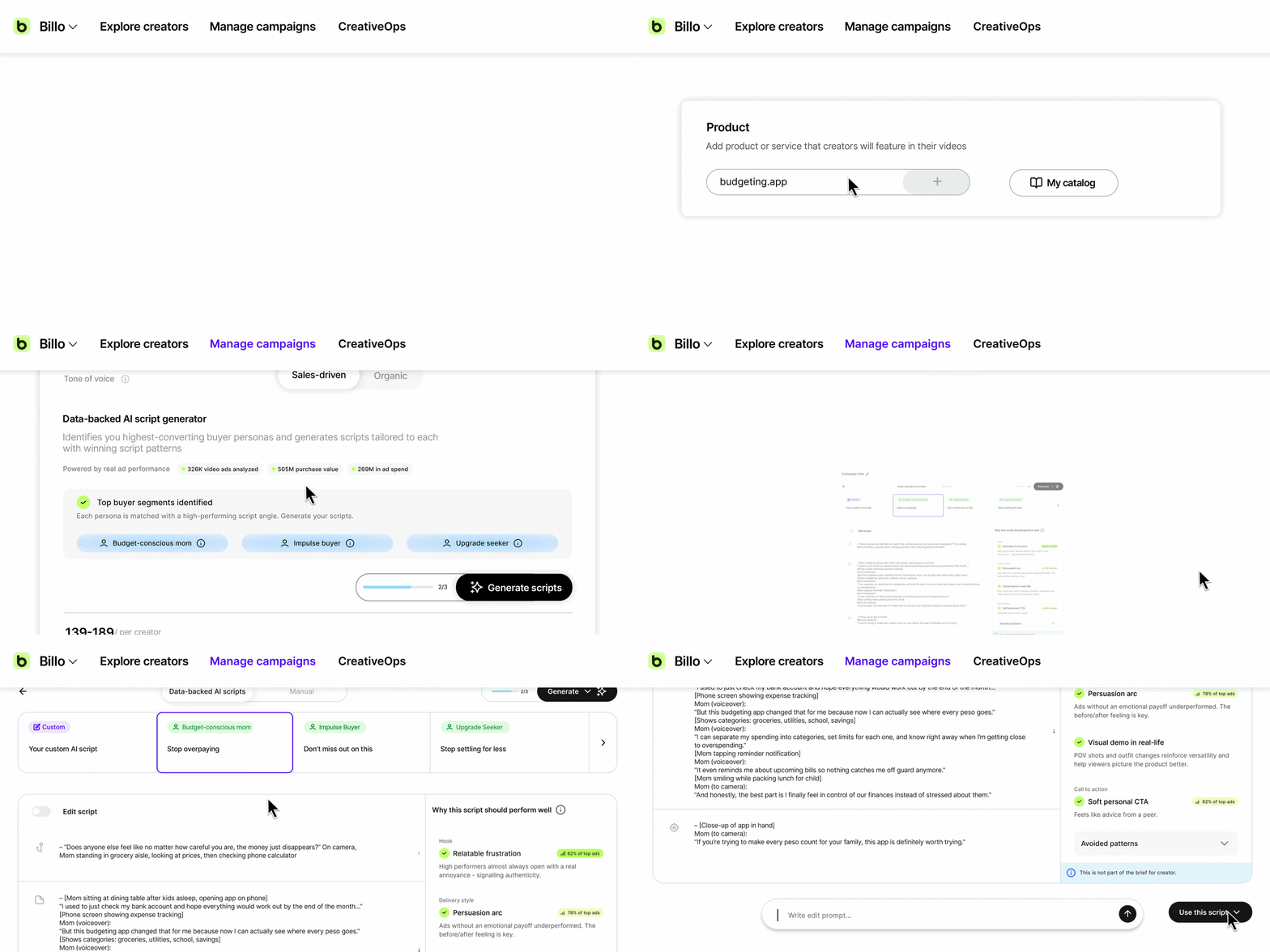
Hitting these volume benchmarks takes an operational system, not just more creators. The loop: start with a data-informed script, match with vetted creators, turn each winning video into multiple ad variations with different hooks and CTAs, then use creative analytics to feed results back into the next brief cycle.
This is the approach Billo’s platform is built around. With performance insights from 500M+ Meta data points and $280M+ in tracked purchase value, briefs and creator selections start from what is actually driving results rather than guesswork. That feedback loop, where paid media outcomes inform the next round of creative production, is what separates producing volume from producing volume that performs.
For agencies, the same workflow scales across client accounts: one system, many brands.
What to Do Next
If your current creative cadence falls short of the benchmarks in this post, the fix is not to produce more of the same. Start by diagnosing where you are: how many new creatives are you launching per week, what is your winner rate, and how fast are your best performers fatiguing? Then close the gap with a production workflow that gives you volume and diversity without scaling your team or budget linearly.
Billo’s CreativeOps platform is built for exactly this: data-driven briefs, matched creators, ad variations from every winning video, and analytics that close the loop. If you are ready to build a creative pipeline that keeps pace with your spend, see how it works.
FAQs
How many ad creatives should I run at once?
How often should I refresh my ad creatives?
What’s a realistic creative budget for a DTC brand?
Do agencies need a different creative volume strategy?

SEO Lead
Passionate content and search marketer aiming to bring great products front and center. When not hunched over my keyboard, you will find me in a city running a race, cycling or simply enjoying my life with a book in hand.
Make creator marketing a data-backed growth channel

Related from Creative Insider

Marketing efficiency ratio: why MER falls when your creative is working

AI Generated Ads vs. Human UGC: What the Performance Data Actually Shows

2026 Black Friday Benchmarks: What Your Hook Rate, CTR & ROAS Should Look Like