What Meta’s AI does with your creative
As Reyna put it, “it’s not just a production problem, it’s an intelligence problem.” Working out which variation fits whom is what Meta’s AI is built for. She described it as a loop: it learns what’s working, for whom and why, from how 3.6 billion people use Meta’s apps every day, and pushes that back into the ads. Three pieces do most of the work:
- GEM is Meta’s ads ranking model. It predicts which creative will land before the money is spent.
- Andromeda handles retrieval. It gets the right version of an ad to the right person in real time.
- Muse generates and edits on-brand images inside Advantage+.
In its Q2 2026 earnings, Meta reported that GEM and its user-understanding models drove 15.7% more conversions on Facebook and 8.3% more ad clicks.
Here’s where many advertisers go wrong. They hear about Andromeda and assume they should flood the system with ads. Reyna says that’s not how it works: the system can only pick the best ad from what you give it. What pays off is testing different angles, audiences and messages, not iterating and relaunching the same ad at volume. Narrow manual audiences fight the system too. We cover the wider shift in our Meta Andromeda update guide.
“Better retrieval just means the system is now more capable of picking the right ad.”
Reyna Baker, Partner Manager, Shop Ads and Creative, Meta
Meta’s AI adapts in real time, but you bring the creative vision, and you know your customers better than any model does. When Donatas asked whether creative is the new targeting, her answer was “100%.”
Why creator content belongs in your always-on campaigns
If creative is the new targeting, where does the best creative come from? Reyna’s answer: creators.
Meta runs an auction to find the best ad for each person at a given moment. For some people, that’s creator content. For others, it’s your brand ad. Adding creators widens what the system can choose from.
Creators can also flex tone, style and message in ways a studio shoot can’t. That’s why Reyna’s recommendation is to mix creators into your always-on campaigns, not run them as a side campaign.
Meta’s “Cracking the creator code” white paper (October 2026) backs this up:
| What Meta found | When | Based on |
|---|---|---|
| 19% lower cost per acquisition | Partnership ads were over 20% of spend | 15 advertiser tests in North America and APAC, 2021-22 |
| 71% higher intent lift | Partnership ads were at least 20% of spend | 14 brand lift studies, 2023-24 |
| 45% lower cost per incremental purchase, 35% higher incremental ROAS | Partnership ads were at least 30% of assets | 20 conversion lift studies in EMEA, January-June 2025 |
Reyna also shared a brand example. When Clarins added creator content to its business-as-usual campaigns, it saw a 69% decrease in cost per incremental website purchase and 121% more incremental website purchases.
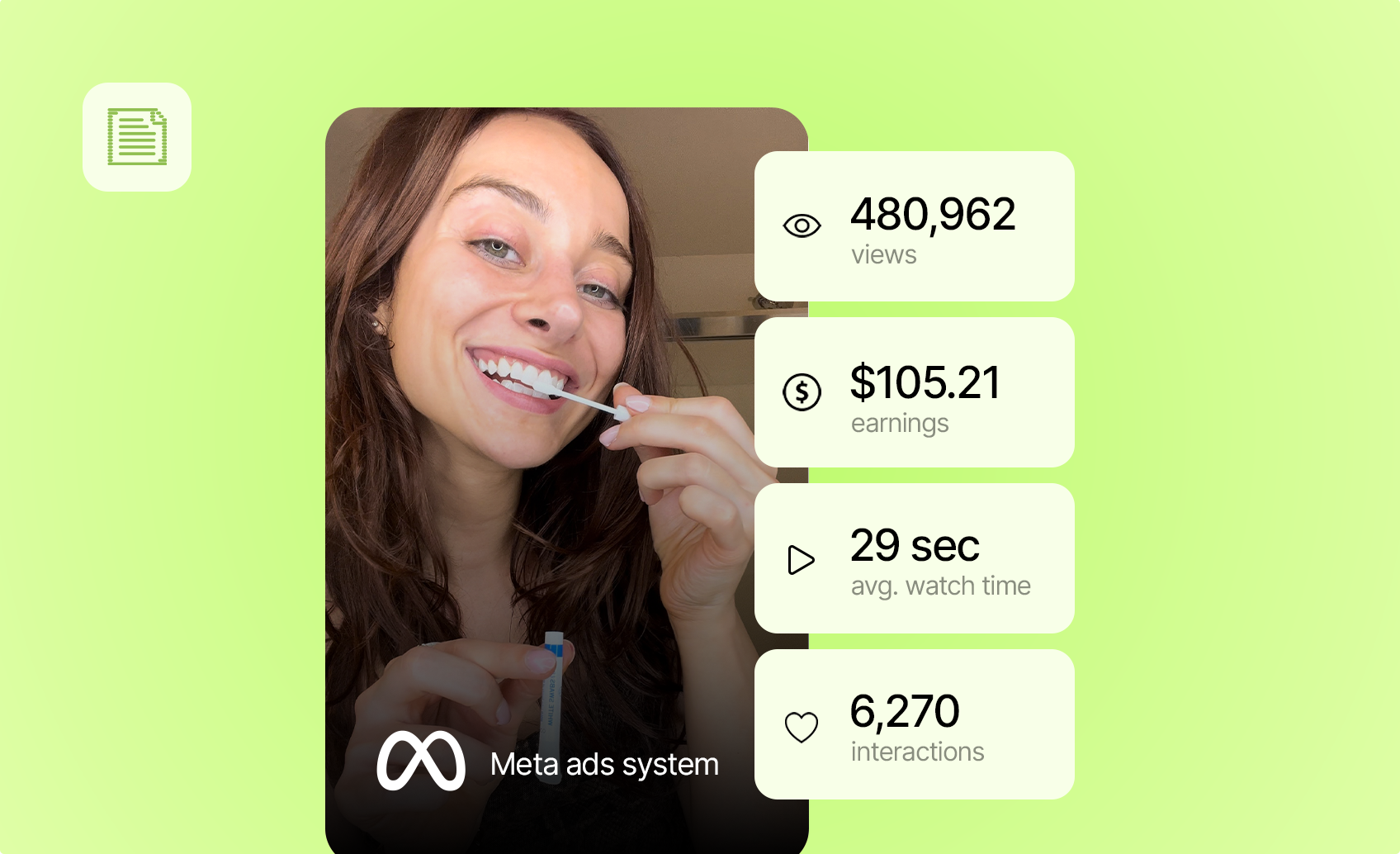
Our own data points the same way. Billo creator ads had an 11% lower CPA than the other video ads in the same accounts ($82 vs $92 in August 2026), and a lower CPA in 17 of the last 20 months (Billo internal analysis of brand-connected Meta ad accounts, January 2025 to August 2026). For more, see how partnership ads compare with brand ads.
“Creators already ran the experiment. Hooks, formats and framing, tested on a live audience every day for years. That’s free R&D most brands walk straight past.”
Reyna Baker, Partner Manager, Shop Ads and Creative, Meta
AI makes creators more valuable, not less
With Meta’s AI doing so much of the work, one of the first audience questions was where AI-generated creative fits. The answer from all three speakers was the same: real creators still win.
- Reyna Baker (Meta): people assume AI is reducing the value of human creativity. In her view, it’s the opposite.
- Curtis Howland (Misfit Marketing): he doesn’t know of any account where the top ad is an AI creator. Where AI helps is in production: finding clips, editing them together and making statics more engaging.
- Anish Dalal (Sapphire Studios): real creators have performed best in his team’s tests. AI helped with the scene. For a high-end cookware brand, the creator was real, but AI made the kitchen look more luxurious, and the ad performed well.
As Donatas summed it up, AI is for augmenting the setup, not the actual person. For the data behind this, see what we found comparing AI-generated ads with human UGC.
“I don’t know any accounts where the number one ad is an AI creator.”
Curtis Howland, VP of Marketing, Misfit Marketing
Give creators guidance, then room to create
So how do you get the best out of real creators? A lot of brands reach for detailed guardrails. Reyna has seen something else work better: find content the creator has already made, for another brand or on their own feed, and show them you liked it. That gives them direction in their own language. Then let them create, because they know their audience best.
Let’s say you want a product demo. Instead of a shot-by-shot script, send a link to a demo they posted last month and say, “More of this, for our product.” Our UGC brief template covers the rest of what to include.
How to get partnership ads right
Once you have the content, how you run it matters too. In Reyna’s words, partnership ads are the most performant way to run creator content on Meta. She gave two reasons:
- Stronger ranking. The ad gets signals from both the brand’s handle and the creator’s, which helps it rank.
- More transparency. You can pull insights and see what’s working.
Then she shared what the best-run accounts do with them:
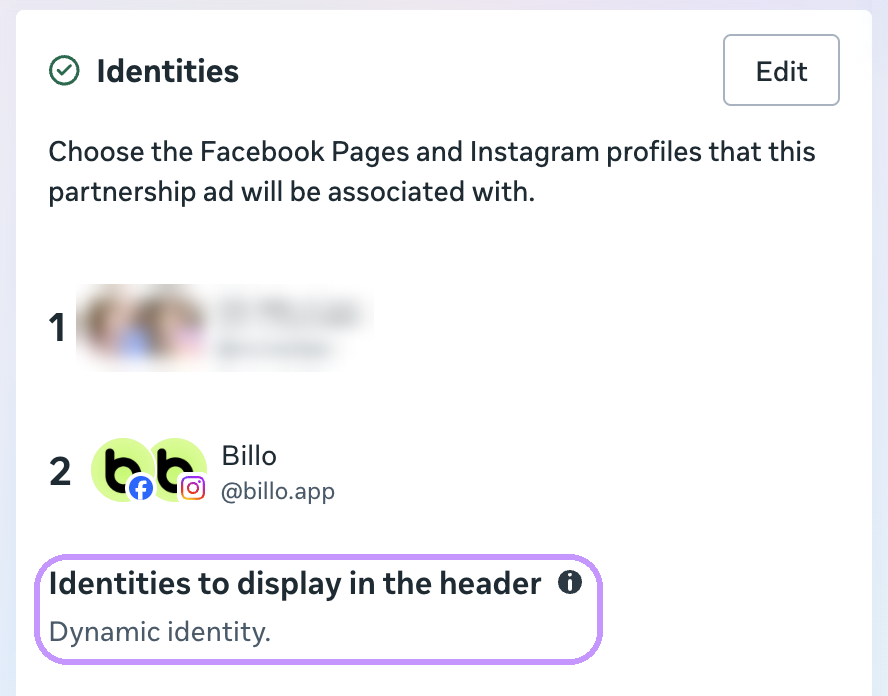
- Turn on dynamic header. Meta decides whether the brand, the creator or both appear in the header, based on what it expects to perform best. A lot of brands assume the creator’s handle alone will win, and that isn’t always true. It also settles a question Curtis asked in the Q&A, whether the creator should go in the first slot: with dynamic header on, the system picks the order for you.
- Test other formats. Partnership ads now come in more formats, including catalog ads.
- Keep several creators in rotation. Running everything through one creator makes a campaign go stale. Test different creators and variations, then boost and scale what works. Your organic team may already have creator content worth boosting, and reshares are a better sign than likes or views.
If you also run TikTok, here’s how partnership ads compare with Spark Ads.
How to set up partnership ads
The setup is short. The part Reyna stressed most is getting permissions right at the start.
1. Link your Facebook and Instagram accounts.
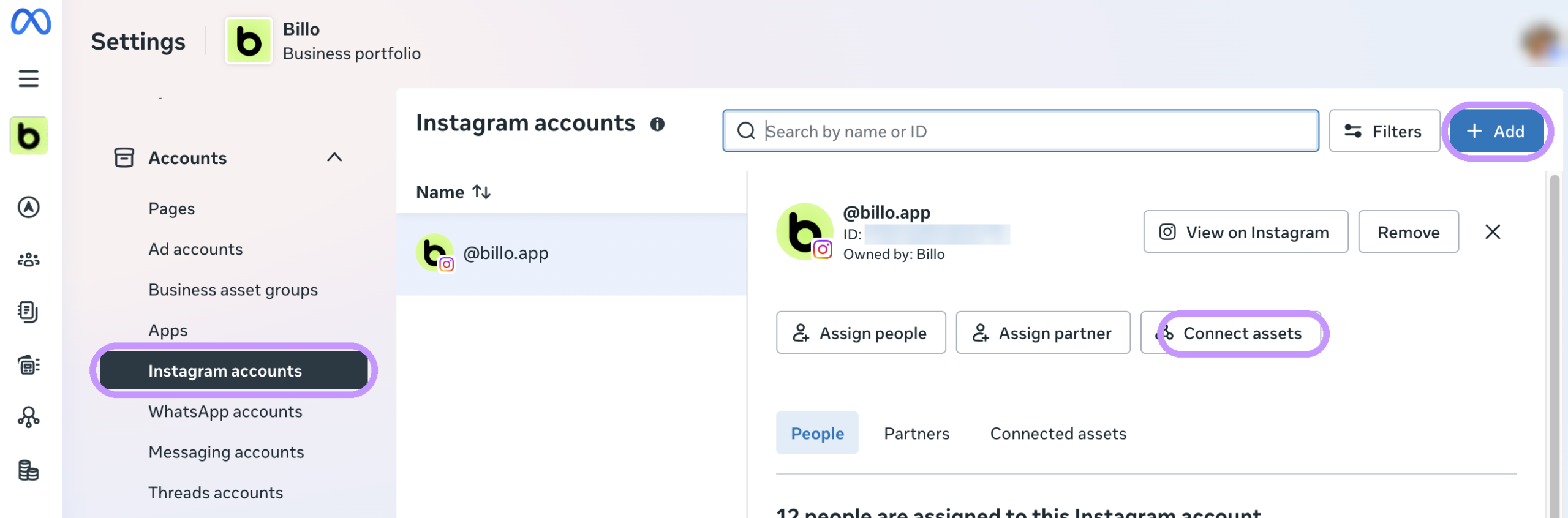
2. Agree permissions with the creator.
Account-level permissions let you run any paid activation with that creator. Post-level permissions only cover a single post. Talk to the creator about content rights before you start, not after. Here’s more on account-level permissions.
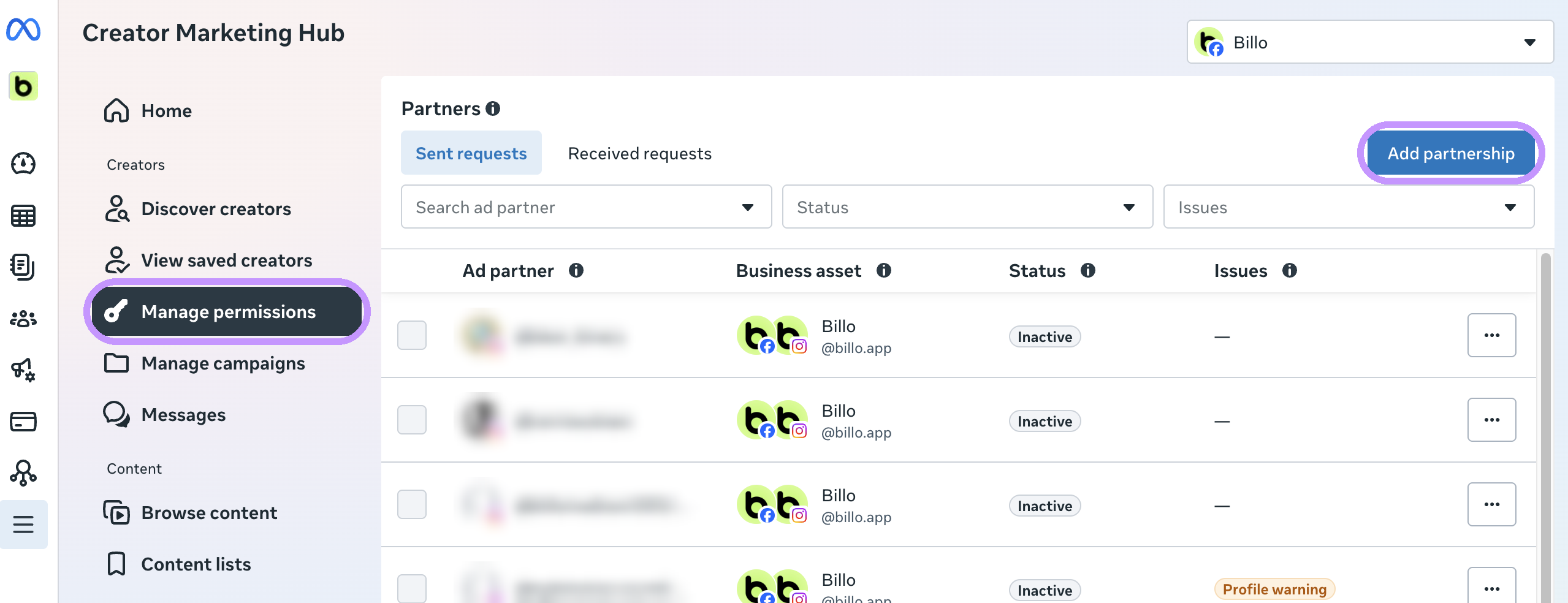
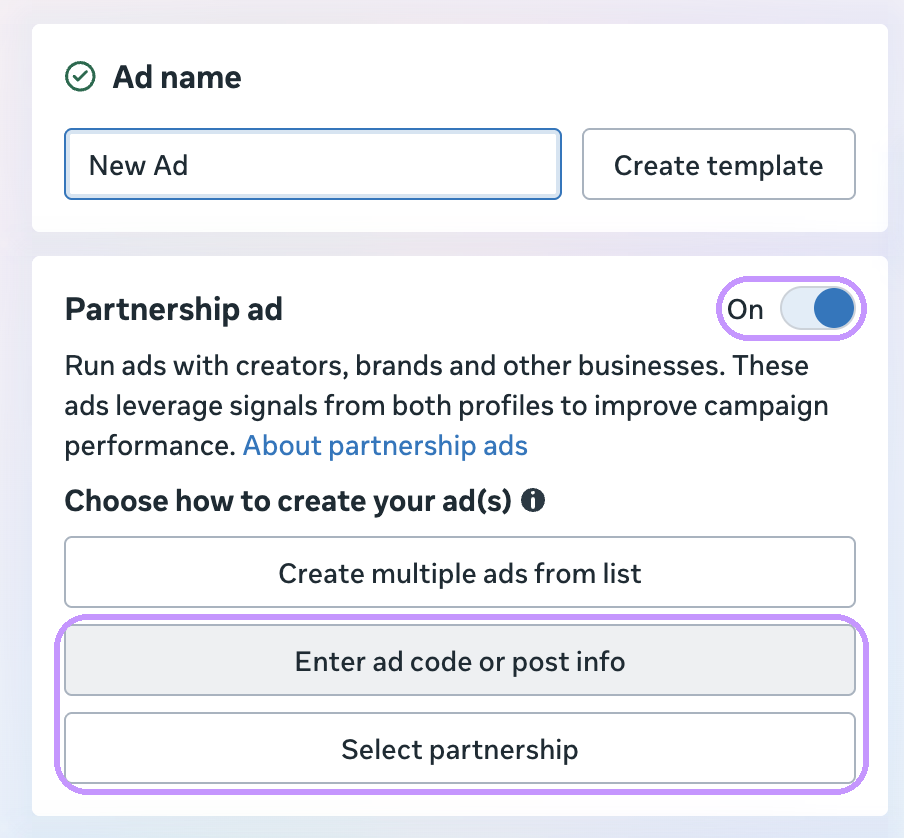
3. Add the creator as a partner, or use an ad code.
Select the creator as a partner, or enter the ad code they share with you. You can also do this directly in Billo.
4. Turn on dynamic header when you build the ad.
For the full walkthrough, see our help center guide to promoting creator content on Instagram and Meta.
How to apply this to your Meta campaigns
- Feed the system variety, not duplicates. Test different angles, audiences and messages.
- Mix creators into your always-on campaigns. Meta’s studies looked at partnership ads making up at least 20% of spend or 30% of assets.
- Run creator content as partnership ads, with dynamic header on.
- Brief creators with their own best work, then give them room to create.
- Agree permissions with the creator up front. Account-level permissions give you the most room.
Reyna’s parting advice was to start now. Build a test-and-learn habit, and feed the system as much creative as you can, especially creator content. If creative is the new targeting, creators are where the best creative comes from.
Ready to run creator content as partnership ads? See how it works with Billo.
Also in this series: Anish Dalal on how to find creators who scale partnership ads, and Curtis Howland on creative testing on Meta.
“Personalization isn’t an edge anymore. It’s the floor.”
Reyna Baker, Partner Manager, Shop Ads and Creative, Meta