AI Generated Ads vs. Human UGC: What the Performance Data Actually Shows


Every marketing team has had some version of the same conversation this year: can we just generate the ad instead of shooting it. The tools are fast, the cost per asset keeps dropping, and the output can look genuinely polished. The question underneath that conversation, though, is whether AI generated ads actually perform as well as ads made by real people, and until recently there was surprisingly little hard data to answer it with.
That changed in May 2026, when Ipsos published a study that put the question to an actual test instead of a survey about opinions. Its researchers took 20 real ads from major brands, half made by humans and half generated with AI, and measured how 3,000 US consumers actually responded to them.
This piece walks through what that study found, what it means alongside the research on AI disclosure and trust, and how marketers can use both AI-generated ads and real user-generated content (UGC) without guessing.
TL;DR
- Ipsos tested 20 real brand ads (10 human-made, 10 AI-generated) with 3,000 US consumers. Human-made ads scored 14% stronger on short-term creative effectiveness and 17% stronger on long-term brand-equity effectiveness.
- Only 25% of viewers could confidently tell which ads were AI-generated, yet 79% said companies should disclose AI use anyway.
- AI-generated ads used a proven storytelling structure only 30% of the time, versus a 49% industry norm, which is a big part of why they underperform on emotional engagement.
- Two disclosure laws, the EU AI Act and California’s AI Transparency Act, both became active on the same date in August 2026, raising the cost of skipping disclosure.
- The practical takeaway is about matching each format to the job it’s actually good at, not about picking a permanent winner.
What “AI-generated ads” mean in 2026
An AI-generated ad is one where a generative model produces the actual footage instead of a human. A language model breaks the creative brief into scenes and shots, then a video model like OpenAI’s Sora 2 generates the final clips, which get edited and tested the same way any other ad would be.
Adoption moved fast enough to reshape media plans in the last year. IAB’s 2026 Digital Video Ad Spend & Strategy report found that a quarter of video ad assets used generative AI in 2025. By 2026 that share had climbed to a third, with buyer adoption jumping from roughly half of advertisers to nearly two-thirds over the same twelve months, and IAB projects the asset share to reach 43% by 2027.
This same acceleration is behind the rise of AI-generated UGC in social ads, a fast, low-cost option that’s increasingly used alongside human creators rather than as a wholesale swap for them.
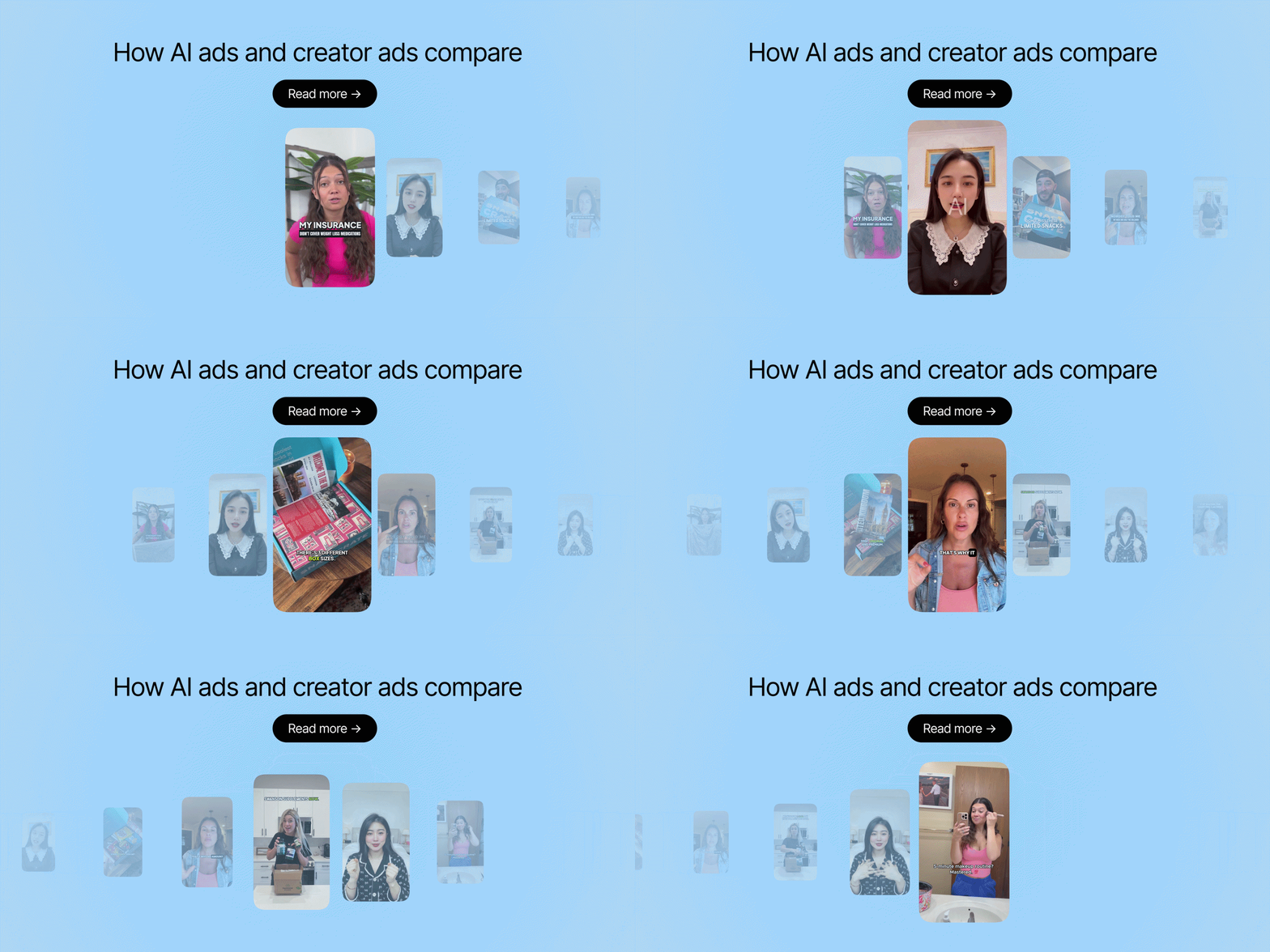
Putting AI generated ads to the test
Ipsos ran this test through its Creative|Spark framework, which is built to score ads the way a marketing team would evaluate them internally. Instead of just asking people whether they liked what they saw.
Researchers selected 20 ads from major brands across several industries, split evenly between fully human-produced spots and AI-generated ones, and held the underlying creative brief constant across both groups using an eight-element strategic framework.
The AI-generated ads in the study weren’t rough drafts. Teams used Google Gemini to break down the creative brief and OpenAI’s Sora 2 to generate the video itself, roughly the same production stack a lot of performance marketers are already testing. That’s part of what makes the Ipsos study useful. It compares two current, realistic production paths, not AI’s best effort against human ads.
The headline gap: creative effect index and equity effect index
Ipsos scored every ad on two indices it already uses to predict real-world performance:
- The Creative Effect Index measures short-term effectiveness, things like attention and message pull.
- The Equity Effect Index measures how much an ad builds a brand’s long-term equity.
Human-made ads outscored AI-generated ads by 14% on the Creative Effect Index and by 17% on the Equity Effect Index. Those numbers matter beyond the test itself. Ipsos has found that ads which score well on the Creative Effect Index go on to produce a 44% higher average sales lift, so a 14-point gap in testing isn’t an academic detail. It’s the kind of gap that shows up in a media report.
| Index | What it measures | Gap vs. human-made ads |
|---|---|---|
| Creative Effect Index | Short-term effectiveness (attention, message pull) | AI ads scored 14% lower |
| Equity Effect Index | Long-term brand-equity building | AI ads scored 17% lower |
Where AI generated ads fall short
Ipsos also used its MISFITS mindset framework to explain why the gap exists, not just confirm that it does. Across three components, human ads scored higher every time:
- 55% versus 43% on creative experiences,
- 48% versus 40% on empathy and fitting in,
- 54% versus 46% on creative ideas.
When consumers compared ads side by side, the pattern held. 46% said the human ad was more creative against 27% for the AI version, 38% found the human ad more emotionally engaging against 18%, and 37% rated it more informative against 24%. In each comparison, a large share of people saw no real difference, which suggests the gap is real but not universal. Plenty of AI-generated ads land just fine. The question is how often, not whether it’s possible.
This kind of granular, before-and-after testing is exactly the sort of decision-making Billo built its AI UGC marketing guidance around, since knowing where AI content underperforms is more useful than a blanket rule against using it.
Why AI generated ads underperform on emotional engagement
The most concrete explanation Ipsos offers is structural. Only 30% of the AI-generated ads used a clear narrative arc instead of a straight product demonstration. Human-made ads hit that mark 49% of the time, which is the industry norm.
Ads that broke category conventions were 20% more likely to earn strong brand attention. Ipsos’s own conclusion is direct: AI draws from what already exists, and it can replicate the conventions of advertising, but it struggles to transcend them.
That’s a production problem as much as a technology one, and it’s worth knowing which AI UGC generators are built to push past formula versus ones optimized to reproduce it.
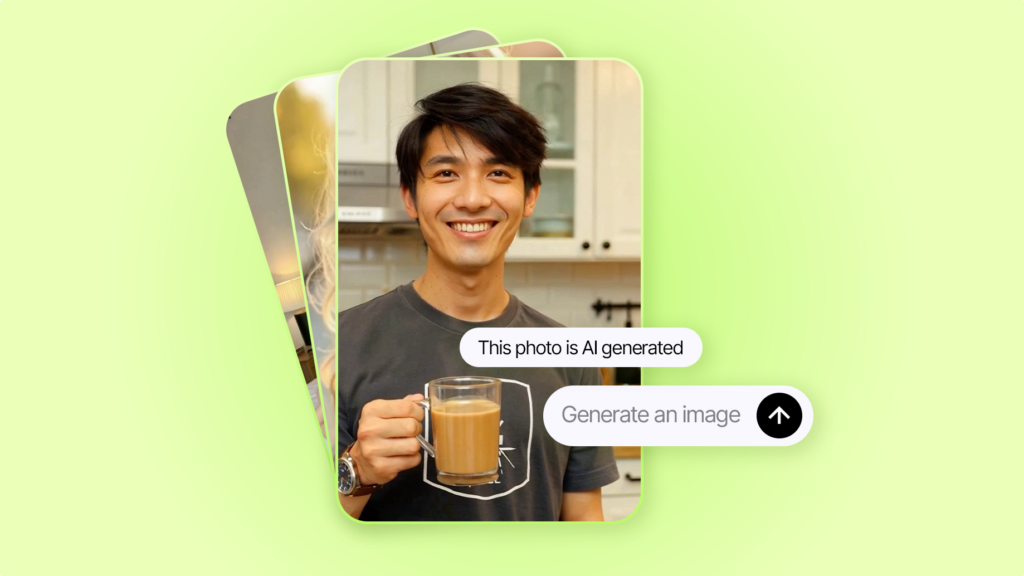
The detection and disclosure problem
Here’s the part that should worry anyone assuming their audience can tell the difference. Only 25% of viewers in the study could confidently identify which ads were AI-generated, and another 40% said they genuinely weren’t sure either way.
That might sound reassuring for AI-generated ads, except for what happened next. 79% of the same viewers said companies should disclose when they use AI in advertising, whether or not people can spot it themselves. Ipsos put it plainly: viewers aren’t equipped to detect AI in advertising, which raises harder questions about transparency and trust than a simple creative test can answer.
Brands caught running undisclosed AI content have already felt this, facing what the study describes as swift, vocal backlash from an informed minority, even when most viewers never noticed the content was AI-generated in the first place. On top of that platforms are already enforcing AI labeling standards, you probably already heard about Article 50 of the EU AI act and California’s AI transparency act. Which means disclosure is quickly becoming procedural rather than optional and failure to comply can result in major fines.
The trust layer: what the research shows
The Ipsos results line up with a broader body of research on how people respond to AI-labeled content, so this isn’t an isolated finding. A study published in the Journal of Consumer Research, based on real TikTok engagement data and eight separate experiments, found that AI disclosures reduce engagement specifically because they lower how much effort viewers think the creator put in, not because people are simply averse to AI itself.
Research from the Nuremberg Institute for Market Decisions found something similar when it showed identical ads labeled as either AI-made or human-made to consumers in the US, UK, and Germany. The AI-labeled version was rated more negatively, especially on emotional dimensions, and got lower interest in clicking, researching, or buying. The researchers were careful to note the effect isn’t drastic, but it’s consistent.
Consumer expectations back this up. In its 2026 content strategy research, Sprout Social found that consumers rank human-generated content as their top priority from brands this year, even as marketers report using AI for content creation more than any other task. That gap between what audiences want and what teams are producing is exactly the tension this whole conversation is about.
What this means for marketers
AI-generated ads aren’t a dead end. They test well on product-driven, direct executions that lean on formats a brand has already proven out, but they still lag on original storytelling and emotional connection, the territory real UGC and human-made creative continue to own.
Marketer behavior reflects that split. Research from Billion Dollar Boy’s Muse study found that 79% of marketers increased AI-generated content spend over the past year, even as consumer skepticism grew, a gap that only closes by pairing that spend with real UGC where it matters most.
This is the gap Billo’s approach is built around: pairing real UGC sourced from creators with AI-assisted production and testing, so brands aren’t choosing one over the other by default. Real examples make that easier to picture than a framework alone.
A practical framework for deciding
Sort ad concepts by what they’re actually trying to do before choosing a production path:
| If your ad is… | Best production path | Why |
|---|---|---|
| A product demo or direct-response format with a simple message | AI-generated production is a reasonable fit | This is where the performance gap in Ipsos’s data was smallest |
| Brand storytelling, emotionally driven, or built to grow long-term equity | Keep it human-made or real-UGC-led | These formats scored meaningfully better on the Equity Effect Index |
| Any ad using AI content | Disclose it clearly | 79% of consumers expect it, and it’s now a legal requirement in the EU and California |
| Any format, before committing budget | Test both approaches against your own audience data | The 14% and 17% gaps are averages across 20 ads, not a guarantee for any single concept |
| Any format, regardless of production path | Add clear, well-written captions | Captions hold attention longer whether the footage is AI-generated or shot with a real creator, one of the easiest wins either way |
Summary
Here’s the bottom line: “AI-generated ads don’t work” is too simple, and so is treating them as a one-to-one swap for real UGC. Ipsos’s test found a real, measurable gap, not a knockout blow. It shows up most in storytelling and emotional connection, and it comes with a disclosure expectation that two major regulatory regimes have made mandatory this year.
If you’re asking where to draw the line: use AI-generated production where the format is proven and the message is direct, keep real UGC and human-made creative for anything meant to build brand equity or emotional connection, and disclose either way. Consumer sentiment and two new disclosure laws are both pointing the same direction right now, which makes human UGC the safer default whenever you’re not sure which side of that line you’re on.
FAQs
Do AI-generated ads perform worse than real UGC and human-made ads?
Do I have to disclose that an ad is AI-generated?
Can viewers actually tell an ad is AI-generated?
Should I use AI-generated ads or real UGC?

SEO Lead
Passionate content and search marketer aiming to bring great products front and center. When not hunched over my keyboard, you will find me in a city running a race, cycling or simply enjoying my life with a book in hand.
Make creator marketing a data-backed growth channel

Related from Creative Insider
Marketing efficiency ratio: why MER falls when your creative is working

2026 Black Friday Benchmarks: What Your Hook Rate, CTR & ROAS Should Look Like
The Creative Operations Setup Paid Social Actually Needs