A creator ad scales when the concept and the audience line up
According to Anish, two things decide whether a creator ad can scale: the concept and the creator’s audience.
His team doesn’t hand creators a blank page. It starts from concepts already working in paid Meta ads and asks creators to reimagine them. Then it matches the creator’s audience to the audience for that specific angle, not to the product as a whole.
One product has many audiences. Let’s say a skincare brand’s “5-minute morning routine” angle wins with women aged 45 to 60, and its “acne fix” angle wins with 18 to 25-year-olds. Those are two different briefs, and two different sets of creators.
“Invest in what paid data proved, not what looked good.”
Anish Dalal, Co-Founder, Sapphire Studios
Four checks before you brief a creator
Once a concept is proven and before a brief goes out, Anish’s team runs four checks:
- Audience fit. Do their followers match the audience for the angle you’re testing?
- On-camera energy. Are they animated and clear, and comfortable testing?
- Authenticity. Have they used the product? When they’re real users, “results jump.”
- Super Content. For creators with an audience, his team looks for posts with 5x more likes than the creator has followers. Several of those show a creator understands visuals, not just their audience.
If you work with creators who make ads rather than post organically, the first three checks do most of the work.
A track record in the format matters too. When a beauty client wanted ASMR ads, his team only shortlisted creators whose past ASMR videos had real reach.
To spot a storyteller, look at the gap between views and followers, or simply ask: if you’re the target buyer, do they keep you watching to the end?
A great creator video isn’t the same as a great ad
When Anish’s team started running partnership ads, it looked for great organic videos: ones that hold viewers to the end, often through storytelling.
That turned out to be a good signal, but not the best one. The best partnership ads came from creators who hit the core pain point up front and showed the product well.
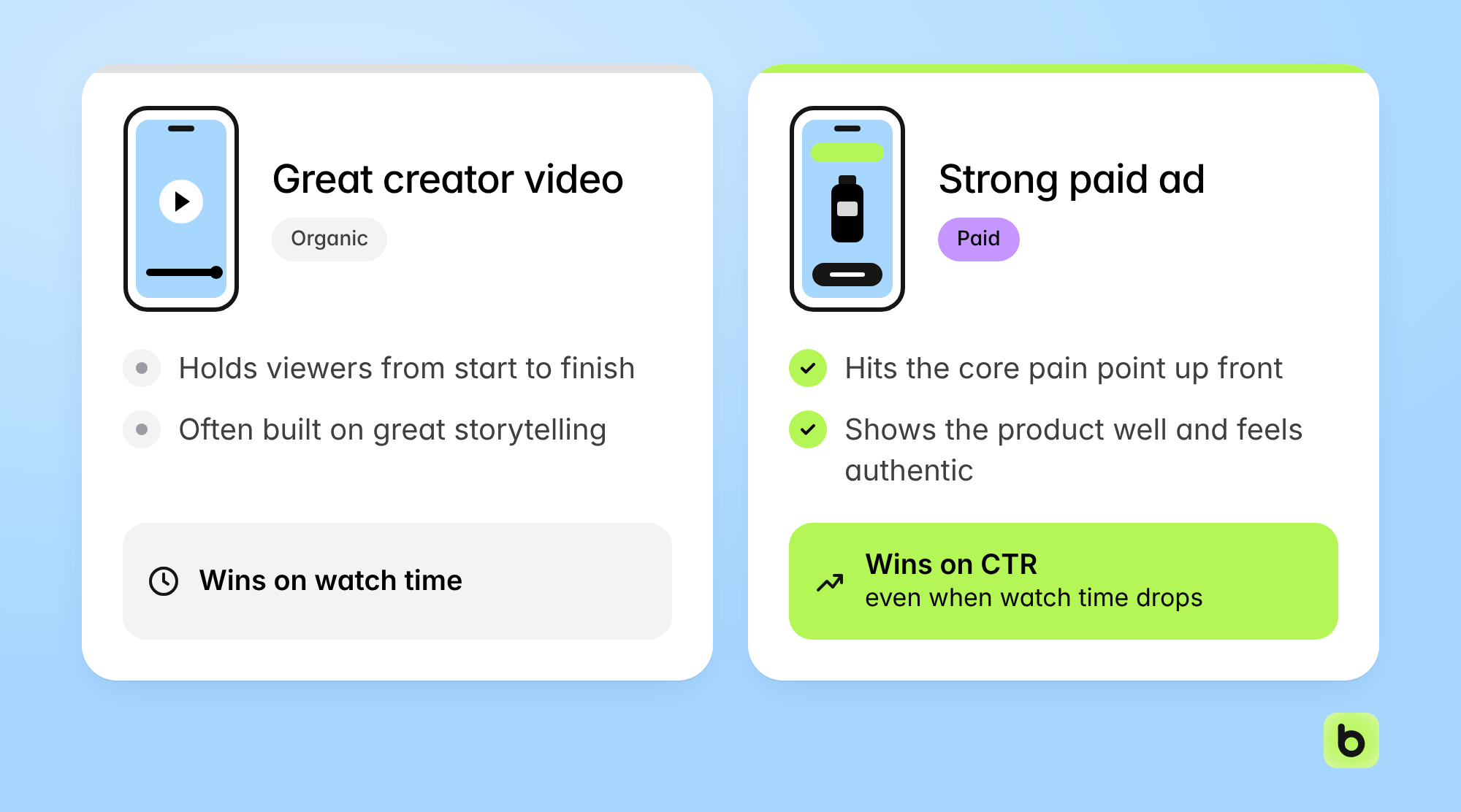
CTR is also where creator ads pull ahead in our own data. Billo creator ads averaged a 2.0% CTR, compared with 1.6% for the other video ads in the same accounts (Billo internal analysis of brand-connected Meta ad accounts, January 2025 to August 2026). If you want to benchmark your own numbers, here’s what a good CTR looks like across platforms, and how hook rate and hold rate fit in.
There’s a twist, though. Anish’s contrarian take is that storytellers make the best partnership ads of all. They’re just hard to find. A creator who tells great stories on their own feed often struggles to turn that into “do this for my product.” When it works, it works tremendously well.
So test storytellers, but don’t rely on them. The reliable bet is an animated creator who demos the product well, names the pain points it solves and works with the data you give them.
“Storytellers make the best type of partnership ads. But they’re really hard to find.”
Anish Dalal, Co-Founder, Sapphire Studios
Test as UGC first, then scale on the creator’s handle
This is the point Anish stressed most: don’t start with partnership ads. Find the signal in regular paid ads first, then scale what works on the creator’s handle.
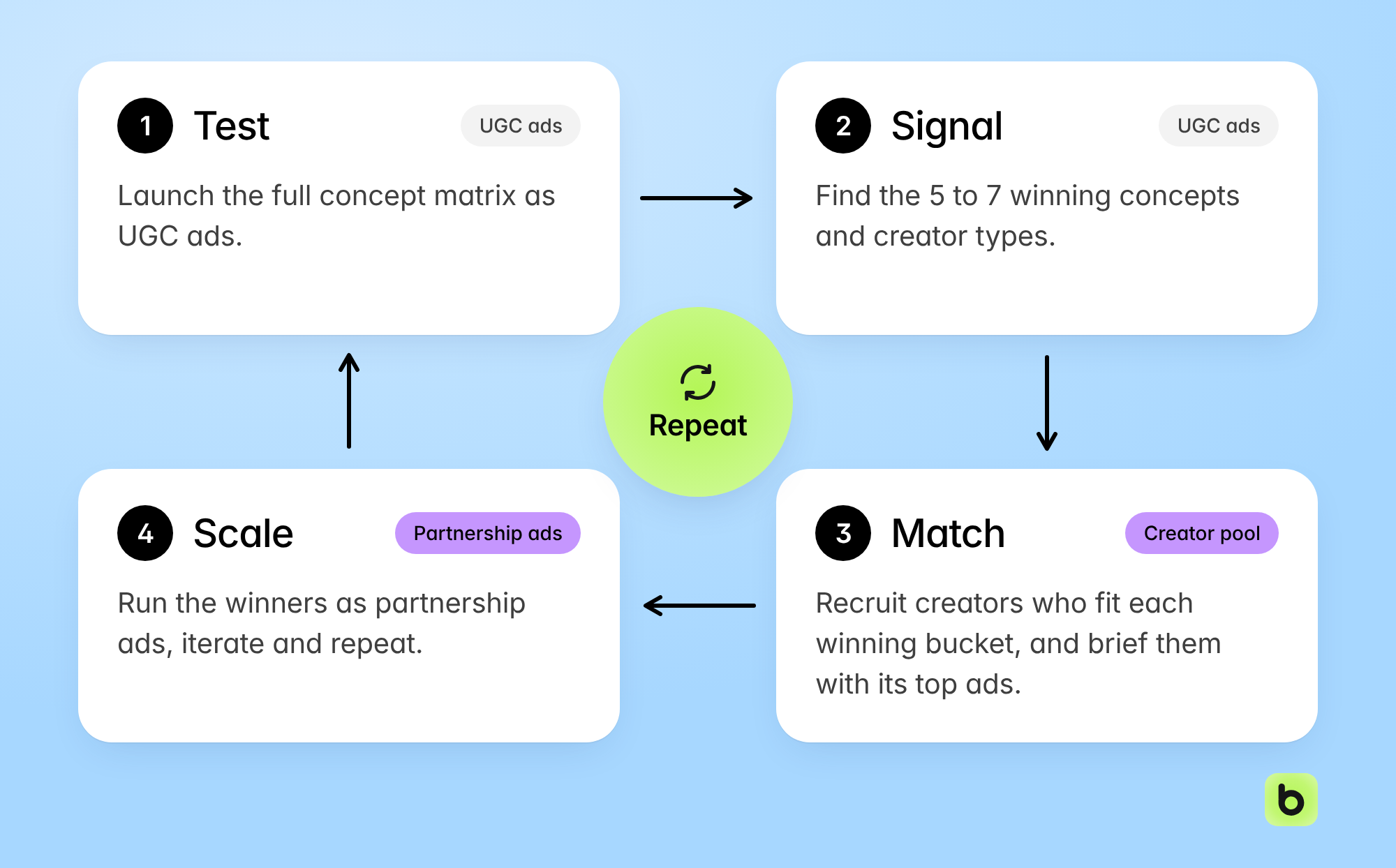
His team runs it as a loop:
- Test. Launch the full concept matrix as UGC ads.
- Signal. Find the 5 to 7 winning concepts and creator types.
- Match. Sort winners into buckets, such as a format that keeps winning or ads that work with men over 60, and recruit a creator pool for each. Brief them with the top ads from that bucket, split by audience, and keep it top-line so the ad still feels like them.
- Scale. Run the winners as partnership ads, iterate and repeat. When a funnel runs dry, go back to step 1.
Anish was clear about when this works and when it doesn’t:
| Partnership ads work well when | They struggle when |
|---|---|
| Concepts are already proven in UGC tests | There’s no concept signal yet |
| You can test enough creators to read a result | There are too few creators to read a result |
With those conditions in place, Anish’s team has seen better ROAS and CTR from partnership ads.
Expect most creators you test not to make the cut. Top-tier creators are hard to find, but when you find one, they can carry an account. That’s why it pays to keep testing. Our UGC brief template covers what else to put in a brief.
“Skipping the test is the #1 mistake.”
Anish Dalal, Co-Founder, Sapphire Studios
Brief creators with your best ads, not a script
Once you know what’s winning, put it in the brief. Anish recommends showing creators its top-performing ads from the paid account, so they’re working from proof rather than guesses.
Anish goes a step further and splits those examples by audience. If you’re recruiting creators aged 45 to 60, show them the ads that won with that age group. If you’re recruiting for 18 to 35, show them a different set.
Then keep it top-line. Share the headline data and lets creators make it their own, so the ad still feels like them. Too much direction is how a creator ad ends up sounding like a brand ad.
If you need a starting point, our UGC brief template covers what to include. And once one angle wins, here’s how to turn it into many variations.
How many creators you actually need
Anish shared his own numbers for how big a creator pool needs to be, and how many creators it takes to build one:
| Ad spend | Solid creators you need | Creators tested to find them |
|---|---|---|
| About $100K | 5+ | 25-30 |
| About $1M | About 50 | 300-500 |
That’s roughly one keeper for every five to ten creators tested. Plan your testing budget with that ratio in mind.
The pool also has to keep moving. When we asked Anish what the brands that stayed scaled had in common, beyond the creative itself, his answer was simple: they kept testing new creators. The brands that plateaued found a stable of creators and then had that same pool make more and more ads. That’s a fast road to creative fatigue.
“The through line was just keep testing as many creators as you can, and then give them the best data you can to be successful.”
Anish Dalal, Co-Founder, Sapphire Studios
Starting small: one great creator can carry you
Those numbers can look out of reach for a brand starting from scratch. The good news is you don’t need dozens of creators to begin.
You don’t need dozens of creators to begin. Anish’s advice for brands with no data yet: find one great creator who fits your brand and have them make lots of different videos. Upload them to your ad account, test and learn, and treat that creator as a brand ambassador.
This gives Meta enough creative to get out of the learning phase, especially with video. It also shows you which concepts carry, so you have proof to brief the next creators with. Brief one creator for ten videos rather than ten creators for one each: a few different hooks, a demo, a problem-solution video and a morning routine.
“You don’t need dozens of creators to start. You just need one really good one that you resonate with.”
Anish Dalal, Co-Founder, Sapphire Studios
How to find older and niche creators
One of the most-asked questions at the webinar was where to find creators aged 50 and over. If your buyers are older, or sit in a narrow niche, finding creators who look and sound like them takes more effort. All three speakers had an answer:
- Search, or use a creator platform. Anish’s advice: search the old-fashioned way, or use a platform like Billo, where you can sort creators by age, occupation, interests and even equipment, then hand-pick from the creators who apply.
- Use Meta’s creator marketplace. Reyna Baker, Partner Manager at Meta, pointed to the Instagram and Facebook creator marketplace, which filters creators by location and age. Facebook is often seen as skewing older, so it’s worth a look.
- Coach them more. Curtis Howland of Misfit Marketing added that niche creators need more coaching: share what worked and what didn’t.
The same works for any hard-to-reach audience, such as a profession, a hobby that needs real gear or a region. A working stylist will sell professional hair tools better than a general beauty creator.
“We have to remember that the creators are people. They want to be there, they want to learn, they want to engage.”
Anish Dalal, Co-Founder, Sapphire Studios
How to apply this to your next creator test
- Prove the concept before you add a creator. Start from what already works in your paid account.
- Match creators to the angle, not the brand. Each angle has its own audience.
- Run the four checks. Audience fit, on-camera energy, authenticity and, for creators with an audience, Super Content.
- Test as UGC, then scale on the creator’s handle. Skipping the test is the most common mistake.
- Brief with your best ads. Split examples by audience and keep it top-line.
- Keep testing new creators. Plan for one keeper in every five to ten. If you’re new, start with one great creator.
Partnership ads reward brands that treat creator selection as a system, not a lucky find. If you need creators for your next concept test, you can find and filter them on Billo.