15 UGC Video Examples That Ooze Authenticity

Key takeaway: UGC videos drive 10x higher conversions, 4x higher click-through rates, and 6x more engagement than brand-produced content, at up to 71% lower cost.
User-generated content (UGC) videos outperform brand-produced content on nearly every metric that matters. And yet, most brands still default to studio-produced creative. The gap between what performs and what gets budgeted is widening, and the brands closing that gap are the ones using real people on camera instead of polished scripts.
This guide breaks down 15+ UGC video examples organized by type, backed by the performance data behind each format, with practical guidance on how to source, structure, and scale UGC video for your brand in 2026.
TL;DR:
- UGC videos consistently outperform brand-produced content across every measurable metric: 10.38x higher conversions, 4x higher CTR, 6x more engagement, and 30-71% lower production costs.
- The formats that convert best depend on where you are in the funnel: problem/solution videos for paid ads, testimonials and reviews for mid-funnel trust, and try-on or before/after videos for closing the sale on product pages.
- TikTok UGC delivers the highest engagement lift (142% above regular ads), Instagram Reels drive the strongest purchase intent (25% of users buy directly), and YouTube UGC earns the most trust (98% higher than other platforms).
- AI-generated UGC can cut costs by 95% and production time from weeks to minutes, but 68% of consumers are concerned about fake content.
- The brands seeing the best results in 2026 are running a hybrid model: AI for rapid testing and scale, human creators for trust and authenticity.
What Is a UGC Video?
A UGC video is any video content created by a real person, whether that’s a customer, a fan, or a hired creator, rather than the brand’s in-house production team or ad agency.
This video can be fully organic, where a customer films something unprompted, or commissioned, where a brand pays a creator to produce content that looks and feels authentic.
The key distinction from influencer marketing is that UGC doesn’t require a large following. 25% of UGC creators say this is their biggest advantage over influencers, and the average UGC creator has just 10,500 Instagram followers. What matters is the quality and authenticity of the content itself, not the audience size behind it.
Short-form vertical video in a 9:16 ratio and under 60 seconds is the dominant format for UGC, purpose-built for TikTok and Instagram Reels where this style of content performs best.
One important shift for 2026: AI-generated UGC is a growing category. Meta, TikTok, and YouTube all now require disclosure when video content is AI-generated. Brands using AI UGC need to ethically label it, and those that skip disclosure risk both trust erosion and platform penalties. Learn more about the US AI regulations and the EU AI act.
Why UGC Videos Work: The Data
The performance case for UGC video is no longer theoretical. Emplifi’s Q3 2025 benchmarks showed that social posts featuring UGC delivered 10.38 times higher conversion rates than non-UGC posts, and that number nearly doubled from the previous quarter’s 5.29 times lift.
UGC-based ads see four times higher click-through rates and 50% lower cost per click compared to traditional ads. User-generated videos specifically show 35% higher watch-through rates than polished brand content, according to 2026 industry benchmarks. On product pages, UGC increases conversion rates by up to 200% and drives a 90% increase in time spent on site.
Consumer trust explains most of this gap. 76% of consumers rank video as the most trustworthy form of UGC, ahead of images at 13% and text at 7%. 90% consider UGC the single most influential factor in their purchase decisions. That trust gap shows up directly against AI-generated ads too: in a 2026 Ipsos head-to-head test, human-made ads beat AI-generated ones on creative effectiveness, brand equity, and emotional engagement.
The cost picture reinforces the argument. The average UGC creator charges roughly $198 per video, which is 71% cheaper than YouTube influencers and 46% cheaper than Instagram influencers. Overall, UGC reduces content creation costs by up to 30% compared to professional branded production. 93% of marketers who have used UGC for ecommerce say it outperformed traditional branded content.
15 UGC Video Examples for Every Type of Content
Among the The best way to understand what makes UGC video effective is to see it working across different formats. Each type serves a different purpose in the funnel, from building awareness to closing the sale.
Below are nine proven UGC video categories with real brand examples and the data behind why they convert.
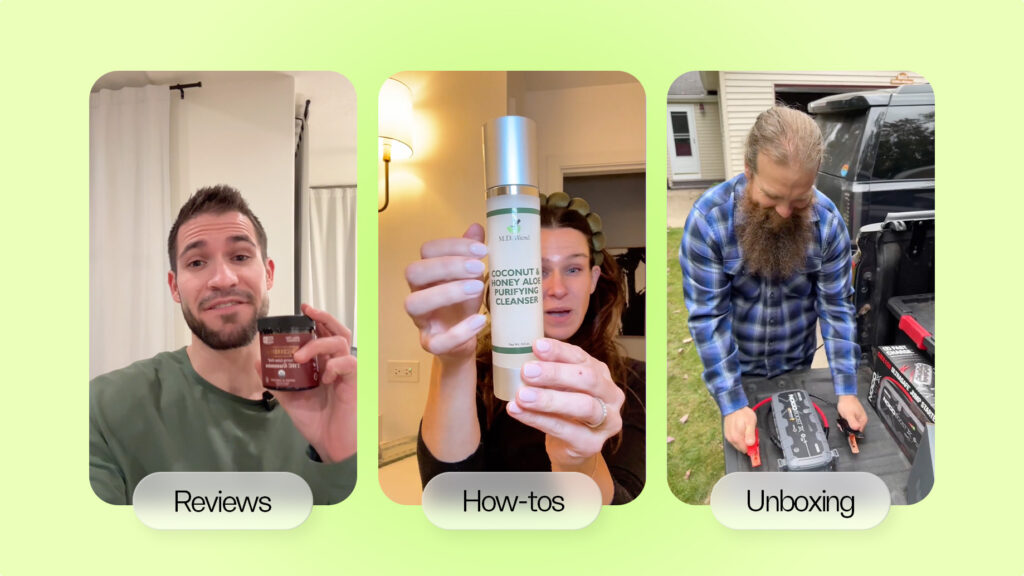
Type 1: Testimonials and Reviews
Testimonial videos are word-of-mouth in visual form. A short, unscripted clip of a happy customer talking about your product can outperform a high-budget promotional video because it reads as genuine peer advice rather than marketing.
Drunk Elephant regularly reposts customer review TikToks, mostly short clips of people showing off their skin after using a product. The content works because the message comes from real fans and feels more trustworthy than anything scripted by the brand. Starface takes a similar approach with UGC testimonials where customers show how pimple patches help heal acne, often posting before-and-after experiences with their Hydro-Star patches.
This format consistently leads in marketer preference. Twenty-six percent of marketers rely on user-generated video product reviews as their top format for driving engagement, the highest of any single UGC type.
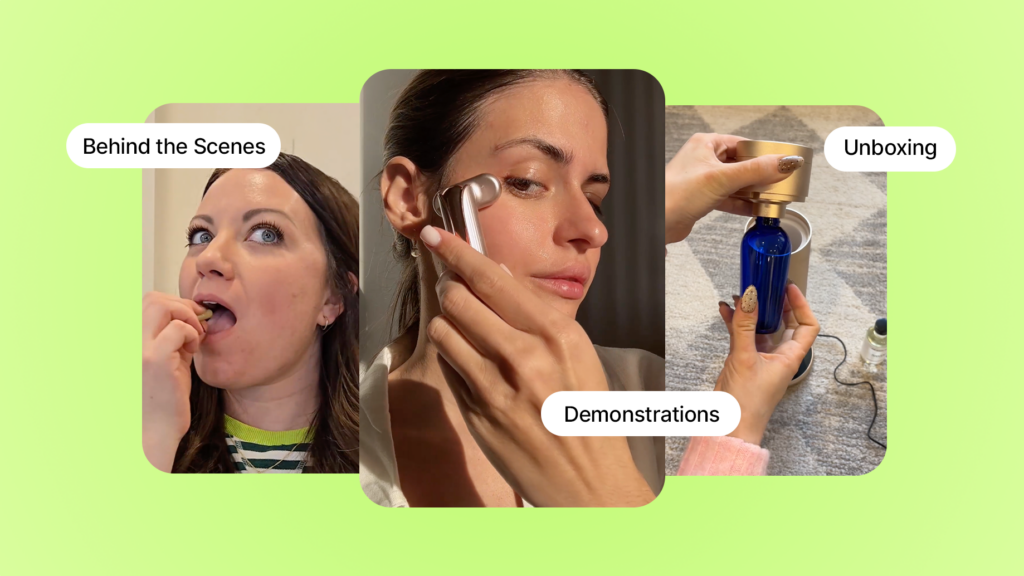
Type 2: Unboxing and First Impressions
Unboxing videos have taken the internet by stormThese videos capture the excitement of receiving a product for the first time, and that first-impression reaction is something no brand can script convincingly. The format thrives because it feels casual and trustworthy, giving potential buyers a genuine look at packaging, product quality, and the real emotional response of opening something new.
Apple and Samsung benefit massively from this format, with tech fans creating unboxing TikToks for every new release. The same dynamic applies at smaller scale: Amazon sellers partnering with TikTok creators who do “Amazon finds” unboxing videos have seen a single viral TikTok send thousands of new customers to a product page in a single day.
A well-executed 30-second unboxing video can entertain while educating customers about your product’s value, boosting sharing rates and replacing the need for lengthy product descriptions.
Type 3: Problem/Solution (Ad Format)
The problem/solution format is the most reliable UGC structure for paid ads. It follows a classic direct-response formula: present a relatable problem, highlight the frustration, and introduce the product as the fix. This mirrors how people actually make purchasing decisions, which is why it consistently drives conversions.
The highest-converting UGC video ads follow a five-part structure: hook, problem, solution, product proof, and a clear call to action. Stanley Tumblers became a viral example of this format when users posted stories about their tumbler surviving car accidents or keeping ice frozen for days. The product was the “hero” solving a real-world problem, and those organic testimonials proved far more persuasive than any brand-produced ad.
If you’re running paid social and want to start with one UGC format, this is the one to test first.
Type 4: Before and After
Before-and-after videos are one of the most visually compelling UGC formats because they answer the single question that matters most: “Will this actually work for me?” Showing a clear transformation, whether it’s a skincare routine clearing up acne, a cleaning product tackling a stained surface, or a fitness supplement delivering visible results, removes the need for any sales pitch.
This format works best for products with a visible, measurable impact. Skincare brands like CeraVe and The Ordinary benefit heavily from this type of creator content, where side-by-side shots of “day one versus day thirty” tell the entire product story in under 15 seconds. In Billo’s H1 2026 beauty ad data, before-and-after arcs were still one of the five patterns behind the top performers.
The key to credibility is keeping it raw. Over-edited before-and-after content gets flagged by audiences as inauthentic, so the less polished the footage looks, the more persuasive it tends to be.
Type 5: How-To and Tutorials
Tutorial UGC turns customers into educators. When someone shows how they use your product in a way you might not have featured in your own marketing, they’re simultaneously demonstrating value and expanding the range of use cases your brand is associated with.
This format ranked as the third most popular UGC type that marketers use to drive engagement, behind reviews and positive brand feedback. It works particularly well for products with multiple applications or a learning curve, because the creator removes the friction between “I’m interested” and “I know how to use this.”
The best tutorial UGC combines practical instruction with personality. A creator showing three ways to style a scarf or demonstrating a non-obvious use for a kitchen gadget gives viewers both entertainment and a reason to buy.
Type 6: Try-On and Fit Videos
For fashion and beauty brands, the “will this look good on me?” question is the single biggest barrier to online conversion. Try-on videos answer it directly by showing how products look and fit on real bodies rather than professional models.
The data backs this up. Clothing is the number one category where consumers consider UGC most important, at 88%, followed by shoes at 76% and health and beauty at 74%. Gen Z consumers are the most responsive to this format, with 96% saying they are more likely to buy a product when user-generated photos and videos are available.
Try-on videos see the strongest conversion results when the creator represents the target customer rather than an aspirational ideal. Showing diverse body types, skin tones, and styling contexts makes the content relatable to a wider audience and removes the doubt that comes with seeing a product only on a single model.
Type 7: In-Action/Lifestyle
In-action videos skip the explanation entirely and just show people using and enjoying the product in their real environment. There’s no voiceover, no feature rundown, just the product integrated into someone’s daily life. This format works especially well for sports and athleisure brands, electronic accessories, outdoor gear, and anything where seeing the product “in the wild” is more persuasive than hearing about its specs.
The strength of this format is that it communicates social proof without feeling like marketing. When someone films themselves trail running in a pair of shoes or cooking dinner with a new kitchen tool, viewers picture themselves doing the same thing. That mental shift from “watching an ad” to “imagining ownership” is what drives purchase intent.
If your brand already has customers sharing this kind of content organically, amplifying it through paid distribution is one of the highest-ROI moves you can make.
Type 8: Challenges and Contests
Brand-initiated challenges turn UGC creation into a shared experience, and when they work, they scale fast. Chipotle’s #GuacDance challenge encouraged TikTok users to dance for free guacamole and generated a massive surge in both engagement and real-world sales. ELF Cosmetics’ #EyesLipsFace campaign became one of TikTok’s most successful branded challenges because it blended seamlessly into the type of content people were already making on the platform.
The common thread in successful challenge campaigns is low friction and clear incentives. Sephora and Starbucks systematize this by rewarding customers with loyalty points or product giveaways for submitting UGC, creating a steady pipeline of fresh content without relying on individual campaigns to go viral.
The format carries more risk than other UGC types because participation depends on creative momentum, but when the concept clicks with the platform’s culture, the reach-to-cost ratio is unmatched.
Type 9: Reaction Videos
Reaction videos capture genuine, unfiltered emotions as someone tries a product or experiences a brand moment for the first time. The format works because authenticity is impossible to fake at the moment of surprise, delight, or honest disappointment, and audiences recognize that immediately.
This type of UGC is especially effective for surprise-and-delight moments: a subscription box reveal, a first taste of a new food product, or an unexpected product feature. The emotional authenticity in these clips creates a connection that scripted testimonials struggle to match.
The production quality is almost always low, and that’s the point. A shaky phone camera and an unplanned exclamation of “wait, this is actually amazing” will outperform a studio-lit reaction shot every time.
UGC Video Examples by Platform
UGC videos have become the secret sauce for brands looking to connect with their audience authentically. To harness the full potential of UGC videos, strategic platform selection is key.
Let’s explore the best platforms to leverage the captivating magic of user-generated narratives:
1. TikTok: Riding the Short-Form Video Wave
TikTok has taken the world by storm with its short-form video trend, making it an ideal playground for UGC content. Capitalize on the platform’s youthful energy and creativity by encouraging users to contribute to challenges or trends related to your brand.
UGC is the single best-performing content type on TikTok, making up 56% of all content on the platform. UGC ads on TikTok achieve a 30% higher completion rate, 142% more engagement, and a 43% lift in conversions compared to regular ads. TikTok UGC videos are also 22% more effective than brand-created videos, outperforming Facebook ads by 32% and traditional ads by 46%.
2. Instagram: Unleashing Creativity through Reels
With its ephemeral nature, Instagram Stories provides the perfect canvas for short, engaging UGC videos. Brands can tap into the spontaneity of the platform, encouraging users to share their experiences in a way that feels immediate and authentic.
The interactive features, from polls to questions, enable direct engagement, transforming viewers into active participants.
Instagram Reels outperform single-image posts by 55% and standard videos by 29%, making Reels the format of choice for UGC on the platform. Instagram produced the highest-quality UGC according to 32% of marketers surveyed.
3. YouTube: Building Communities on the Video Giant
YouTube, the behemoth of video platforms, offers unparalleled opportunities for brands to build a UGC community.
YouTube UGC drove 12 times more impressions, 17 times more engagements, and 10 times more views compared to brand-owned content. Users are 98% more likely to trust creator recommendations on YouTube than on other platforms, and YouTube Shorts engagement in the US grew by over 25%. Sixty-five percent of marketers planned to shift their focus to YouTube and increase budgets in 2025.
What Makes a UGC Video Convert?
Knowing the video types is half the equation. The other half is understanding the structural elements that separate UGC that performs from UGC that gets scrolled past.
The hook decides everything. Viewers form their judgment within 1.7 seconds. Videos with a strong opening hook are three times more likely to be fully watched, and on platforms like TikTok, you need to grab attention within two seconds. If you’re running paid ads, benchmark against your category first. Billo’s H1 2026 data puts the Meta average at 25.44% on three-second views, so anything above 30% is top-tier.
The most effective hooks are a single sentence, under 15 words, and either bold, relatable, or emotionally charged. They should not sound scripted. The best UGC hooks feel like a real person talking to a friend, not a brand reading from a UGC brief template. For real openers that have stopped scrolls in the wild, browse our hook examples library. Visual hooks like eye-catching movement or a product close-up combined with verbal hooks like a provocative question or surprising statement work best in combination.
After the hook, the structure matters. The highest-converting UGC ads follow a five-step framework: hook, problem, solution, product proof, and call to action. Early clarity in the video significantly increases watch time, and each step should feel like a natural progression rather than a forced sequence.
Authenticity signals are the final layer. Real settings rather than studios, natural lighting, imperfect framing, genuine emotion, and the product clearly visible during use all contribute to the “this is a real person” feeling that makes UGC outperform branded creative. Raw footage conveys authenticity, and audiences can spot the difference instantly.
How to Get UGC Videos for Your Brand
You don’t need a massive budget or a creator network to start building a UGC library. Most brands already have organic UGC being created about their products; they just haven’t built the systems to find and use it.
Start by mining what already exists. Search your brand name and product names on TikTok, Instagram, and YouTube using each platform’s native search, filtered by recency. You’ll often find customers who tagged you or mentioned your product without any prompting. A post-purchase upload widget on your Thank You page or order confirmation email with a prompt like “Share your video, get 15 percent off” captures UGC from customers who want to share but wouldn’t think to tag you on social media.
Branded hashtag campaigns scale participation. Apple’s #ShotOniPhone has powered years of consistent UGC because the prompt is simple, the barrier to entry is low, and the brand publicly celebrates the creators whose content gets featured. The same principle applies at any scale: give customers a clear prompt like “Show us how you use our product,” attach a hashtag, and actively engage with the content they create.
Contests and loyalty programs systematize collection. Sephora and Starbucks reward customers with loyalty points or product giveaways for submitting UGC, creating a consistent pipeline of fresh content that doesn’t depend on individual campaigns going viral. Community engagement, including liking, commenting, and stitching or dueting existing UGC, signals to your audience that their contributions are valued and encourages more participation.
For brands that need consistent volume and quality, UGC platforms like Billo connect you with vetted creators who produce authentic-style video at scale, with packages starting from roughly $36 per video on subscription plans.
AI vs Human UGC: What Brands Need to Know in 2026
AI-generated UGC is the fastest-growing category in the space, and the cost advantages are hard to ignore. A single studio shoot can cost around $3,000, while AI tools can deliver 75 videos for the same spend. One footwear retailer cut its concept-to-launch timeline from 25 days to 36 minutes using AI UGC, ran twice as many A/B tests, and lowered CPA by 27 percent.
But speed and cost come with real tradeoffs. 68%of consumers are concerned about fake videos, and 63% expect brands to actively address fake UGC. Meta, TikTok, and YouTube all now require AI-generated content to be disclosed, and brands that skip this step risk both consumer trust and platform penalties. The US AI regulations can also become an issue in the near future.
The hybrid approach is what’s working best in 2026. AI handles the tasks where speed and scale matter most: rapid creative testing, localizing ads across markets, and generating variations of concepts that have already been proven. Human creators handle the work where trust is the primary objective: testimonials, emotional storytelling, and community-building content.
The practical split looks like this. Use AI UGC when you need to test 20 hook variations in a week or translate a winning ad into six languages. Use human creators when a customer needs to look into the camera and say “this product changed my routine,” because that kind of authenticity remains something AI cannot replicate convincingly.
Summary and Next Steps
UGC videos outperform brand-produced content across every metric that matters: conversions at 10.38 times higher, CTR at four times higher, engagement at six times greater, and production costs 30% – 71% lower than alternatives. The business case is settled.
Start by auditing your existing organic UGC. Search your brand on TikTok and Instagram, set up post-purchase collection prompts, and identify which of the nine video types in this guide best matches your product. Problem/solution is the strongest starting point for paid ads, before-and-after works best for visible-result products, and try-on videos are the priority for fashion and beauty.
For consistent volume, a UGC platform like Billo connects you with vetted creators who produce content at scale. And in 2026, the brands outpacing their competitors are running a hybrid model: human creators for the content that builds trust, and AI tools for the testing and iteration that drives efficiency.
FAQs
What is a UGC video?
How much do UGC videos cost?
What types of UGC videos convert best for ecommerce?
Can you use AI to create UGC videos?

SEO Lead
Passionate content and search marketer aiming to bring great products front and center. When not hunched over my keyboard, you will find me in a city running a race, cycling or simply enjoying my life with a book in hand.
Make creator marketing a data-backed growth channel

Related from Creative Insider
Billo vs SideShift: a side-by-side comparison
Billo vs Influee: a side-by-side comparison
Best Cohley alternatives: 6 platforms compared for 2026