UGC Creator Jobs: Get Paid to Make Content in 2026 (No Following Required)


If you’ve been searching for UGC creator jobs and mostly finding job board listings or a single crowded Reddit thread, that gap is real. Very little has been written that explains what this work actually pays, how it works day to day, and which platforms are worth your time.
The demand behind it is genuine. The global UGC platform market reached $7.6 billion in 2025, up 69% from $4.5 billion the year before, and 67% of retailers say they plan to increase their UGC spending this year.
None of that growth requires you to already have an audience. UGC jobs pay for content production skills, and follower counts rarely factor into the rate a brand offers. That is a real structural difference from influencer marketing, and it is worth understanding before you start applying.
This guide walks through what the work actually pays, where the real opportunities are across today’s platforms, how to land your first job, and how to tell a legitimate brand deal from a scam.
TL;DR
- UGC creator jobs don’t require a following. Brands pay for content production skills, not audience reach.
- Realistic pay runs from about $50 to $500 or more per video, with wide variation by platform, niche, and experience.
- Add-on income, like organic posting fees and whitelisting, often matters as much as the base rate.
- Most creators earning steady income work two or three platforms at once rather than relying on one.
- Legitimate gigs never ask you to pay a fee upfront. That single check filters out most scams.
What is a UGC creator job?
A UGC creator job means producing short videos or photos for a brand to use in its own marketing, typically in paid social ads, on product pages, or in organic posts. The brand owns the content and the usage rights, and it pays for the deliverable itself rather than for your audience.
That is a different arrangement from influencer marketing, where a brand pays partly for the reach of your existing following. It is also different from traditional freelance videography, where you are usually paid for production value and equipment rather than an on-camera, testimonial-style performance.
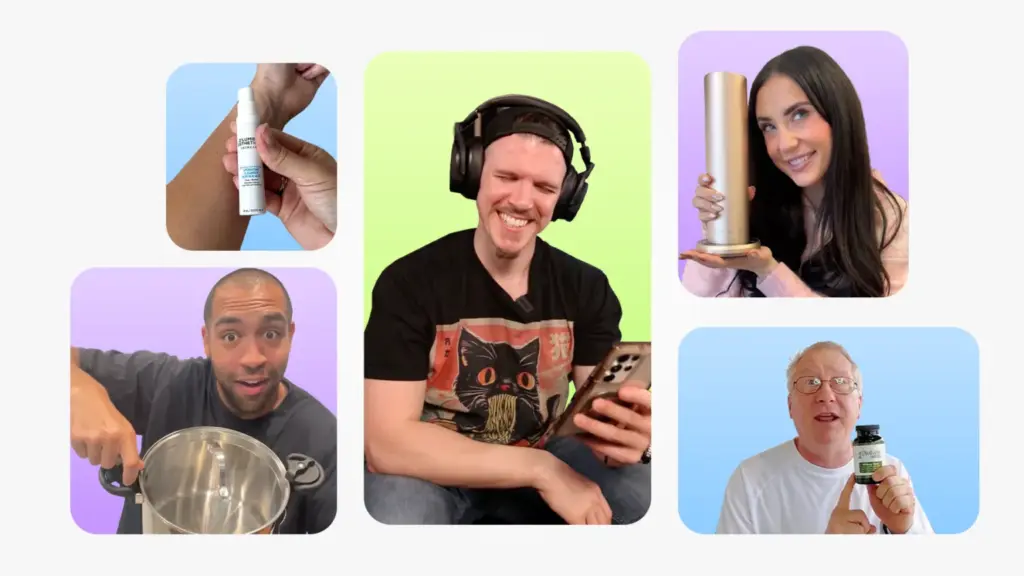
Most UGC creator jobs ask for a short, authentic-feeling video:
- Someone using a product,
- Reacting to it,
- Explaining why they like it,
- Shot on a phone rather than with a full production crew.
Skill in scripting, delivery, and basic editing matters far more than follower count or professional gear.
What UGC creator jobs pay?
Pay for UGC creator jobs varies widely, but a few patterns hold across the market.
- Entry-level creators with a handful of finished samples typically earn in the $50 to $150 range per video.
- Creators with a stronger portfolio and consistent turnaround often move into the $150 to $500 range.
- Specialists with niche expertise or particularly strong production quality can charge more.
The base rate per video is only part of the picture, though. The creators earning the most consistently are usually the ones stacking income streams on top of that rate rather than relying on a single flat fee per job.
Add-on income is where that stacking happens. Platforms like Billo let creators earn beyond the base video fee through organic posting fees, where the brand pays you to post the content from your own account, whitelisting or partnership ads, where the brand pays to run your content as an ad through your handle, and additional content. A creator charging a modest base rate but adding two or three of these on top will often out-earn someone charging more per video but working only with brands that pay for the raw file and nothing else.
Where to find UGC creator jobs
Once you understand what the work pays, the practical question is where to actually find it. The platforms below are the ones most frequently mentioned by working UGC creators, compared on the things that matter to you as the person doing the work, not as the brand buying it.
| Platform | Follower requirement | Typical pay | Payout terms | Add-on income | Geographic eligibility |
|---|---|---|---|---|---|
| Billo | None | $50 to $500+ per video | Every two weeks, via PayPal | Organic posting, partnership ads, additional content. | US, UK, Canada |
| Insense | None | Negotiated per campaign | Wallet to PayPal or bank; timeline not published | Product seeding, affiliate commissions, whitelisting, TikTok Shop | Not specified |
| Influee | None | Roughly $92 to $315 per video | 5 to 10 business days after approval | Not advertised | 24 countries |
| JoinBrands | None stated | $50 to $150+ for video, $15 to $40 for images | Not publicly disclosed | Extra-content upsells, tips | Not specified |
| Soona (formerly Trend) | None | $37 to $115 per video published for Soona’s UGC role | Not publicly disclosed | In-person roles available near partner studios | Apply from anywhere in the US |
| Cohley | None stated, but requires an existing portfolio | Not publicly disclosed | Not publicly disclosed | Not disclosed | Not specified |
| Hummingbirds | None stated | Gift cards only, no cash | New campaigns weekly | Community access | Select US cities only |
Billo’s approach is built around creating more paid work for creators, which shows up in guaranteed biweekly payouts and a Premium tier that unlocks after 14 videos, with no following required.
Soona acquired Trend.io and now operates it as Soona UGC, which is why this table lists them as one platform rather than two. Trend was known for the fastest payout in the category before the acquisition, so it’s worth confirming directly whether that still holds. Cohley and Soona are also the two platforms that disclose no pay information anywhere on their creator pages, making them the hardest to evaluate up front.
Hummingbirds pays in gift cards, not cash, which is worth knowing before you apply since it changes what “getting paid” actually means there.
How to land your first UGC creator job
1. Pick a niche you can talk about credibly, not just one that looks profitable.
Beauty, home goods, pet products, and food and beverage are consistently in demand, but the niche that gets you hired fastest is usually the one where you already have real opinions and can improvise dialogue without a full script.
2. Build a portfolio of three to five sample videos before you apply anywhere.
Brands and platforms want to see how you perform on camera and how you edit, not just that you own good equipment.
3. Apply to more than one platform at once.
Approval timelines and campaign availability vary enough that relying on a single platform slows down how quickly you land your first paid job.
4. Treat your first few gigs as portfolio-building, not only as income.
A strong deliverable from a real brand, even at a modest rate, becomes the sample that gets you into higher-paying campaigns later.
Working multiple UGC platforms without burning out
Most creators earning consistent income are not doing it on one platform. Running two or three at once is common, but it needs a system, or the applications and deadlines start colliding.
A workable system usually starts with one platform as a home base, where you build a track record and go first when a good brief comes in, with one or two others layered on top for extra volume. Billo can work well in that home-base role, given the biweekly payout schedule and no follower requirement, while you fill in gaps elsewhere.
Do keep a simple calendar or spreadsheet of every open application, every accepted campaign, and every deliverable deadline across all platforms you use. Do build a shooting schedule that batches filming days, since covering several briefs in one session is far more efficient than starting from scratch for each one. Do tell a brand proactively the moment a timeline looks tight, rather than letting a deadline pass silently.
Don’t accept two campaigns with overlapping deadlines from competing brands in the same category. Usage rights conflicts between competitors can get you removed from a platform entirely. Don’t say yes to every campaign just because it’s available; turning down a poor-fit brief protects the time you need for higher-paying work. Don’t let unpaid revision requests pile up across multiple platforms at once. Agree on a revision limit before you start filming, not after.
How to tell a legit UGC job from a scam
Asking whether a UGC creator job is legit is a reasonable first question, especially once unsolicited “paid collaboration” messages start showing up. Most real work comes through an application you submit, not a DM that finds you out of nowhere. A few checks filter out almost everything fraudulent.
Check the sender’s email domain before responding to anything. A message from a Gmail or Outlook address claiming to represent a known brand is one of the clearest signs of a fake offer, and brand deal red flag guidance lists a mismatched domain as the first thing to verify.
Be wary of any request for money upfront, whether it’s framed as a shipping fee, an equipment deposit, or an onboarding cost. The FTC’s guidance on side-hustle scams is direct about this: no legitimate job requires payment before you start working.
Treat pressure to respond immediately as a warning sign rather than urgency. Real brands allow time to review a contract, and UGC-specific scam checklists flag rushed timelines and requests for passwords or banking logins as consistent patterns in fake offers.
Look for a written agreement before you film anything. A brand that won’t put deliverables, usage rights, and payment terms in writing isn’t one worth the risk, no matter how good the rate sounds.
Final thoughts
UGC creator jobs are a real, growing way to get paid for content skills rather than audience size, but the work rewards people who treat it like a small business: diversify across platforms, add income streams beyond the base rate, and verify every offer before committing to it.
If you’re ready to put this guide into practice, Billo’s whole model is built around creating more paid work for creators rather than just listing a few campaigns and hoping for a match. No follower requirement, no contracts, and payouts every two weeks.
Do I need a following to get UGC creator jobs?
How much do UGC creators get paid?
What does a UGC creator actually do?
How fast do UGC platforms pay creators?
Can I work on more than one UGC platform at the same time?

SEO Lead
Passionate content and search marketer aiming to bring great products front and center. When not hunched over my keyboard, you will find me in a city running a race, cycling or simply enjoying my life with a book in hand.
Make creator marketing a data-backed growth channel

Related from Creative Insider
What Are The Steps Of Video Post-Production?